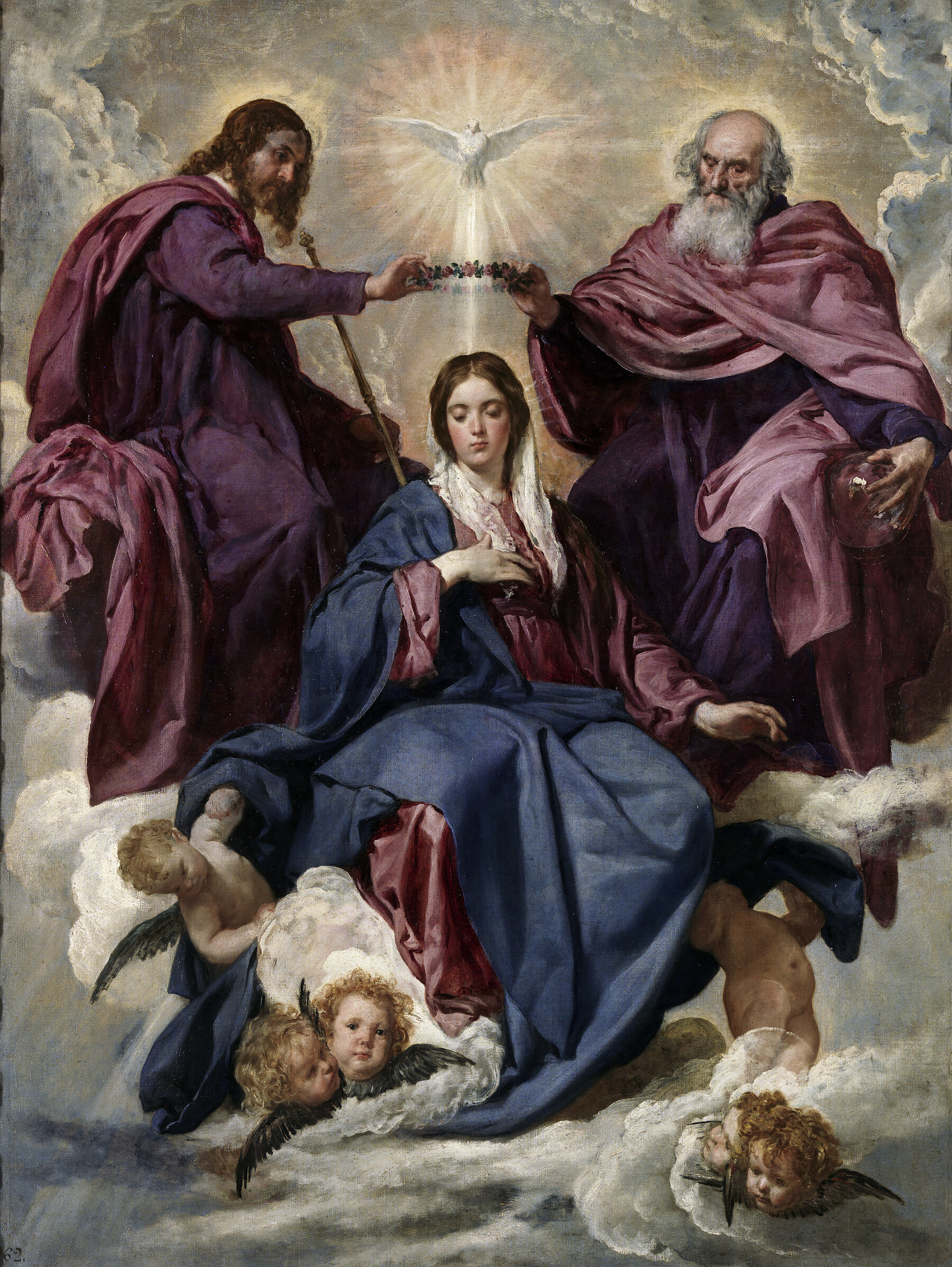
There is a fair question behind this feast: queen of what? Nobody crowned her in her lifetime, she governed no territory, she married no king. The answer lies in a detail of the Old Testament that is almost never explained — and once explained it settles at a stroke Mary’s queenship, her intercession, and why Catholics ask her for things. In the kingdom of Judah the queen was not the king’s wife. She was his mother.
The gebirah
The kings of Judah had many wives. Solomon, the extreme case, had hundreds. In a court like that, “king’s wife” is not an office: it is a condition shared by dozens of people, and it governs nothing.
So the Davidic monarchy institutionalised something else. There was a formal post with its own title — gebirah, the “great lady” or queen mother — and it always belonged to the mother of the reigning king, because a king has many wives and only one mother.
This is not inference: it is in the text. The Book of Kings introduces each new reign with a fixed formula, and the formula includes the mother’s name. “He was twenty-five years old when he began to reign (…) and his mother’s name was…” Reign after reign. Scripture records the queen mothers the way it records ministers of state, because that is what they were.
One verse that explains everything
And there is a scene that shows the office at work. Bathsheba, Solomon’s mother, goes to speak to her son, now king, carrying someone else’s request:
“Bethsabee came to king Solomon (…). And the king arose to meet her, and bowed to her, and sat down upon his throne: and a throne was set for the king’s mother, and she sat on his right hand. And she said to him: I desire one small petition of thee, do not put me to confusion. And the king said to her: My mother, ask, for I must not turn away thy face.” (1 Kings 2:19-20)
Read it slowly, because every element of Catholic doctrine about Mary is inside it:
- The king rises and bows to her. An absolute monarch of the ancient East bows to nobody — except his mother.
- She has a throne, and it is at his right. The place of delegated power. Not decorative honour; an institutional seat.
- She arrives interceding for somebody else. She is not asking for herself. That was precisely the queen mother’s office: to bring the king the petitions of those with no access to him.
- “My mother, ask, for I must not turn away thy face.” It is the sentence the Church has been repeating for two thousand years in other words.
Queen because mother of the King
With that in hand, the Angel’s announcement changes key. Gabriel does not tell Mary she will have a good son. He tells her:
“The Lord God shall give unto him the throne of David his father; and he shall reign in the house of Jacob for ever, and of his kingdom there shall be no end.” (Lk 1:32-33)
A young Jewish woman hearing that understood perfectly what was being said about herself: if this child is the Davidic heir, then she is the gebirah of the kingdom that does not end. Her queenship is not an honorary title added later by popular devotion — it follows automatically from the divine motherhood.
She is queen not by conquest, nor by marriage, nor by election. She is queen by relation: because the King is her son, and no king has two mothers.
It is worth noting what kind of queen she is. The only instruction the Gospel records from her mouth, addressed to anyone, is five words at Cana: “Whatsoever he shall say to you, do ye” (Jn 2:5).
That is this queen’s entire programme of government. She turns nobody away from her Son — she pushes everyone towards him. Anyone who fears Marian devotion steals attention from Christ has to explain why the only order she gives is that one.
Why the feast falls today
Pius XII instituted the feast in 1954 with the encyclical Ad caeli Reginam, and first fixed it on 31 May. The calendar reform of 1969 moved it to 22 August — and the move was deliberate.
The 22nd of August is exactly an octave after the Assumption. This is not a scheduling accident: it is a sentence spoken in dates. First she is taken up body and soul; eight days later, crowned. Arriving and being crowned are one event in two movements, and the calendar forces you to read them together.
In the Rosary it is the same sequence: the Assumption is the fourth glorious mystery, the Coronation the fifth. Anyone who prays the beads already knows this by heart, even having never heard the word gebirah.
The woman with the crown of stars
And there remains the image from the Apocalypse, which the liturgy uses on both days: “a woman clothed with the sun, and the moon under her feet, and on her head a crown of twelve stars” (Rev 12:1).
Twelve stars: the twelve tribes, the twelve apostles — Israel and the Church in one crown. And immediately afterwards the text shows this queen in flight, in labour, with a dragon waiting. It is an honest portrait of the office. Her queenship spared her nothing, which is exactly why one can turn to her without embarrassment: she is not a queen at a distance from what happens to the people who ask.
Regina caeli, laetare. Queen of heaven, rejoice — and do for us what the queen mother always did: carry to the King the request of those with no access to him.
- The Assumption of Our Lady — the arrival, an octave earlier.
- Consecration to Our Lady — giving yourself to this queen.
- Saint Bernard of Clairvaux — who taught the West to call her the star.
- Words of the saints — a growing collection, in English and Portuguese.

Comments