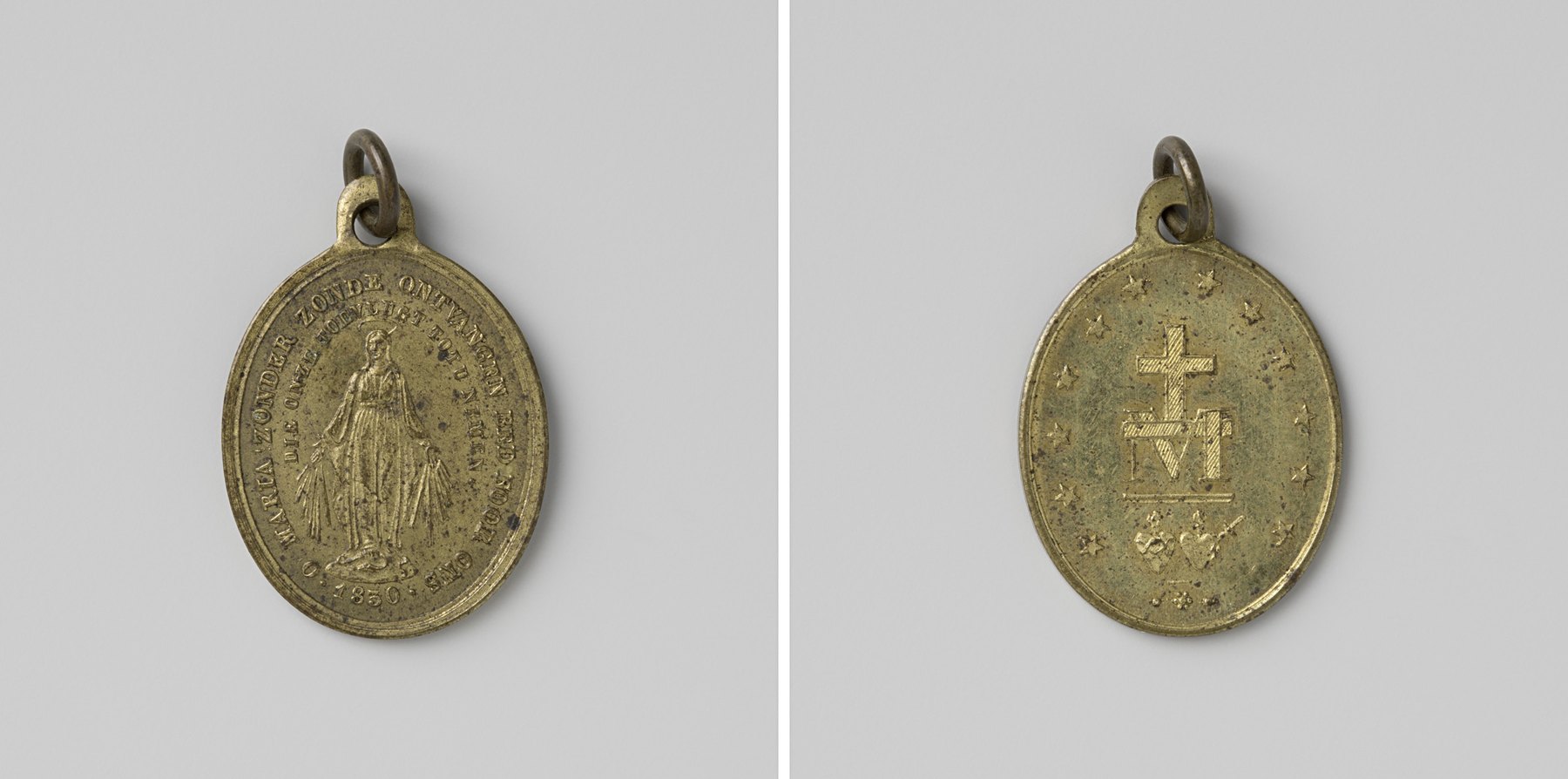
Today, 27 November, the Vincentian family and countless parishes keep Our Lady of the Miraculous Medal, known in Brazil as Our Lady of Graces. It was on a Saturday, 27 November 1830, at half past five in the afternoon, during the novices’ meditation in the chapel of the Rue du Bac in Paris, that one of them heard a sound “like the rustle of a silk dress” and saw Our Lady. What she saw now fits in the palm of a hand.
Saturday, 27 November 1830
The novice was Catherine Labouré, of the Daughters of Charity, who had already seen Our Lady on the night of 18–19 July that year. In the account she left, which the shrine in the Rue du Bac preserves, the November apparition came as two living pictures, one fading into the other. In the first, the Virgin stood on half a globe, crushing the serpent, and held in her hands a small golden ball topped with a cross, raised towards heaven; Catherine heard that the ball represented “the whole world, France and each person in particular”.
In the second, from Mary’s open hands, with jewelled rings on her fingers, came rays of dazzling brightness falling on the earth. Some of the stones gave out no rays at all, and Catherine later told the explanation she received: those were the graces people forget to ask for. Then an oval formed around the apparition, bearing these words in letters of gold: “O Mary, conceived without sin, pray for us who have recourse to thee”. And a voice asked that a medal be struck after that model. At last the picture turned, and she saw the reverse: the letter M surmounted by a cross and, below, two hearts, one crowned with thorns, the other pierced by a sword. In December 1830 the same image appeared again, for the last time.
From vision to medal
Catherine’s confessor, Father Jean-Marie Aladel of the Congregation of the Mission, did not believe her and even forbade her to think about it. She persisted. In February 1832 a cholera epidemic broke out in Paris which, according to the shrine, killed more than twenty thousand people. With the approval of the Archbishop, Hyacinthe-Louis de Quélen, the first medals were struck, and in June 1832 the Daughters of Charity began to give out the first two thousand. Healings, protection and conversions followed, and the people of Paris began to call it “miraculous”.
It spread astonishingly fast. By the shrine’s reckoning there were already more than half a million medals by the autumn of 1834; more than a million in 1835; more than ten million in 1839. In 1836 the sessions began of the canonical inquiry the Archbishop ordered into the origin of the medal. The visionary did not appear: nobody but her confessor knew who she was. That story, the story of the sister who kept the secret, is told tomorrow, on the day of Saint Catherine Labouré.
The brass medal above is two and a half centimetres high and belongs to the Rijksmuseum in Amsterdam, which received it as a gift in 1885. Around the Virgin the invocation is in Dutch: Maria zonder zonde ontvangen… Below is engraved the year 1830, the date of the apparition, not of the striking: the medals were first made in 1832.
There are no words on the reverse. There is the M of Mary joined to the cross, the hearts of Jesus and Mary and, all round, the twelve stars, which the shrine reads as the twelve apostles, that is, the Church.
A conversion in Rome, a dogma in 1854
The most famous case linked with the medal happened in Rome. Alphonse Ratisbonne, a Jew from Strasbourg, agreed somewhat reluctantly to wear the medal at a friend’s request. On 20 January 1842, entering the church of Sant’Andrea delle Fratte, he saw Our Lady just as she appears on the medal, and asked for baptism. The Church examined the event and recognised it, and it came to be recalled in the office of the feast.
Twenty-four years after the apparition, on 8 December 1854, Pius IX defined the dogma of the Immaculate Conception: what the medal had been repeating on millions of breasts, “conceived without sin”, became defined doctrine. On 23 July 1894 Leo XIII instituted the feast of the Manifestation of the Immaculate Virgin of the Miraculous Medal, with its own Mass and Office, for the priests of the Congregation of the Mission, on 27 November; a decree of September that year allowed it to be celebrated in the chapels of the Daughters of Charity. The day is therefore not in the General Roman Calendar: it belongs to the Vincentian family and to places such as the Archdiocese of Paris, where it is an optional memorial. In Brazil, where she is called Nossa Senhora das Graças, it is a widely loved devotion.
Not a charm
The medal is a sacramental: it does not work by itself, like a talisman. The Church teaches that sacramentals, through the Church’s prayer, prepare us to receive grace and dispose us to cooperate with it. The promise Catherine heard carries a clear condition: great graces for those who wear it with confidence. That is why the invocation is engraved on it: the medal is, before anything else, a prayer worn over the heart.
- The front says who Mary is: conceived without sin, standing on the world, crushing the serpent.
- The rays say what she does: she pours out graces on those who ask, and some graces nobody asks for.
- The reverse says where she stands: joined to the cross and to the heart of her Son, at the centre of the Church.
- The condition is confidence: the medal does not replace faith; it is a way of living it.
“These rays are the symbol of the graces I shed upon those who ask me for them.”— Words of Our Lady, 27 November 1830, in the account of Saint Catherine Labouré
“Have, have a medal struck after this model. Those who wear it with confidence will receive great graces.”— Words of Our Lady, 27 November 1830, in the account of Saint Catherine Labouré
The prayers
The prayer that cannot be left out is the invocation of the medal itself, which Catherine saw written in French. The second is the prayer with which the Roman Ritual blesses the Miraculous Medal. Both are translated directly from the original. The novena to Our Lady of the Miraculous Medal, which ended yesterday, also gives the Memorare, and many choose this day to make or renew the total consecration to Our Lady of Saint Louis de Montfort.
Ô Marie conçue sans péché, priez pour nous qui avons recours à vous.
O Mary, conceived without sin, pray for us who have recourse to thee.
To be repeated many times through the day.
Dómine Iesu Christe, qui beatíssimam Vírginem Maríam matrem tuam ab orígine immaculátam innúmeris miráculis claréscere voluísti: concéde, ut eiúsdem patrocínium semper implorántes, gáudia consequámur ætérna. Qui vivis et regnas in sǽcula sæculórum.
Lord Jesus Christ, who willed that the most blessed Virgin Mary, thy Mother, immaculate from her origin, should shine forth with countless miracles: grant that, ever imploring her protection, we may attain to everlasting joys. Who livest and reignest for ever and ever.
Amen.
O Maria, sine labe concepta, ora pro nobis qui ad te confugimus. Our Lady of the Miraculous Medal, pray for us.
- Saint Catherine Labouré — tomorrow: the visionary who kept the secret for forty-six years.
- The Miraculous Medal prayer — the invocation in Latin and English, ready to print.
- Saint Maximilian Kolbe — the Militia Immaculatae still blesses the Miraculous Medal in its enrolment ceremony.
- Words of the saints — a growing collection, in English and Portuguese.

Comments