Today, 28 November, the Vincentian family keeps Saint Catherine Labouré, the sister whom Our Lady asked for the Miraculous Medal. When he canonised her in 1947, Pius XII summed up her life in two Latin words from the Imitation of Christ: Ama nesciri, “love to be unknown”. Yesterday the site told what she saw; today, who she was.
Zoé, the girl from Burgundy
Zoé Labouré was born on 2 May 1806 at Fain-lès-Moutiers in Burgundy, the daughter of Pierre and Madeleine, farmers who owned their land. Her mother died in 1815, aged forty-six; it is told that the little girl climbed on a chair to kiss the statue of Our Lady and said to her: “Now you will be my mother.” At twelve she was already running the house: the vegetable garden, the hens, a dovecote of eight hundred pigeons, the week’s bread and washing. And every day she went to pray in the village church, which since the Revolution had had no priest and an empty tabernacle.
At eighteen she still could not read or write. While at a boarding school in Châtillon-sur-Seine she visited the house of the Daughters of Charity and recognised, in a portrait on the wall, the old priest she had seen in a dream: it was Saint Vincent de Paul. Her father refused her vocation and sent her to work in a brother’s restaurant in Paris. Only in April 1830 did she enter the seminary (the novitiate) in the Rue du Bac. On 25 April she walked in the translation of Saint Vincent’s relics.
Forty-six years at Reuilly
The apparitions of that year (in July, on 27 November and in December) are in yesterday’s post. On 30 January 1831, her seminary over, Catherine was sent to the Hospice of Enghien at Reuilly, a poor district in the south-east of Paris. There she stayed for the rest of her life: first in the kitchen, then in the linen room, then with the old men of the hospice and at the porter’s lodge, welcoming the poor. She took her vows on 3 May 1835.
Meanwhile the medal was going round the world, and almost nobody knew that the visionary was that sister. In 1836, when the Archbishop opened the canonical inquiry, she would not appear; Father Aladel later stated on oath that the reason was her humility and her wish to remain unknown. Hearing someone say that the sister “who claims to have seen the Virgin” had at most seen a picture, she answered firmly that she had seen her in flesh and blood. During the siege of Paris in 1870 she would say: “The Virgin will watch over us; she will keep everything safe.” The one thing that made her suffer was that the statue of the Virgin with the globe, as she had seen her, had still not been made. “It is the martyrdom of my life,” she said.
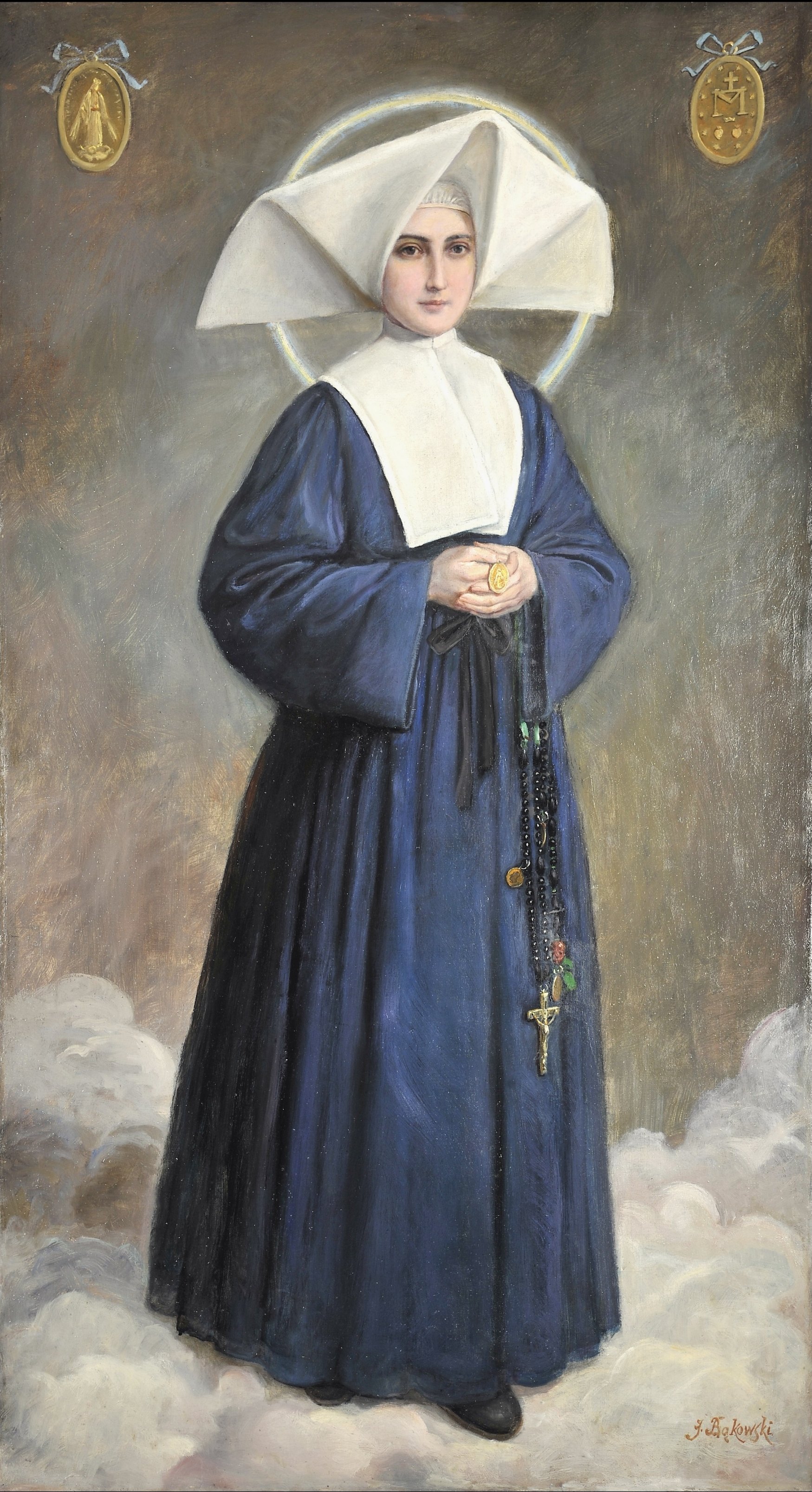
The Polish painter Jan Bąkowski (1872–1934) painted her full length in the blue habit of the Daughters of Charity and the great white cornette, with its broad wings, that they wore. In her hands she holds the medal; in the upper corners float its front and back. The painting hangs in a parish of the priests of the Congregation of the Mission, the Vincentians, in Kraków, and was restored in 2019.
The secret told at the end
In May 1876, her confessor having been moved, Catherine found herself with no one to speak to. She then told her superior, Sister Jeanne Dufès, that she felt the time had come, but that she would first ask Our Lady’s leave in prayer. The next day she called the superior to the parlour and told her everything, over about two hours. Beyond that, the secret became public only after her death.
At the end of December she received the anointing of the sick. A sister asked whether she was afraid to die, and she was astonished: “Why be afraid of going to see Our Lord, his Mother and Saint Vincent?” She died on 31 December 1876, while the sisters at her bedside repeated the invocation of the medal and were finishing the litany of the Immaculate Conception. She was buried on 3 January, the feast of Saint Geneviève, in a vault beneath the chapel at Reuilly.
The body in the Rue du Bac
In 1933, at the time of her beatification, the vault was opened after fifty-seven years. According to the shrine and the biographer Joseph Dirvin, the body was found intact, the limbs still supple. It was taken to the chapel in the Rue du Bac and placed beneath the altar of the Virgin with the globe, the very image she had asked for so long, and it rests there in a glass reliquary. Pius XI beatified her on 28 May 1933, and Pius XII canonised her on 27 July 1947.
Today’s date is that of the Vincentian family; the Archdiocese of Paris keeps it as an optional memorial, and the Roman Martyrology remembers her on 31 December, the day of her death. This year 28 November falls on a Saturday, the eve of the First Sunday of Advent, like 27 November 1830, which she herself described as “the Saturday before the first Sunday of Advent”.
- Humility: she received the most widely spread message of her century and chose not to be known.
- Service: forty-six years of kitchen, linen, old men and porter’s lodge, like any Daughter of Charity.
- Obedience: she entrusted everything to her confessor and waited, even when she was not believed.
- Simple prayer: before the tabernacle, to speak and to listen.
“Ama nesciri! The whole life, the whole soul of Catherine Labouré is expressed in these two little words.”— Pius XII, address to the pilgrims of the canonisation, 28 July 1947
“Why be afraid of going to see Our Lord, his Mother and Saint Vincent?”— Saint Catherine Labouré, late December 1876, as recorded by the shrine in the Rue du Bac
“My dear, the Sister who saw the Blessed Virgin saw her in flesh and blood, just like you and me!”— Saint Catherine Labouré, as recorded by the shrine in the Rue du Bac
The prayers
Catherine left no composed prayers. She left something better: the way she prayed, in her own words, which the shrine in the Rue du Bac preserves. The translation is made directly from the French. And, as at her deathbed, the prayer of the house is the invocation of the medal.
Lorsque je vais à la chapelle, je me mets là devant le Bon Dieu, et je lui dis : « Seigneur, me voici, donnez-moi ce que vous voulez. » S’il me donne quelque chose, je suis bien contente et je le remercie. S’il ne me donne rien, je le remercie encore, parce que je n’en mérite pas davantage.
Et puis je lui dis alors tout ce qui me vient dans l’esprit : je lui raconte mes peines et mes joies, et j’écoute. Si vous l’écoutez, il vous parlera aussi, car avec le Bon Dieu il faut dire et écouter. Il parle toujours quand on y va bonnement et simplement.
When I go to the chapel, I place myself there before the good God and say to him: “Lord, here I am; give me what you will.” If he gives me something, I am very glad and I thank him. If he gives me nothing, I thank him all the same, because I deserve no more than that.
And then I tell him whatever comes into my mind: I tell him my sorrows and my joys, and I listen. If you listen to him, he will speak to you too, for with the good God one must both speak and listen. He always speaks when one goes to him simply and with an open heart.
Saint Catherine Labouré (1806–1876).
O Mary, conceived without sin, pray for us who have recourse to thee.
Amen.
Sancta Catharina, ora pro nobis. Saint Catherine Labouré, pray for us.
- Our Lady of the Miraculous Medal — yesterday: the apparition of 27 November 1830 and the medal.
- Novena to Our Lady of the Miraculous Medal — its nine days follow Catherine’s life step by step.
- Words of the saints — a growing collection, in English and Portuguese.

Comments