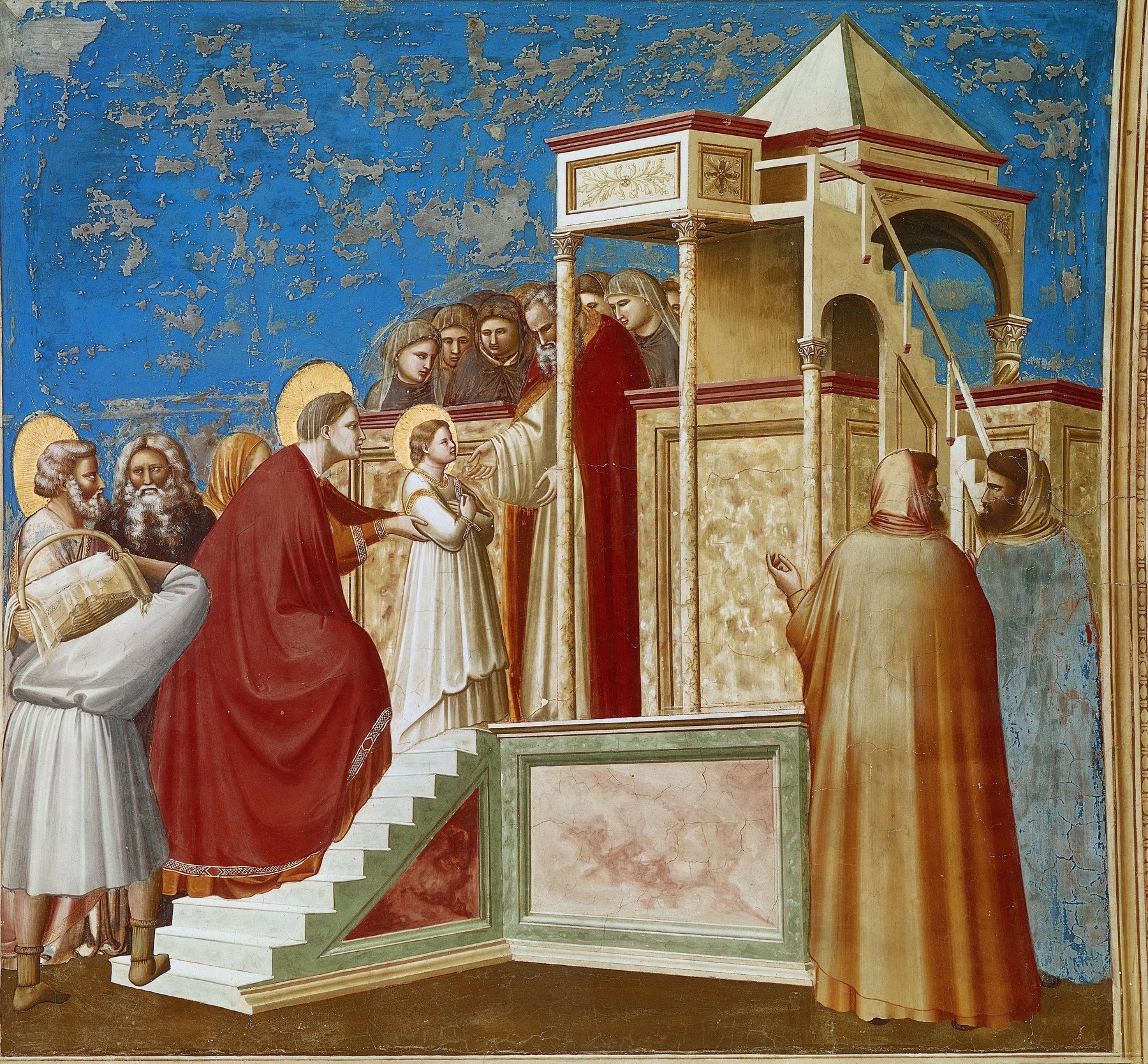
Today, 21 November, the Church keeps the memorial of the Presentation of the Blessed Virgin Mary. The scene comes from an ancient text that is not part of the Bible: a three-year-old girl goes up to the Temple in Jerusalem, the priest kisses her, blesses her and sets her on the third step of the altar, and she, the story says, danced with her feet, and all the house of Israel loved her.
What the tradition tells
The Gospels say nothing about Mary’s childhood. The account of the Presentation is found in the Protoevangelium of James, an apocryphal writing that historians date to before the year 200. According to it, Joachim and Anne, who had no children, promised to God whatever child might come. When the girl was two, Joachim wished to fulfil the vow; Anne asked that they wait for the third year, “that the child may not seek for father or mother”. At three they brought her to the Temple, escorted by Hebrew girls carrying lighted lamps, so that she would not turn back.
The text goes on: her parents went down marvelling, because the child had not turned back; Mary stayed in the Temple “as if she were a dove” and received food from the hand of an angel, until she was twelve, when the priests entrusted her to Joseph. Later writings, such as the Gospel of Pseudo-Matthew, repeat and expand the story.
It should be said plainly: this is tradition, not Scripture. The Church does not vouch for the details of the episode. Saint Paul VI, in the exhortation Marialis cultus (1974, no. 8), places the Presentation among the memorials which, apart from their apocryphal content, carry lofty and exemplary values and continue venerable traditions born above all in the East.
A feast that came from the East
The feast is bound up with Jerusalem. In 543, under the Emperor Justinian, a great church of Our Lady, known as the “New Church”, was dedicated near the area of the ancient Temple; the Persians destroyed it after 614. In the East the commemoration appears in the Menologion of Basil II, from the eleventh century, and in 1166 a constitution of the Emperor Manuel Comnenus lists it among the days on which the law courts did not sit. For the Byzantine Churches it is the Entry of the Mother of God into the Temple, one of the twelve great feasts of the year.
In the West it was brought in by a French nobleman, Philippe de Mézières, chancellor of the King of Cyprus. In 1372, at Avignon, Gregory XI kept it before the cardinals with an office adapted from the Greek. Sixtus IV received it into the Roman Breviary; Saint Pius V removed it from the calendar; Sixtus V restored it in 1585. Today it is an obligatory memorial of the General Roman Calendar. In 2026 the 21st falls on a Saturday, the eve of Christ the King.
Around 1303–1305 Giotto covered with frescoes the chapel that Enrico Scrovegni had built in Padua. Before the life of Christ he painted the life of Joachim, of Anne and of Mary, following the traditional accounts closely.
In the Presentation, look at the stair: Saint Anne, in a red mantle, climbs behind her daughter and gently urges her on, and the child, in white, is already almost in the priest’s arms. Below, one of their companions carries a basket with the offering. It is a painting of a self-giving: the child goes, and does not look back.
What the Church celebrates
The Church does not celebrate the detail of the step or the dance: it celebrates Mary’s giving of herself to God, from the beginning of her life, under the action of the Holy Spirit who filled her with grace. That is why the Gospel at Mass today is from Matthew (Mt 12:46-50), where Jesus, stretching forth his hand towards his disciples, says who his family is: “For whosoever shall do the will of my Father, that is in heaven, he is my brother, and sister, and mother” (Mt 12:50, Douay-Rheims).
In the Liturgy of the Hours, today’s reading is from a sermon of Saint Augustine on this same passage. For him, Mary’s greatness lies not only in having given birth to Christ but in having done the Father’s will: she was a disciple first. The Presentation, as tradition tells it, says the same thing with a simple image: the little girl who climbs the steps alone and does not turn round.
21 November is also Pro Orantibus Day, dedicated to cloistered nuns and monks. At the Angelus of 19 November 2006, Benedict XVI recalled that the day is kept precisely on the occasion of the memorial of the Presentation, and spoke of those in monasteries, “totally dedicated to God in prayer, silence and concealment”, as silent witnesses that God does not change.
- Not Scripture: the episode comes from the Protoevangelium of James (second century), an apocryphal text; the Church receives it as tradition.
- Eastern roots: the feast was born in Jerusalem and Constantinople and reached the West only in the fourteenth century.
- The heart is self-giving: Mary consecrated to God from childhood, a disciple before she was a mother.
- Pro Orantibus: on this day the Church prays for the cloistered communities.
“Holy Mary did, she fully did the will of the Father; and therefore it is a greater thing for Mary to have been Christ’s disciple than to have been Christ’s mother.”— Saint Augustine, Sermon 72A (Denis 25), 7
“The one support that never topples is God, the indestructible rock of faithfulness and love.”— Benedict XVI, Angelus of 19 November 2006, on Pro Orantibus Day
The prayers
The first is the Collect of the memorial, from the Roman Missal; the second, the troparion that the Byzantine Churches sing on this day, since long before the feast reached Rome. Both translations are made directly from the original.
Sanctíssimæ venerántibus Vírginis Maríæ memóriam gloriósam, ipsíus nobis, quǽsumus, Dómine, intercessióne concéde, ut de plenitúdine grátiæ tuæ nos quoque mereámur accípere. Per Dóminum.
As we honour the glorious memory of the most holy Virgin Mary, we ask you, Lord: grant through her intercession that we too may be found worthy to receive from the fullness of your grace. Through our Lord.
Amen.
Σήμερον τῆς εὐδοκίας Θεοῦ τὸ προοίμιον, καὶ τῆς τῶν ἀνθρώπων σωτηρίας ἡ προκήρυξις· ἐν Ναῷ τοῦ Θεοῦ τρανῶς ἡ Παρθένος δείκνυται, καὶ τὸν Χριστὸν τοῖς πᾶσι προκαταγγέλλεται. Αὐτῇ καὶ ἡμεῖς μεγαλοφώνως βοήσωμεν· Χαῖρε τῆς οἰκονομίας τοῦ Κτίστου ἡ ἐκπλήρωσις.
Today is the prelude of God’s good pleasure and the herald of the salvation of mankind: in the Temple of God the Virgin is openly shown forth, and to all she announces Christ beforehand. To her let us also cry aloud: Rejoice, fulfilment of the Creator’s design!
Traditional, in Greek; translated from the original.
Sancta Maria, in templo Domini praesentata, ora pro nobis. Holy Mary, presented in the Temple of the Lord, pray for us.
- Novena to Our Lady of the Miraculous Medal — it began on the 18th; today is the fourth day.
- Christ the King — tomorrow, the last Sunday of the liturgical year.
- Consecrated life: the hundredfold already in this life — to pray with on Pro Orantibus Day.
- Words of the saints — a growing collection, in English and Portuguese.

Comments