Today, 16 November, the Church keeps the memorial of Saint Gertrude, virgin, a nun of the monastery of Helfta in Germany. She founded no order, governed no house and never left home: she entered at the age of five and died there. And yet she is the only German woman to be called “the Great” — for the height of what she learned, what she wrote and what she lived with Christ.
This page joined Catholic Inspiration for a family reason: my son was born and, because of his birth, I decided to add Saint Gertrude to the saints of November, to learn more about her. What I found in the sources is set out below.
The child of Helfta
Gertrude was born on 6 January 1256, the feast of the Epiphany. Nothing is known of her parents or of her birthplace. In 1261, at the age of five, she was entrusted to the monastery of Helfta, near Eisleben in Saxony, as was the custom of the time, to be educated. She never left.
Helfta was then at its best. The house was governed by Abbess Gertrude of Hackeborn; her sister, Saint Mechtilde of Hackeborn, had charge of the children and was the young Gertrude’s teacher; and the mystic Mechtild of Magdeburg lived there too. The girl learned everything there was to learn: the arts of the trivium and the quadrivium, literature, music, chant, the art of miniature painting. She describes herself as strong-willed, impulsive and often negligent.
The night of 27 January
For twenty years, nothing out of the ordinary: study and prayer. In Advent 1280 Gertrude began to feel a distaste for it all. On 27 January 1281, a few days before the feast of the Purification of Our Lady, at the hour of Compline, she had a vision of a young man who took her by the hand to lead her out of a tangle of thorns. In his hand she recognised the marks of the wounds. She was twenty-five.
She understood that unrest as a gift: God meant, she writes, to pull down the “tower of vanity and curiosity” that she had been building with her pride, though she bore the name and the habit of a nun. From then on she gave up profane studies for Scripture, the Fathers and theology, and her “negligent” life for intense prayer. Her biographer sums it up in a phrase: from a grammarian she became a theologian.
The Herald of Divine Love
Much of what Gertrude wrote has been lost. Two works remain, both in Latin. The first is the Legatus divinae pietatis, the Herald of Divine Love, in five books; only the second is from her own hand — the others were compiled by nuns of Helfta. The second is the Spiritual Exercises, seven meditations that run from the grace of baptism to the preparation for death.
Everything in her springs from the liturgy. The graces she records come in Advent and at Christmas, in Lent and at Easter, on the feasts of Our Lady, in choir or, when she was ill, away from it. Benedict XVI, who devoted a catechesis to her in 2010, calls her life a school: friendship with Jesus is learned in love for Scripture, for the liturgy and for Mary.
The Heart of Jesus, four centuries earlier
The best-known mark of Gertrude’s piety is her devotion to the Heart of Christ. In the Herald she gives thanks for two favours above all others: the Lord’s wounds impressed upon her heart, and the “wound of love” with which he marked it; and she says that Jesus opened to her the intimacy of his divine Heart. She also tells of a vision, on the feast of Saint John the Evangelist, in which she rests her head near the open side of Christ and hears the beating of his heart.
That was written at Helfta at the end of the thirteenth century — almost four hundred years before the apparitions to Saint Margaret Mary at Paray-le-Monial. Devotion to the Sacred Heart did not begin with Gertrude, but few early pages speak of it so clearly.
- The Great. The only German woman to bear the title, Benedict XVI recalls, for her cultural and evangelical stature.
- From grammarian to theologian. She did not stop studying: she changed what she studied, and for whom.
- A mystic of the liturgy. Her visions follow the Church’s year; they do not replace it.
- A friend of souls. Her charity reached the living and the dead; that is why she is invoked for the souls in purgatory.
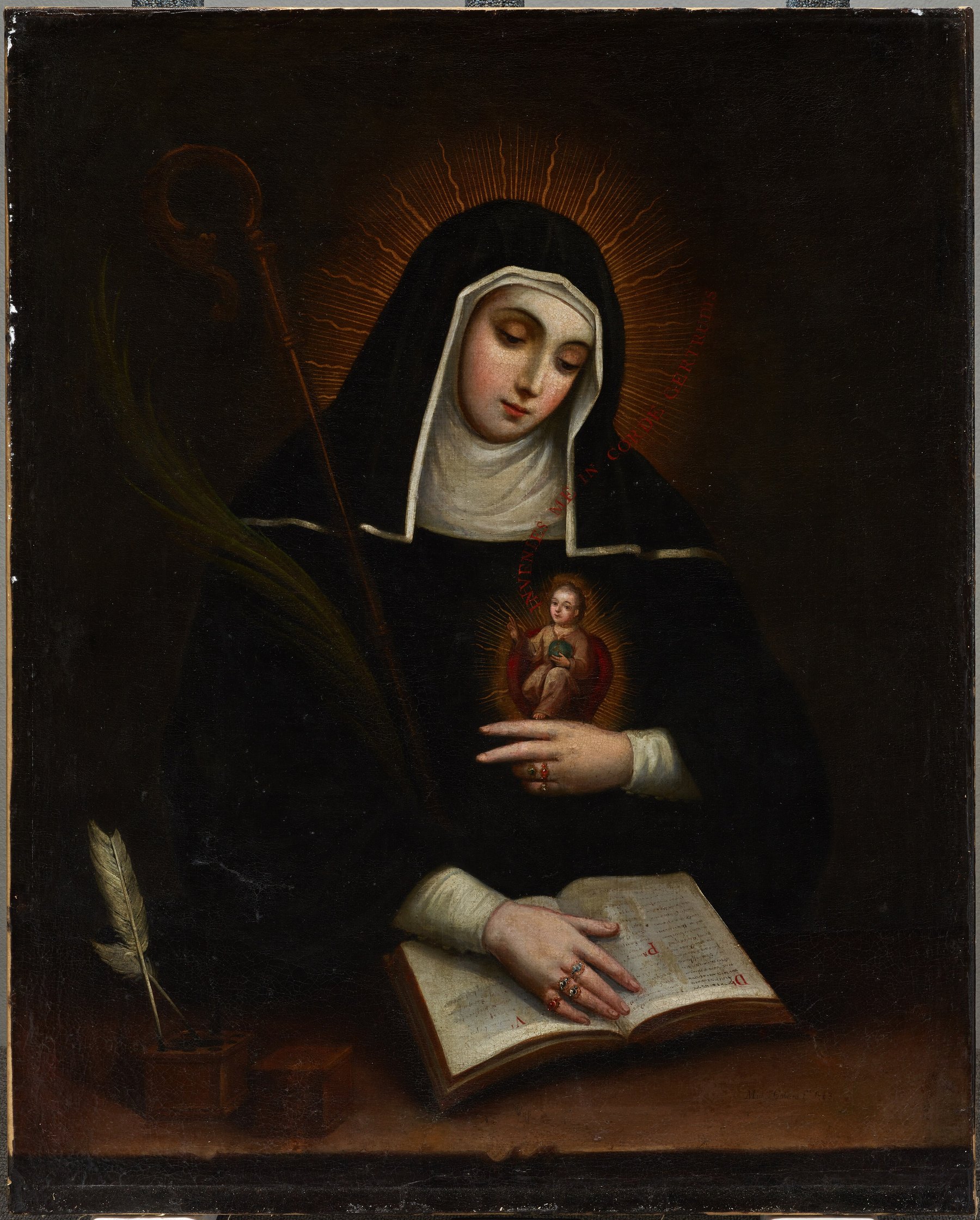
The portrait on this page was painted in Mexico in 1763 by Miguel Cabrera, and is now in the Dallas Museum of Art. Around the halo runs a phrase in Latin: Invenies me in corde Gertrudis — “You will find me in the heart of Gertrude”. It is the same thought as the Collect of the feast, given below: God made ready a dwelling for himself in her heart. That is why the Child Jesus appears inside a heart on the saint’s breast.
The crosier, on the left, is an old mistake. For a long time the saint was confused with the abbess of the same name, Gertrude of Hackeborn, and painters came to show her as an abbess. She never was one. Her veneration reached Spanish America early: at the request of the King of Spain, Saint Gertrude was declared patroness of the West Indies.
A saint without a canonisation process
Gertrude died at Helfta on 17 November 1301 or 1302, aged about forty-six. She was never canonised by a solemn process. Her cult grew with the reading of her works, printed in the sixteenth century and widely read in Spain, among the Carmelites. Rome approved a liturgical office in her honour in 1606; in 1677 her name entered the Roman Martyrology; and in the eighteenth century Clement XII extended her feast to the whole Church. Today the Roman Calendar keeps her on 16 November as an optional memorial; in German-speaking countries the date is the 17th.
A well-known prayer for the souls in purgatory circulates under her name (“Eternal Father, I offer you the most precious Blood…”). It is a good prayer, but it is not found in the saint’s works, and the promise that it frees “a thousand souls” each time has no source in her writings.
“O Jesus, whom I love beyond measure, be with me always, so that my heart may stay with you and your love remain with me, never to be parted; and bless my passing, so that my spirit, freed from the bonds of the flesh, may at once find rest in you.”— Saint Gertrude, Spiritual Exercises, VII; quoted by Benedict XVI at the audience of 6 October 2010
“From a grammarian she became a theologian.”— Saint Gertrude’s biographer, Herald of Divine Love, I, 1
“The heart of a happy life, of a true life, is friendship with the Lord Jesus.”— Benedict XVI, on Saint Gertrude, audience of 6 October 2010
The prayers
The traditional Collect of Saint Gertrude’s feast takes up the image of the heart: it asks God, who made her heart his dwelling, to cleanse ours. Here is the Latin text with a translation.
Deus, qui in corde beatae Gertrudis Virginis iucundam tibi mansionem praeparasti: ipsius meritis et intercessione, cordis nostri maculas clementer absterge, et eiusdem tribue gaudere consortio. Per Dominum.
O God, who made ready for yourself a pleasing dwelling in the heart of the blessed virgin Gertrude, by her merits and intercession mercifully cleanse the stains from our hearts, and grant us to rejoice in her company. Through our Lord.
Amen.
Sancta Gertrudis, ora pro nobis. Saint Gertrude, pray for us — and for the children who have just been born.
- Saint Margaret Mary Alacoque — the Heart that loved so much, four centuries after Helfta; and the Litany of the Sacred Heart.
- The prayer attributed to Saint Gertrude for the souls in purgatory — the text and its history.
- Saint Albert the Great, on the 15th, and Saint Elizabeth of Hungary, on the 17th — her neighbours in the calendar.
- Words of the saints — a growing collection, in English and Portuguese.

Comments