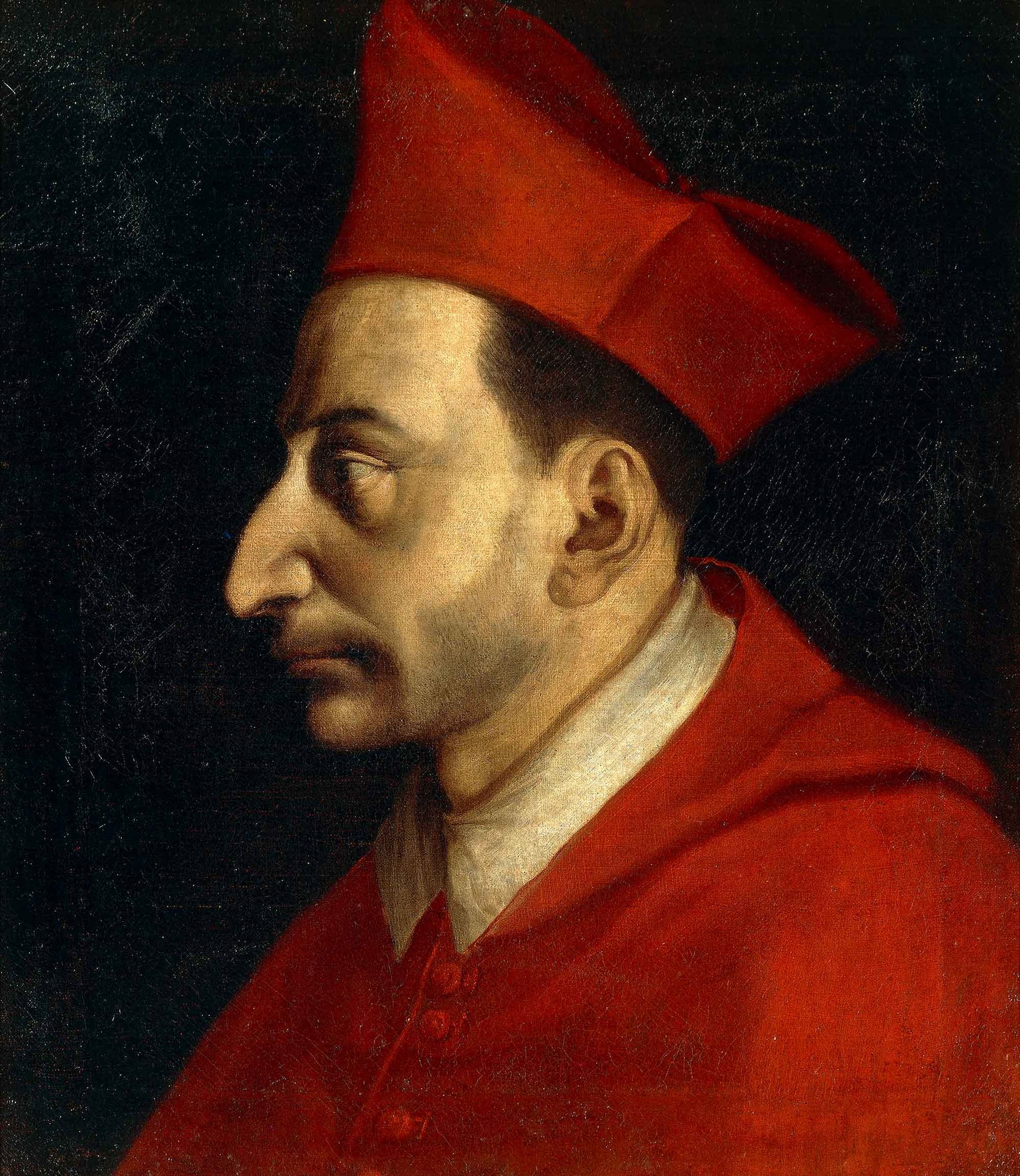
Today, 4 November, the Church keeps Saint Charles Borromeo, bishop. In August 1576, when plague reached Milan, the Archbishop was away, at a funeral in Lodi. He came straight back. He made his will, gave himself to his people and stayed — and that epidemic passed into history under his name: the plague of Saint Charles.
A Pope’s nephew
Charles was born on 2 October 1538 in the castle of Arona, on the shore of Lake Maggiore, the second son of Count Giberto Borromeo and Margherita de’ Medici. At twelve he was given an abbey at Arona in commendam; the sources say he insisted that its income go to the poor. He studied law at Pavia and took his doctorate in 1559.
At the end of that year his mother’s brother, Cardinal Giovanni Angelo de’ Medici, was elected Pope as Pius IV, and called his nephew to Rome. On 31 January 1560, aged twenty-one, Charles was created cardinal; a few days later he was given the administration of the archdiocese of Milan. In practice he became his uncle’s secretary of state. It was largely through his patience that the Council of Trent, suspended since 1552, met again in January 1562 and was brought to a close in December 1563. Afterwards he took part in preparing the Roman Catechism, the Catechism of the Council.
The decision of 1562
In 1562 his elder brother Federico died suddenly, and the family expected Charles to leave the clerical state, marry and take charge of the house of Borromeo. He did the opposite: he was ordained priest on 4 September 1563 and bishop on 7 December of the same year. Benedict XVI saw in this the first and most radical act of reform: before reforming others, Charles reformed himself.
The Council required bishops to live in their dioceses, and Milan had had no resident archbishop for some eighty years. Charles made his solemn entry into the city on 23 September 1565, at twenty-seven, and after the death of Pius IV at the end of that year he left Rome and settled there for good.
The pastor of Trent
In eighteen years of government he applied the Council with an energy that became a model for the whole Church:
- Seminaries. He founded the seminaries of Milan, for the formation of priests, and the Swiss College, for the clergy of Switzerland.
- Visitations and synods. He travelled his diocese several times, up to the remotest Alpine valleys; he held six provincial councils and eleven diocesan synods, the last in 1584.
- Catechesis. He promoted the schools of Christian doctrine for children and founded, in 1578, the Oblates of Saint Ambrose, secular priests at the bishop’s disposal.
- The poor. In the famine of 1570, according to the Catholic Encyclopedia, he fed as many as three thousand people a day for three months, at his own expense.
The reform had enemies. On the evening of 26 October 1569, while he was praying with his household in the chapel of the archbishop’s palace, a member of the order of the Humiliati, which resisted reform, fired an arquebus at him from a few yards away. The ball struck him but did not pass through his vestments; Charles signed to them to finish the prayers. Two years later Pius V suppressed the order.
The plague of 1576
Back in Milan, Charles made his will on 9 September 1576 and gave himself to the people: he visited the houses of the sick and the hospital of Saint Gregory, where the worst cases lay; persuaded the clergy of the city to do the same, and spent what he had. In processions of penance he walked barefoot, with a rope round his neck, carrying the relic of the Holy Nail venerated in the cathedral. The epidemic began to abate early in 1577 and was gone the following year. “Souls”, he used to say, according to Saint John Paul II, “are won on one’s knees.”
He wore himself out quickly. At the end of October 1584, after a retreat at the Sacro Monte of Varallo, he reached Milan with a fever and died on 3 November, aged forty-six. Paul V canonised him on 1 November 1610 and fixed his feast on 4 November. In the General Roman Calendar the day is an obligatory memorial.
Above the lake where Charles was born stands the Sancarlone: a statue 23.40 metres high on a granite pedestal of 11.70, showing the saint standing, a book in his left hand and his right raised in blessing. It was wanted by his cousin and successor, Cardinal Federico Borromeo, designed by Giovanni Battista Crespi, called Il Cerano, and made of copper sheets beaten with the hammer; the work lasted from 1624 to 1698.
Inside, a stair climbs to the head, and visitors can look out over the lake through the saint’s eyes. For almost two centuries it was the tallest statue that could be climbed from within, until the Statue of Liberty in 1886.
“Nothing is so necessary to all churchmen as mental prayer, which goes before all our actions, accompanies them and follows them. … If you administer the sacraments, brother, meditate on what you are doing; if you celebrate Mass, think of what you are offering; if you sing in choir, think to whom you are speaking and of what; if you guide souls, meditate on the blood by which they were redeemed.”— Saint Charles Borromeo, sermon at his last synod (1584), Acta Ecclesiae Mediolanensis, Milan, 1599, quoted by Saint John Paul II in his homily of 4 November 1980
“Saint Charles worked for a profound reform of the Church, beginning with his own life.”— Benedict XVI, message Lumen caritatis, 1 November 2010, n. 1
“His charity towards the poor and the suffering shone out in an extraordinary way during the plague of 1576, when the holy Archbishop chose to remain in the midst of his people, to encourage them, serve them and defend them with the weapons of prayer, penance and love.”— Benedict XVI, Lumen caritatis, n. 2
The prayers
The prayers the Church says on this day are those of the Mass of the memorial. The Collect asks that the Church be “unceasingly renewed”, the word that sums up Charles’s life; the Prayer after Communion asks for the strength that made him “faithful in ministry and fervent in charity”. Below, the Latin of the Missal and our own translation.
Custodi, quaesumus, Domine, in populo tuo spiritum, quo beatum Carolum episcopum implevisti, ut Ecclesia indesinenter renovetur, et, Christi se imagini conformans, ipsius vultum mundo valeat ostendere.
Preserve in your people, O Lord, we pray, the spirit with which you filled the bishop Saint Charles, that the Church may be unceasingly renewed and, conforming herself to the image of Christ, may show his face to the world.
Through our Lord Jesus Christ, your Son. Amen.
Praestent nobis, quaesumus, Domine, sacra mysteria quae sumpsimus eam animi fortitudinem, quae beatum Carolum reddidit in ministerio fidelem et in caritate ferventem.
May the sacred mysteries we have received, O Lord, we pray, give us that strength of soul which made Saint Charles faithful in ministry and fervent in charity.
Through Christ our Lord. Amen.
Sancte Carole, ora pro nobis. Saint Charles Borromeo, pray for us — and for our bishops and priests, that they may be faithful in ministry and fervent in charity.
- Saint Martin de Porres — the Dominican brother of Lima, yesterday, the 3rd.
- Saint John Paul II — Karol, whose patron saint was Charles.
- Words of the saints — a growing collection, in English and Portuguese.

Comments