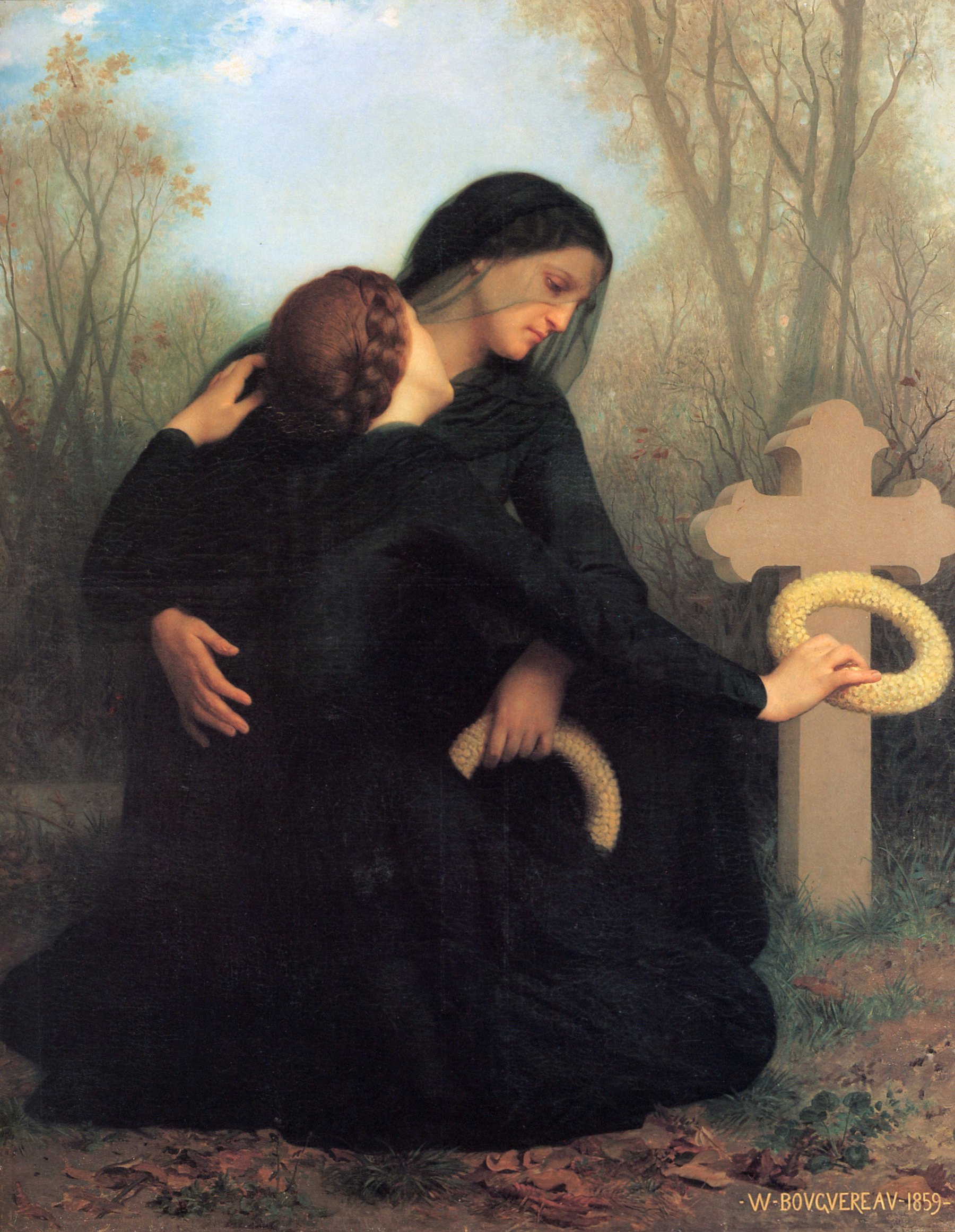
Today, 2 November, the Church keeps the Commemoration of All the Faithful Departed, All Souls’ Day. There is a request, made in the fourth century by a woman close to death, that sums up the meaning of this day. Saint Monica was at Ostia, far from her homeland, and her sons were anxious about where to bury her. She answered: “Lay this body anywhere; let no care for it trouble you. This only I ask of you: that you remember me at the altar of the Lord, wherever you may be.”
The practical guide for this day, with the prayers and the indulgences, is already on the site: All Souls’ Day: prayers and the plenary indulgence. This page deals with the question that comes first: why we pray for the dead.
A prayer older than Christianity
The first answer is in Scripture. The Second Book of Machabees tells how, after a battle, Judas Machabeus and his men went to gather the bodies of the fallen soldiers to bury them. Under their coats they found objects dedicated to the idols of Jamnia, which the Law forbade. Judas then made a collection and sent twelve thousand drachms of silver to Jerusalem, for a sacrifice to be offered for the sins of the dead, “thinking well and religiously concerning the resurrection” (2 Mac 12:43).
The text explains the reasoning: if Judas had not hoped that the slain would rise again, it would have seemed superfluous and vain to pray for the dead. And it concludes: “It is therefore a holy and wholesome thought to pray for the dead, that they may be loosed from sins” (2 Mac 12:46). The Second Vatican Council quotes that very verse when it recalls that the pilgrim Church, from the earliest times, has cherished the memory of the dead and offered suffrages for them (Lumen Gentium, no. 50).
What the first Christians did
In the first centuries the names of departed brethren were written in the diptychs, the lists read out at the liturgy. At the beginning of the third century Tertullian records the custom as something already settled: “We make offerings for the dead, for their birthdays, on the anniversary” (De corona, 3). For Christians the birthday meant the day of death, the birth into eternal life.
Saint Augustine, in a sermon on the dead, separates precisely what consoles the living from what helps the departed. The procession, the costly burial, the sumptuous tomb are, he says, a consolation for the living; but by the prayers of the Church, by the sacrifice of the Mass and by the alms given for them, “there is no doubt that the dead are helped”. And he adds that this was handed down by the Fathers and is observed by the whole Church (Sermon 172, 2). The flowers and candles of All Souls are a lovely gesture of love; what reaches the dead is prayer.
“Remember me at the altar”
Monica’s request is in her son’s Confessions (IX,11,27). She died at Ostia, on the ninth day of her illness, aged fifty-six; Augustine was thirty-three. He writes that she asked for no chosen monument and no costly funeral, nor did she insist on being buried beside her husband, as she had once wished; she wanted only to be remembered at the altar, where the holy victim is offered by which the debt that stood against us was blotted out.
At the end of Book IX Augustine turns that request into a prayer and extends it to his readers: that all who read those pages may remember Monica and Patricius at the altar. Sixteen centuries later, whoever reads the Confessions is still fulfilling the request.
Prayer for the dead is ancient, but the day itself is medieval. Saint Odilo, Abbot of Cluny (who died in 1048 or 1049), ordered all the monasteries dependent on Cluny to keep each year a commemoration of all the faithful departed on the day after All Saints, with prayers, Masses and alms for the poor. The traditional date is 998, but the Catholic Encyclopedia notes that it was probably after 1030. The custom passed to other monasteries and dioceses and reached Rome in the thirteenth century.
The order of the two days is no accident: first the Church celebrates those already in glory; then she prays for those still being purified.
Why pray, and not only remember
- Love does not end at death. The communion of saints unites the living, those being purified and those in glory in one body, and members of one body can help one another.
- Scripture approves it. The “holy and wholesome thought” of 2 Mac 12:46 is the biblical ground the Church has always cited.
- The tradition is constant. From the diptychs and Tertullian to Augustine and Odilo, the Church has never ceased to offer suffrages for the dead.
- The Mass comes first. Monica asked for neither flowers nor marble, but for the altar.
- It is an act of hope. Only someone who believes in the resurrection prays for the dead, as Judas Machabeus did.
“Lay this body anywhere; let no care for it trouble you. This only I ask of you: that you remember me at the altar of the Lord, wherever you may be.”— Saint Monica, in Saint Augustine, Confessions IX,11,27
“The pomp of funerals, the crowds at the obsequies, the costly care of burial, the sumptuous building of tombs are some sort of consolation for the living, not a help for the dead.”— Saint Augustine, Sermon 172, 2
The prayers
First, Saint Augustine’s prayer for his mother, which closes Book IX of the Confessions (passages from IX,13,35 and 37); then the Collect of the first Mass of All Souls’ Day, in Latin. The other prayers of this day, the Requiem aeternam, the De profundis and the prayer of Saint Gertrude, are in the All Souls guide.
Ego itaque, laus mea et vita mea, Deus cordis mei, sepositis paulisper bonis eius actibus, pro quibus tibi gaudens gratias ago, nunc pro peccatis matris meae deprecor te. Exaudi me per medicinam vulnerum nostrorum, quae pependit in ligno et sedens ad dexteram tuam te interpellat pro nobis. … Dimitte, Domine, dimitte, obsecro, ne intres cum ea in iudicium. …
Sit ergo in pace cum viro … Et inspira, Domine meus, Deus meus, inspira servis tuis, fratribus meis, … ut quotquot haec legerint, meminerint ad altare tuum Monnicae, famulae tuae, cum Patricio, quondam eius coniuge.
And so, my praise and my life, God of my heart, setting aside for a little while her good deeds, for which I give you thanks with joy, I now entreat you for the sins of my mother. Hear me through the healing of our wounds, who hung upon the wood and, seated at your right hand, intercedes with you for us. … Forgive, Lord, forgive, I beseech you: enter not into judgement with her. …
May she rest, then, in peace with her husband … And inspire, my Lord, my God, inspire your servants, my brothers, … that all who read these pages may remember at your altar Monica, your handmaid, with Patricius, once her husband.
— Saint Augustine, Confessions IX,13,35.37
Preces nostras, quaesumus, Domine, benignus exaudi, ut, dum attollitur nostra fides in Filio tuo a mortuis suscitato, in famulorum tuorum praestolanda resurrectione spes quoque nostra firmetur. Per Dominum nostrum Iesum Christum Filium tuum, qui tecum vivit et regnat in unitate Spiritus Sancti, Deus, per omnia saecula saeculorum.
Graciously hear our prayers, O Lord, that, as our faith in your Son, raised from the dead, is lifted up, so our hope may also be made firm in the resurrection your servants await. Through our Lord Jesus Christ, your Son, who lives and reigns with you in the unity of the Holy Spirit, God, for ever and ever.
Amen.
Requiem aeternam dona eis, Domine, et lux perpetua luceat eis. Eternal rest grant unto them, O Lord, and let perpetual light shine upon them.
- All Souls’ Day: prayers and the plenary indulgence — the practical guide, with the conditions and the text of the prayers.
- Novena for the Holy Souls — nine days of prayer for the departed.
- All Saints — the day before, and Saint Monica, the mother who asked for the altar.
- Words of the saints — a growing collection, in English and Portuguese.

Comments