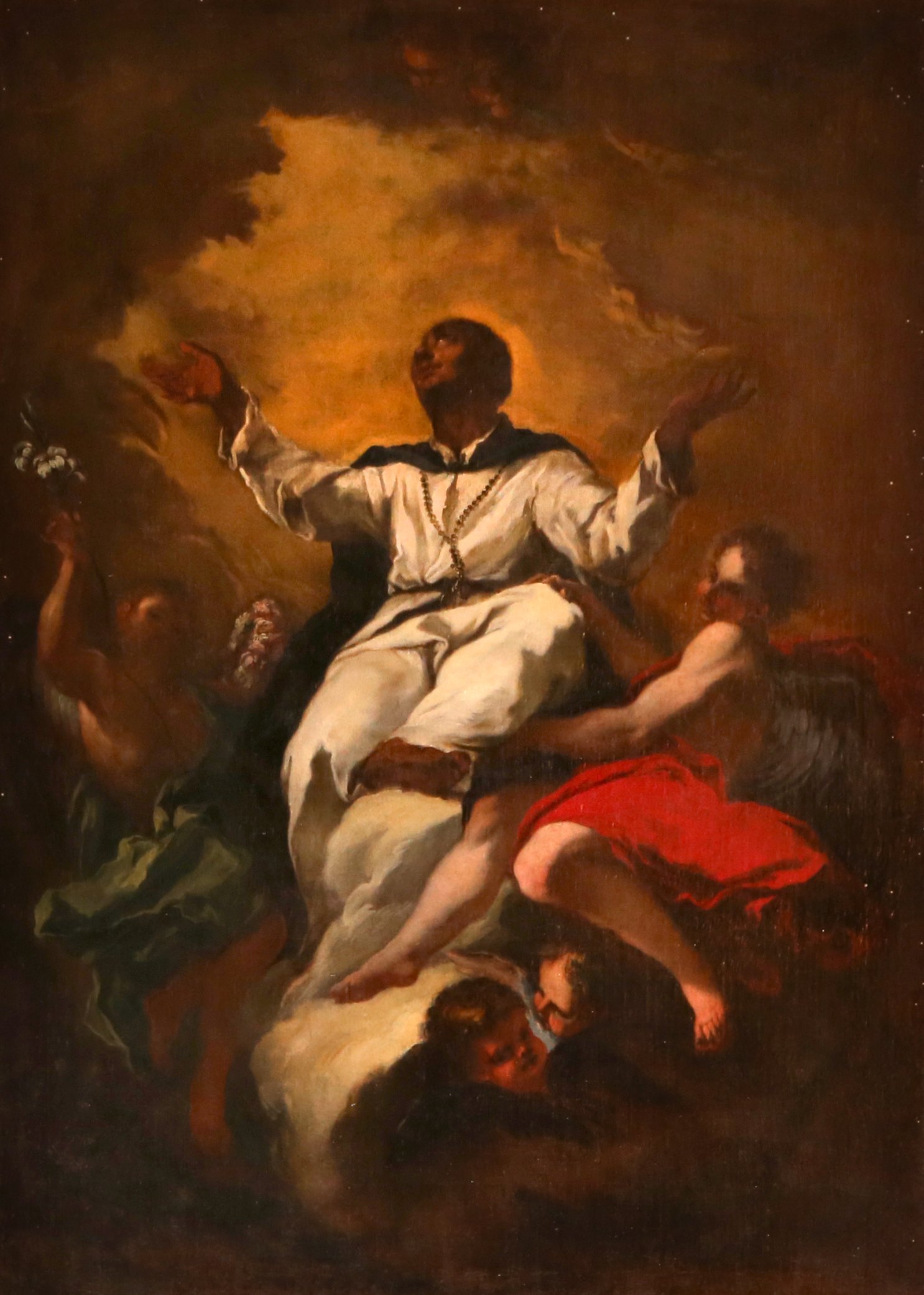
Today, 3 November, the Church keeps Saint Martin de Porres, a brother of the Order of Preachers in Lima. He left no book, no sermon, no letter of doctrine. He left a broom — painters show him holding one — and a reputation that, while he was still alive, earned him a nickname: the people of Lima called him Martin of Charity.
Son of a nobleman and a freed woman
He was born in Lima, in the Viceroyalty of Peru, and baptised on 9 December 1579 in the church of Saint Sebastian; the register reads “father unknown”. His father was Don Juan de Porres, a Spanish nobleman from Burgos and a knight of the Order of Alcántara; his mother, Ana Velázquez, was a free Black woman born in Panama. After the birth of a sister, Juana, the father left the family, and only years later acknowledged his children. Ana supported them as best she could.
While still a boy, Martin was apprenticed to a barber-surgeon — the trade that, in those days, combined cutting hair, letting blood and dressing wounds. He learned to care for other people’s bodies, and caring is how he spent his life. It is said that even then he spent hours of the night in prayer.
A “donado” in the priory of the Rosary
Around 1594, at fifteen, he knocked at the door of the Dominican priory of the Rosary in Lima. The rules of the time made it hard for men of mixed or African descent to become friars; he was received as a donado, a tertiary who lived in the priory, wore the habit and did the humblest work. He swept, washed, served in the kitchen and cut the friars’ hair. On 2 June 1603 he made his perpetual donation of himself to the priory, with vows of obedience, chastity and poverty; historians debate whether he then became a lay brother or remained a donado — he was never a priest.
Not everyone accepted him. Some in the priory insulted him for the colour of his skin and his illegitimate birth. According to the accounts gathered by his biographers, when the priory fell into debt he offered himself to be sold as a slave to pay what was owed: “I am only a poor mulatto; sell me.” Nobody sold him.
The infirmary, the city and the poor
In the priory infirmary, where he stayed until his death, he cared for friars and lay people, Spanish noblemen and slaves newly brought from Africa. He begged alms through the city and, according to the witnesses, fed a great number of poor people every day. He founded in Lima a home for orphans and abandoned children. He was a friend of Saint Rose of Lima, a Dominican tertiary, and of Saint John Macías, another lay brother of the same order; the three now rest together in the Basilica of Santo Domingo in Lima.
Two of his replies, handed down by Dominican tradition, sum it all up. Rebuked for putting a beggar covered in sores in his own bed, he is said to have answered: “Compassion, my brother, is preferable to cleanliness.” And when, during an epidemic, the prior reproached him for taking into the priory an Indian wounded by a knife, against the order he had been given, he said: “Forgive my error and instruct me, for I did not know that the precept of obedience came before that of charity.” From then on, the story goes, the prior gave him freedom to follow the promptings of mercy.
He died in the priory of the Rosary on 3 November 1639, aged fifty-nine. So many people of Lima came to his wake that, according to tradition, each one snipped a tiny piece of his habit to keep as a relic.
In pictures Martin holds a broom — hence the Spanish nickname Fray Escoba, “Brother Broom” — and is often shown with a dog, a cat and a mouse eating together from the same dish. The scene comes from the popular tradition of Lima: the Peruvian writer Ricardo Palma, in his Peruvian Traditions, says that around 1840, at the feasts for the beatification, a printed sheet of his virtues and miracles circulated in Lima, ending with the couplet “And from a single dish they ate, / dog and mouse and cat.”
Palma tells the story with humour and without asking the reader to believe it: the friar is said to have freed a little mouse caught in a trap and sent it to tell the others to move to the garden, where he would bring them food. Legend or not, the image has stayed as a sign of a charity that did not choose whom to serve.
From beatification to the altars of the world
The processes began in Lima in 1660. Clement XIII recognised his heroic virtues in 1763, Gregory XVI beatified him on 29 October 1837, and Saint John XXIII canonised him in Rome on 6 May 1962, a few months before the opening of the Second Vatican Council. In his homily, in Latin, the Pope said that Martin “followed ways and methods that we might judge entirely new for those times, almost forerunners of our own age”, and recalled that Pius XII had already proclaimed him patron of all the social institutions of Peru. In 1966 Paul VI declared him patron of the hairdressers and barbers of Italy, as Pope Francis recalled in 2019.
- Humility. The Collect of the Mass says God led him to glory “by the path of humility”; the broom is its sign.
- Charity without borders. Spaniards and slaves, Indians and friars, the poor of the streets and the sick of the priory: he served them all.
- Prayer. John XXIII recalls his love for the Crucified, for the Eucharist, which he adored in hiding for long hours, and for Our Lady.
- Humble work made holy. Barber, infirmarian, porter, almoner: no task was too small for God.
“He excused the faults of others; he forgave the bitterest insults, convinced that for the sins he had committed he deserved far heavier punishments; he strove with all his zeal to bring the guilty back to a good life; he sat kindly by the sick; he gave the poorest food, clothing and medicine.”— Saint John XXIII, homily at the canonisation of Saint Martin de Porres, 6 May 1962 (AAS 54, 1962)
“…so that he deserved to be called by the people Martin of Charity.”— Saint John XXIII, the same homily
“May the example of Martin teach many, for their salvation, how sweet and how blessed it is to follow in the footsteps of Jesus Christ and to obey his divine commandments.”— Saint John XXIII, the same homily
The prayers
Martin de Porres left no written prayers. The prayer the Church says on his day is the Collect of the Mass of the memorial (an optional memorial in the General Roman Calendar), given here in Latin and in our own translation. To pray with him for nine days, the site has the complete novena.
Deus, qui beatum Martinum per humilitatis iter ad caelestem gloriam perduxisti, tribue nobis eius ita nunc persequi exempla praeclara, ut exaltari cum ipso mereamur in caelis.
O God, who led Saint Martin by the path of humility to the glory of heaven, grant us so to follow his shining example now that we may be worthy to be exalted with him in heaven.
Through our Lord Jesus Christ, your Son. Amen.
Sancte Martine de Porres, ora pro nobis. Saint Martin de Porres, pray for us — and teach us to find no service too small.
- Saint Martin de Porres novena — nine days of prayer with the saint of the broom.
- Saint Dominic — the founder of the order in which Martin lived.
- Saint John XXIII — the Pope who canonised him; and, tomorrow, Saint Charles Borromeo.
- Words of the saints — a growing collection, in English and Portuguese.

Comments