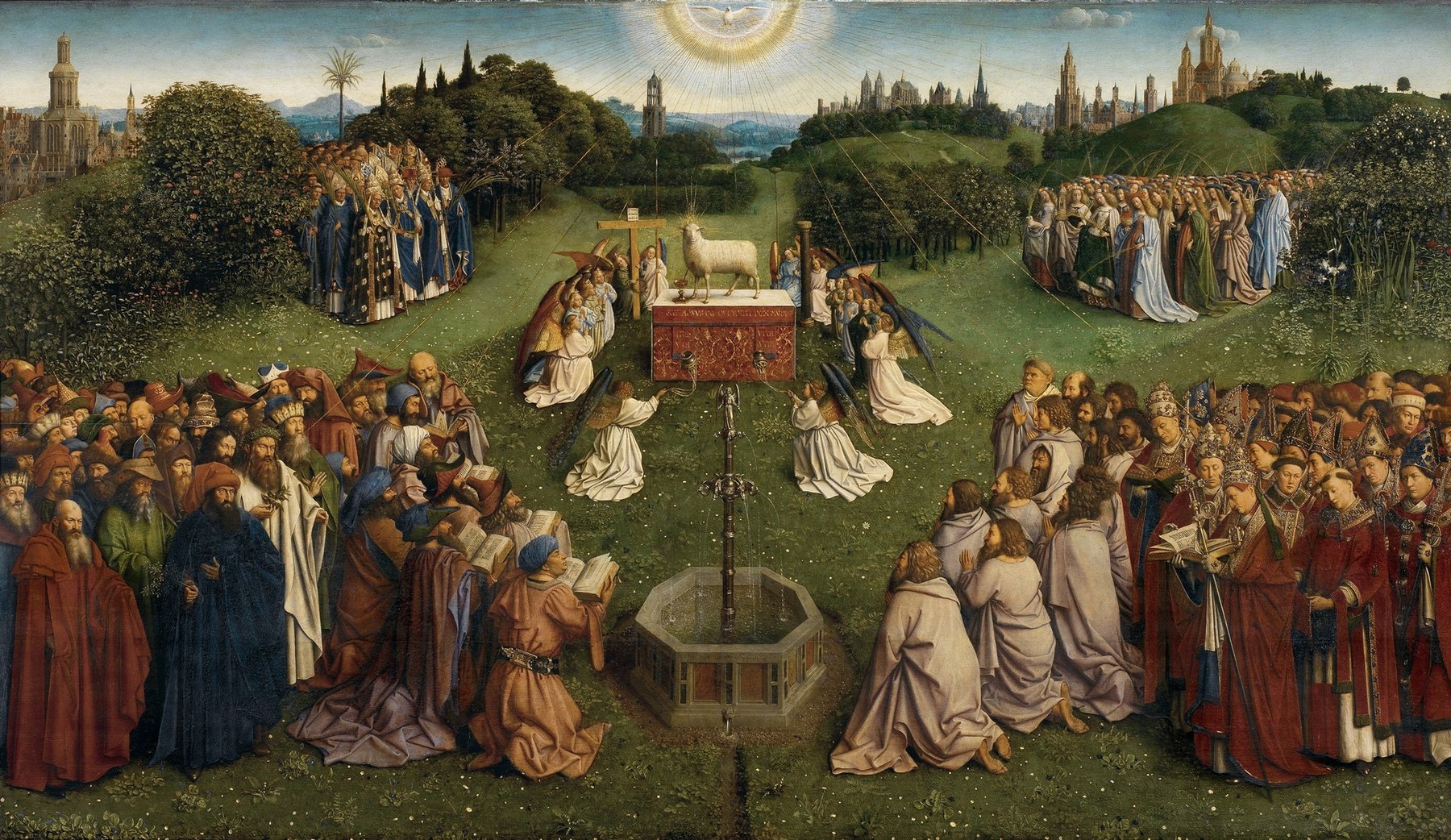
Today, 1 November, the Church keeps the Solemnity of All Saints. This year the day falls on a Sunday, and the feast takes its place. In the first reading at Mass, Saint John tells what he saw: “After this I saw a great multitude, which no man could number, of all nations, and tribes, and peoples, and tongues, standing before the throne, and in sight of the Lamb, clothed with white robes, and palms in their hands” (Apoc 7:9). That multitude is what the Church celebrates today: not only the saints of the calendar, but everyone who is already with God.
A multitude from every nation
When one of the elders asks John who these people in white are, the answer comes at once: “These are they who are come out of great tribulation, and have washed their robes, and have made them white in the blood of the Lamb” (Apoc 7:14). They are not self-made heroes; they are people washed by Christ. That is why today’s feast includes people no process of canonisation ever recorded: grandparents, labourers, mothers of families, children, forgotten monks, whose names God alone knows.
The Second Vatican Council describes the whole Church in three states: some are still on pilgrimage on earth, others, after this life, are being purified, and others are already in glory, beholding God. All of them, says the constitution Lumen Gentium (no. 49), are united in the same love and sing the same hymn to God. Today the Church looks at those who have arrived; tomorrow, on All Souls’ Day, she prays for those still being purified.
Where the feast comes from
The feast was born of the martyrs. In the first centuries each community kept the anniversary of a martyr’s death at the place of martyrdom. With the great persecutions, above all Diocletian’s, the martyrs became so many that there were not days enough for them all, and a common day appeared: at Antioch, on the Sunday after Pentecost; Saint Ephrem the Syrian and Saint John Chrysostom already speak of it in the fourth century.
In Rome, on 13 May 609 or 610, Pope Boniface IV consecrated the ancient Pantheon to Saint Mary and all the martyrs. More than a century later, Gregory III (731–741) dedicated an oratory in Saint Peter’s to the holy apostles and to all the saints, martyrs and confessors; tradition links this to 1 November, though historians dispute the exact date. In 835, at the request of Pope Gregory IV, the Emperor Louis the Pious made 1 November a holy day throughout the Frankish Empire. The date was already known in Ireland and in Northumbria: some manuscripts of the Irish martyrologies, from around the year 800, mark on this day a commemoration of all the saints of the world.
The painting at the top of this page is the central panel of the Ghent Altarpiece in Belgium, the work of the brothers Hubert and Jan van Eyck, installed in St Bavo’s Cathedral on 6 May 1432. In the centre the Lamb on the altar pours its blood into a golden chalice; in front flows the fountain of life. From every side the multitude arrives: prophets and ancient sages on the left, the apostles and clergy on the right, confessors in the background and, opposite them, the virgin martyrs with their palms — Saint Agnes with her lamb, Saint Barbara with her tower.
Art historians note that the arrangement of the groups seems to follow the liturgy of All Saints itself. Albrecht Dürer went to see it in 1521.
Why honour those who do not need us
Saint Bernard of Clairvaux put that question to himself in a sermon for this feast: what use to the saints are our praises and our solemnities? And he answered plainly: to them, none at all. We are the ones who gain. Remembering the saints, he says, kindles a strong desire; the first is to enjoy their company, to be a fellow citizen of the patriarchs, prophets, apostles and martyrs, and to rejoice with them in the communion of saints.
The Gospel of the day, the Beatitudes (Mt 5:1-12), shows the road they travelled: “Blessed are the clean of heart: for they shall see God” (Mt 5:8). And the Council recalls that this road is not for the few: all the faithful, of whatever state or condition, are called to the fullness of the Christian life and to the perfection of charity (Lumen Gentium, no. 40).
- The communion of saints. The Church in heaven, the Church being purified and the Church on pilgrimage form one body in Christ.
- The nameless saints. The feast includes all who are with God, not only those the Church has canonised.
- Everyone’s calling. Holiness is the common destiny of the baptised, not a privilege of the few.
- Intercession. The more intercessors, says the Collect, the greater the abundance of mercy we ask for.
- A bridge to All Souls. Having celebrated those who have arrived, the Church prays the next day for those who still wait.
“The saints have no need of our honours, and nothing is added to them by our devotion. When we venerate their memory, the profit is ours, not theirs.”— Saint Bernard of Clairvaux, Fifth Sermon for the Feast of All Saints, 5
“There they are in their very selves; we are there only by our desires. They are there by presence; we, by memory.”— Saint Bernard of Clairvaux, Fifth Sermon for the Feast of All Saints, 5
The prayers
Two prayers of the feast itself: the Collect of the Mass, which asks for abundant mercy because the intercessors are many, and the Magnificat antiphon at Vespers, which takes up the Apocalypse and which so many composers have set to music.
Omnipotens sempiterne Deus, qui nos omnium Sanctorum tuorum merita sub una tribuisti celebritate venerari, quaesumus, ut desideratam nobis tuae propitiationis abundantiam, multiplicatis intercessoribus, largiaris. Per Dominum nostrum Iesum Christum Filium tuum, qui tecum vivit et regnat in unitate Spiritus Sancti, Deus, per omnia saecula saeculorum.
Almighty and eternal God, who have granted us to honour in a single celebration the merits of all your Saints, we pray that, as our intercessors are multiplied, you may pour out on us the abundance of your mercy for which we long. Through our Lord Jesus Christ, your Son, who lives and reigns with you in the unity of the Holy Spirit, God, for ever and ever.
Amen.
O quam gloriosum est regnum, in quo cum Christo gaudent omnes Sancti! Amicti stolis albis, sequuntur Agnum quocumque ierit.
O how glorious is the kingdom in which all the Saints rejoice with Christ! Clothed in white robes, they follow the Lamb wherever he goes.
Apoc 7:9-14; 14:4
Omnes Sancti et Sanctae Dei, intercedite pro nobis. All you holy men and women, saints of God, intercede for us.
- All Souls: why we pray for the dead — the next day, the other half of the communion of saints.
- The Litany of the Saints — the oldest of the litanies, in Latin and English.
- Saint Bernard of Clairvaux — the mellifluous doctor, author of the sermon quoted above.
- Words of the saints — a growing collection, in English and Portuguese.

Comments