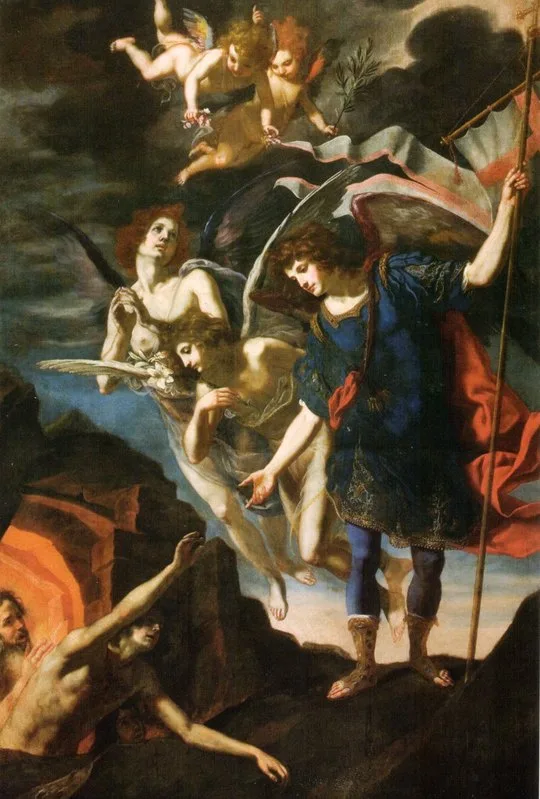
2 November · Commemoration of All the Faithful Departed
All Souls Day: prayers for the faithful departed and the plenary indulgence
On 2 November, the day after All Saints, the Church remembers all the faithful departed. Having celebrated those who are already in glory, she turns to those who died in God's grace and are still being purified, and prays for them.
This page gathers what you need to keep the day well: where the commemoration comes from, what the Church teaches about Purgatory, how to gain the plenary indulgences granted for the holy souls in these days, and which prayers to say, each with its full text on this site.
What All Souls Day is
Prayer for the dead is very old in the Church, but 2 November as the proper day for all the faithful departed has monastic roots. According to tradition, around 998 St Odilo, Abbot of Cluny, ordered the monasteries under Cluny to pray the Office of the Dead on the day after All Saints. The custom spread to other houses and dioceses and was in time adopted by the whole Western Church.
On 10 August 1915, in the middle of the First World War, Pope Benedict XV issued the apostolic constitution Incruentum altaris sacrificium, extending to every priest of the Latin rite the permission to celebrate three Masses on All Souls Day, a privilege that until then had existed only in some places, such as Spain and Portugal. One Mass may be offered for any intention, another for all the faithful departed, and another for the intentions of the Pope. The privilege has never been revoked: to this day, 2 November and Christmas are the only days on which the general law of the Church allows every priest to celebrate three Masses, without needing the bishop's permission.
What the Church teaches about Purgatory
The Catechism of the Catholic Church teaches that those who die in God's grace and friendship, but still imperfectly purified, are assured of their eternal salvation; after death they undergo purification so as to achieve the holiness necessary to enter the joy of heaven (no. 1030). The Church gives the name Purgatory to this final purification of the elect, which is entirely different from the punishment of the damned (no. 1031).
That is why we pray for the dead. The Catechism notes that this practice rests on Scripture, where Judas Maccabeus made atonement for the dead (2 Maccabees 12:46), and that from the beginning the Church has honoured the memory of the dead and offered prayers in suffrage for them, above all the Eucharistic sacrifice, and also almsgiving, indulgences and works of penance (no. 1032). The same paragraph quotes St John Chrysostom: let us not hesitate to help those who have died and to offer our prayers for them.
The plenary indulgences for the faithful departed
The Manual of Indulgences (Enchiridion Indulgentiarum, 4th edition, 1999, grant no. 29) grants two plenary indulgences that can be applied only to the souls in Purgatory:
1. On each day from 1 to 8 November, to those who devoutly visit a cemetery and pray for the departed, even if only mentally. One can be gained each day, eight in all, each for a particular soul or for the holy souls in general.
2. On 2 November, to those who devoutly visit a church or an oratory and there pray the Our Father and the Creed. At the discretion of the Ordinary (usually the diocesan bishop), this visit may also be made on the Sunday before or after, or on the Solemnity of All Saints.
On other days the same works carry a partial indulgence. A partial indulgence is also granted to those who devoutly pray Lauds or Vespers from the Office of the Dead, or the prayer Eternal rest (Requiem aeternam).
The usual conditions
For the indulgence to be plenary, the usual conditions apply: sacramental confession, Holy Communion and prayer for the intentions of the Pope (one Our Father and one Hail Mary suffice, though another prayer may be chosen), together with the interior disposition of complete detachment from all sin, even venial. If any of these is lacking, the indulgence is partial. According to the Apostolic Penitentiary, the conditions may be fulfilled several days before or after the prescribed work (about twenty days); one confession suffices for several plenary indulgences, but each requires its own Communion and its own prayer for the Pope. Only one plenary indulgence can be gained per day.
What about the whole month of November?
In 2020 and 2021, because of the pandemic, the Apostolic Penitentiary issued decrees that extended the cemetery visit to any eight days of November and allowed the 2 November indulgence to be moved to another day of the month. These were temporary decrees for those years only. Unless a new concession is made, the ordinary norm above applies; it is worth asking your parish or diocese whether any special provision has been made this year.
How to pray for the dead
The greatest good we can offer one who has died is the Holy Mass. Having a Mass offered for someone's soul, or attending Mass and receiving Communion for them, is the form of suffrage the Church has always placed first.
Alongside the Mass, tradition recommends the Rosary offered for the holy souls, visits to the cemetery, almsgiving and small sacrifices. There are also short, ancient prayers that fit any moment of the day: the Requiem aeternam, said after each decade or when passing a cemetery; the psalm De profundis, which the Church has prayed for the dead for centuries; the prayer attributed to St Gertrude; and the sequence Dies irae, long sung at the Requiem Mass.
Those keeping watch with someone near death can pray with them the commendation of the soul, the Proficiscere. And if you want to prepare in good time, the novena for the holy souls can be started at the end of October so as to finish around All Souls, or prayed at any time of the year.
A text often read at funerals
At this time of year the text "Death is nothing at all" is widely shared, often attributed to St Augustine. It is not his: it comes from a sermon by the English canon Henry Scott Holland. We tell the story of the text, and what the Catholic faith adds to it, on a page of its own.
Frequently asked questions
When can I gain the All Souls plenary indulgence?
By visiting a cemetery and praying for the departed on any day from 1 to 8 November (one per day), and by visiting a church or oratory on 2 November and praying there the Our Father and the Creed. The bishop may allow that visit on the Sunday before or after, or on All Saints. In every case the usual conditions apply: confession, Communion, prayer for the Pope's intentions and detachment from all sin.
Do I have to go to confession on the same day?
No. The Apostolic Penitentiary explains that confession, Communion and prayer for the Pope may be done several days before or after the prescribed work, about twenty days. One confession covers several plenary indulgences, but each needs its own Communion and its own prayer for the Pope's intentions.
Can I apply the indulgence to myself or to someone living?
No. The indulgences of 1 to 8 November and of 2 November can be applied only to the souls in Purgatory. You may offer them for a particular person who has died or for the holy souls in general.
Does the indulgence apply to the whole of November?
Under the ordinary norm, no: the plenary indulgence for the cemetery visit runs from 1 to 8 November. The extension to the whole month was granted in 2020 and 2021 by temporary decrees of the Apostolic Penitentiary because of the pandemic. On the other days of November, visiting a cemetery and praying for the dead carries a partial indulgence.
Why may a priest celebrate three Masses on All Souls Day?
Because in 1915 Benedict XV extended this privilege, which had existed only in some countries, to the whole Latin Church. One Mass may be for any intention, another is for all the faithful departed and another for the intentions of the Pope.