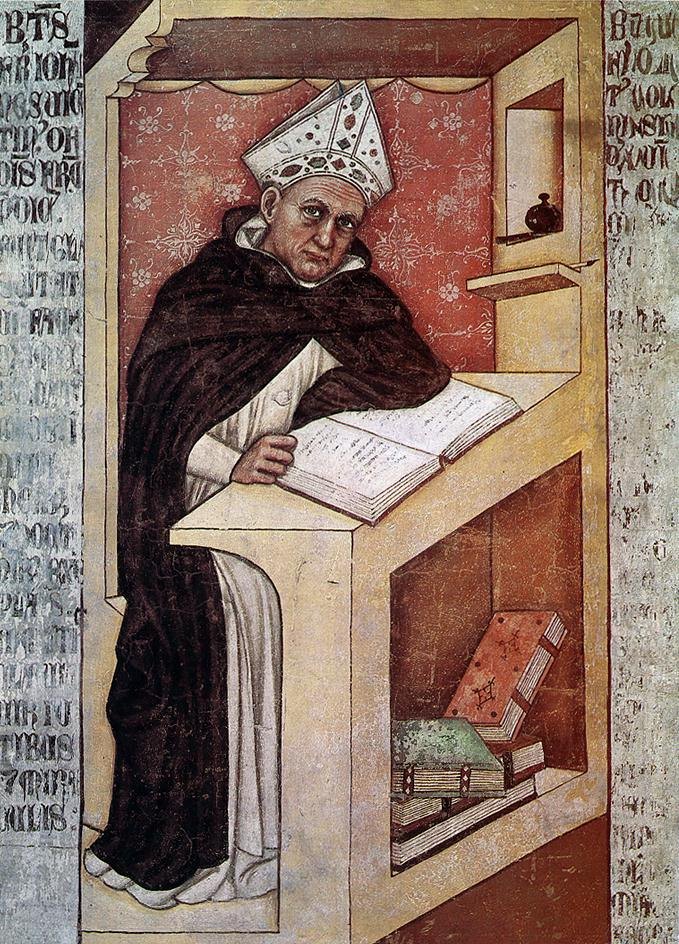
Today, 15 November, the Church remembers Saint Albert the Great, bishop and Doctor of the Church. In 2026 the date falls on a Sunday, and the Mass is that of the Sunday; but the day has been his since 1280, when he died in his cell in the Dominican convent at Cologne. One of his disciples, Ulrich of Strasbourg, called him “the wonder and the miracle of our time”. The Church calls him the Universal Doctor.
From Swabia to Paris
Albert was born at Lauingen in Swabia at the beginning of the thirteenth century — around 1200, according to most scholars; the dates proposed run from 1193 to 1206. As a young man he went to Padua, in Italy, to study the so-called liberal arts: grammar, rhetoric, dialectic, arithmetic, geometry, astronomy and music. Already he showed the taste for the natural sciences that would stay with him all his life.
In Padua he attended the church of the Dominicans. The decision to join the Order came gradually, Benedict XVI recounts: prayer, the example of the friars and the preaching of Blessed Jordan of Saxony, Saint Dominic’s successor, from whom he received the habit, all played their part — against his family’s resistance. After ordination he taught theology in German convents such as Hildesheim, Freiburg, Regensburg, Strasbourg and Cologne, and in 1245 he became a master of theology at the University of Paris, the most famous of its day.
The master and the “dumb ox”
In Paris and in Cologne one of his students was a quiet, heavily built young Italian, Thomas Aquinas. In 1248 the Order sent Albert to open a house of theological studies at Cologne, and he took Thomas with him. The other students called the young man “the dumb ox”; Bernard Gui, a fourteenth-century biographer of Thomas, records the story that Albert replied the whole world would one day hear that ox bellow. Between the two grew a friendship of mutual esteem that lasted until Thomas’s death in 1274.
In 1254 Albert was elected provincial of the Dominicans of Germany, a province that stretched across much of central and northern Europe. Pope Alexander IV called him to his side as an adviser and in 1260 appointed him Bishop of Regensburg, a large diocese in difficulties. He stayed two years: he made peace in the city, reorganised parishes and convents, gave new life to works of charity, and went back to teaching. In 1263 and 1264 he preached in Germany and Bohemia at the request of Urban IV; at Cologne he arbitrated between the archbishop and the citizens; in 1274 he took part in the Second Council of Lyons, which sought union with the Greeks. After Thomas died, he defended his former pupil’s thought against criticism and condemnation.
He died on 15 November 1280 in the convent at Cologne, at a great age. He was beatified in 1622. On 16 December 1931 Pius XI canonised him and declared him a Doctor of the Church; ten years later, in 1941, Pius XII proclaimed him patron of those who cultivate the natural sciences.
The book of nature
The titles of Albert’s works read like the index of an encyclopaedia: physics, chemistry, astronomy, mineralogy, botany, zoology, alongside philosophy, theology and commentaries on Scripture. His method was not yet that of modern science, Benedict XVI notes: it consisted in observing, describing and classifying. But in this way he opened the door to future research. In his treatise on plants he left a principle that became famous — experimentum solum certificat in talibus, “in such matters only experience gives certainty”.
Another of his merits was to welcome Aristotle, whose works were then reaching the West, often through Arab commentators, and whom many Christians feared. Albert studied them rigorously, convinced that whatever is truly rational is compatible with the revealed faith — without idolising the Greek philosopher, as one of the sayings below shows. From this came a clear distinction between philosophy and theology, which converse and cooperate; Thomas would give the work its definitive form.
- Universal Doctor. Pius XII gave him the title for the breadth of his learning; his contemporaries already called him “the Great”.
- Teacher of Saint Thomas. He recognised his pupil’s gifts and defended him after his death.
- Bishop and peacemaker. At Regensburg and at Cologne he was a man of reconciliation.
- Patron of scientists. For him, to study creation is to read a book written by God; the Book of Wisdom (Wis 13:5) teaches that from the greatness and beauty of creatures the Creator can be known by analogy.
The portrait on this page was painted in 1352, seventy-two years after Albert’s death, by Tommaso da Modena, in the chapter house of the former Dominican convent of San Nicolò at Treviso, in northern Italy. The cycle shows forty eminent friars of the Order — popes, cardinals, theologians —, each at his own desk among books and inkwells. Albert wears a mitre, in memory of his years as a bishop.
In the same cycle is Cardinal Hugh of Saint-Cher, with a pair of spectacles on his nose: the earliest known picture of anyone wearing glasses.
“In such matters only experience gives certainty.”— Saint Albert the Great, De vegetabilibus VI, tr. 2, c. 1
“Whoever believes that Aristotle was a god must also believe that he never erred. But if one believes that Aristotle was a man, then without doubt he was liable to error, just as we are.”— Saint Albert the Great, Physica VIII, tr. 1, c. 14
“To desire all that I desire for the glory of God, as God desires for his glory all that he desires.”— Saint Albert’s “formula of holiness”, quoted by Benedict XVI at the audience of 24 March 2010
The prayers
Saint Albert’s Collect in today’s Roman Missal was rewritten after the Council. The older prayer praised the saint for having subjected human wisdom to faith; the present one praises him for having joined them, and asks that the progress of the sciences may lead us to know and love God more. Below, the Latin text and a translation.
Deus, qui beatum Albertum episcopum in humana sapientia cum divina fide componenda magnum effecisti, da nobis, quaesumus, ita eius magisterii inhaerere doctrinis, ut per scientiarum progressus ad profundiorem tui cognitionem et amorem perveniamus. Per Dominum.
O God, who made the bishop Saint Albert great in joining human wisdom to divine faith, grant, we pray, that we may so hold fast to the teachings of his magisterium that, through the progress of the sciences, we may come to a deeper knowledge and love of you. Through our Lord.
Amen.
Sancte Alberte, ora pro nobis. Saint Albert the Great, pray for us — and for all who study creation.
- The Eucharistic hymns of Saint Thomas Aquinas — the pupil’s work; and Saint Thomas’s prayer before study.
- Saint Dominic — the founder of the Order of Preachers.
- Saint Elizabeth of Hungary — the princess of the poor, on the 17th.
- Words of the saints — a growing collection, in English and Portuguese.

Comments