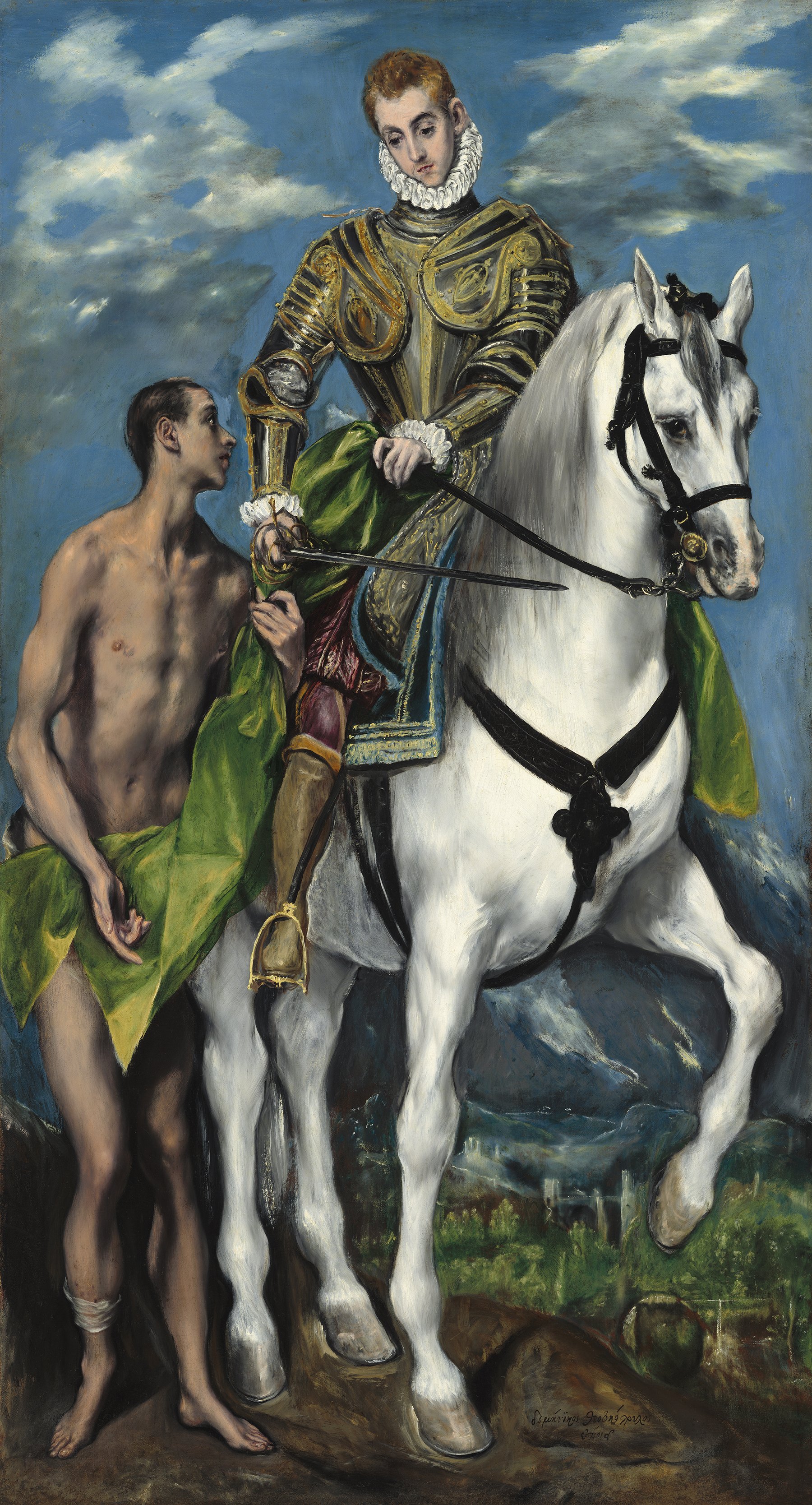
Today, 11 November, the Church keeps Saint Martin of Tours, bishop. In a winter so harsh that many were dying of cold, a young Roman officer met at the gates of Amiens a naked beggar whom everyone else passed by. He had nothing left to give but his cloak. He drew his sword, cut it in two and gave half to the poor man. That night, says a man who knew him, he saw in a dream Christ clothed in that half.
The catechumen soldier
The one who tells the story is Sulpicius Severus, a Gallic aristocrat who visited Martin and wrote the Life of Saint Martin while the bishop was still alive. Martin was born at Sabaria in Pannonia — today Szombathely, in Hungary — around 316 (some historians prefer 336), to pagan parents; his father was a military tribune. He grew up at Pavia in Italy. At ten, against his parents’ wishes, he ran to the church and asked to become a catechumen. As a veteran’s son, under an imperial edict, he was enrolled by force at fifteen and served in the cavalry in Gaul.
It was as a soldier, still a catechumen, that he divided his cloak at Amiens. Some of those who saw it laughed at the figure he cut in half a cloak; others, says Sulpicius, groaned because they had not done the same, when they had more to give. The following night Christ appeared to him surrounded by angels, wearing the half cloak, and said aloud: “Martin, still a catechumen, has clothed me with this garment.” Sulpicius recalls the word of the Gospel: “as long as you did it to one of these my least brethren, you did it to me” (Mt 25:40). Martin did not grow proud: he hurried to ask for baptism, at eighteen.
“I am a soldier of Christ”
According to Sulpicius he remained in the army for about two more years (the dates of his military life are debated by historians). Before a battle against the barbarians near Worms, as the Caesar Julian was handing out a bounty to the troops, Martin asked for his discharge: “Until now I have served you; let me now serve God. I am a soldier of Christ: it is not lawful for me to fight.” Accused of cowardice, he offered to stand the next day before the enemy lines unarmed, protected only by the sign of the cross. The next day, Sulpicius says, the enemy sent to sue for peace.
Free of the army, he went to Saint Hilary, Bishop of Poitiers, who made him an exorcist. He fought the Arians, was even driven out of Milan by them, and when Hilary returned from exile in 361 he founded near Poitiers, at Ligugé, a community of monks — “the oldest monastery known in Europe”, in the words of Benedict XVI.
The bishop who remained a monk
Around 371 the city of Tours wanted him as its bishop. To get him out of his monastery a ruse was needed: a citizen pretended his wife was ill and brought him to the city, where the people acclaimed him. Some bishops objected to this man “contemptible in appearance, with dirty clothes and unkempt hair”; the people paid them no heed. Martin accepted, but did not change his way of life. Two miles from the city, by the Loire, he founded the monastery of Marmoutier, where some eighty disciples lived with him in wooden cells and caves dug into the rock. From there he went out to evangelise the countryside of Gaul, still largely pagan.
- Charity. The cloak of Amiens sums it all up: give what you have, even if it is only half.
- Peace. The soldier who refused to kill, and the bishop who died trying to reconcile the clergy of a parish.
- Monastic life. Ligugé and Marmoutier are among the first communities of monks in the West.
- Humility. As bishop he still dressed like the poor; Sulpicius says nothing changed in his heart or his clothing.
He neither feared to die nor refused to live
In old age he went to Candes, in the heart of his diocese, to settle a quarrel among the clergy. He made peace, but fell ill. His disciples wept: “Why are you leaving us, father?” He answered, Sulpicius tells his mother-in-law Bassula in a letter, only with a prayer: “Lord, if I am still needed by your people, I do not refuse the toil: your will be done.” He chose to die lying on ashes and sackcloth — “it is not fitting for a Christian to die except on ashes” — and asked to be allowed to look at heaven rather than at the earth. He died at Candes on 8 November 397. Carried down the Loire to Tours, he was buried on 11 November, the day of his feast; according to Sulpicius, some two thousand monks followed the funeral.
Martin is among the first saints venerated in the West who did not die as martyrs. Sulpicius himself, in his second letter, says that he won the honour of martyrdom without shedding his blood. In the General Roman Calendar the day is an obligatory memorial.
The half of the cloak that Martin kept, the cappa, became a relic of the Frankish kings, who carried it even into battle. The place where it was kept came to be called the capella, the “little cloak”, and the clerics who looked after it capellani: according to an old and widely repeated etymology, that is where the words chapel and chaplain come from.
The painting at the top of this page was made by El Greco between 1597 and 1599 for a chapel in Toledo, where it stayed until 1907, when it was sold to the American collector Peter Widener; it now hangs in the National Gallery of Art in Washington. El Greco dressed the Roman soldier in damascened armour and a Spanish lace ruff of his own day.
“I am a soldier of Christ: it is not lawful for me to fight.”— Saint Martin, before the Caesar Julian, according to Sulpicius Severus, Life of Saint Martin 4.3
“There was the same humility in his heart, the same poverty in his clothing; and so, full of authority and grace, he fulfilled the dignity of a bishop without forsaking the purpose and virtue of a monk.”— Sulpicius Severus, Life of Saint Martin 10.2
“Almost like an icon, he shows the irreplaceable value of the individual witness of charity.”— Benedict XVI, encyclical Deus caritas est, n. 40 (2005)
The prayers
The Collect of the Mass of Saint Martin is woven from words of Saint Paul (Phil 1:20 and Rom 8:38-39): God was glorified in him “both by his life and by his death”. The responsory, from the ancient Office of Saint Martin preserved in the Liber responsalis, puts the saint’s last words on the lips of the Church. Below, the Latin and our own translation.
Deus, qui in beato Martino episcopo sive per vitam sive per mortem magnificatus es, innova gratiae tuae mirabilia in cordibus nostris, ut neque mors neque vita separare nos possit a caritate tua.
O God, who were glorified in the bishop Saint Martin both by his life and by his death, renew the wonders of your grace in our hearts, that neither death nor life may separate us from your love.
Through our Lord Jesus Christ, your Son. Amen.
O beatum virum Martinum antistitem, qui nec mori timuit, nec vivere recusavit.
℣. Domine, si adhuc populo tuo sum necessarius, non recuso laborem; fiat voluntas tua.
O blessed man, Martin the bishop, who neither feared to die nor refused to live!
℣. Lord, if I am still needed by your people, I do not refuse the toil: your will be done.
— words of Saint Martin according to Sulpicius Severus, Letter 3
Sancte Martine, ora pro nobis. Saint Martin of Tours, pray for us — and teach us to share our cloak with those who are cold.
- Saint Charles Borromeo — another bishop who stayed with his people, on the 4th.
- Saint Elizabeth of Hungary — the princess who served the poor, on the 17th.
- Saint Benedict of Nursia — the father of Western monks.
- Words of the saints — a growing collection, in English and Portuguese.

Comments