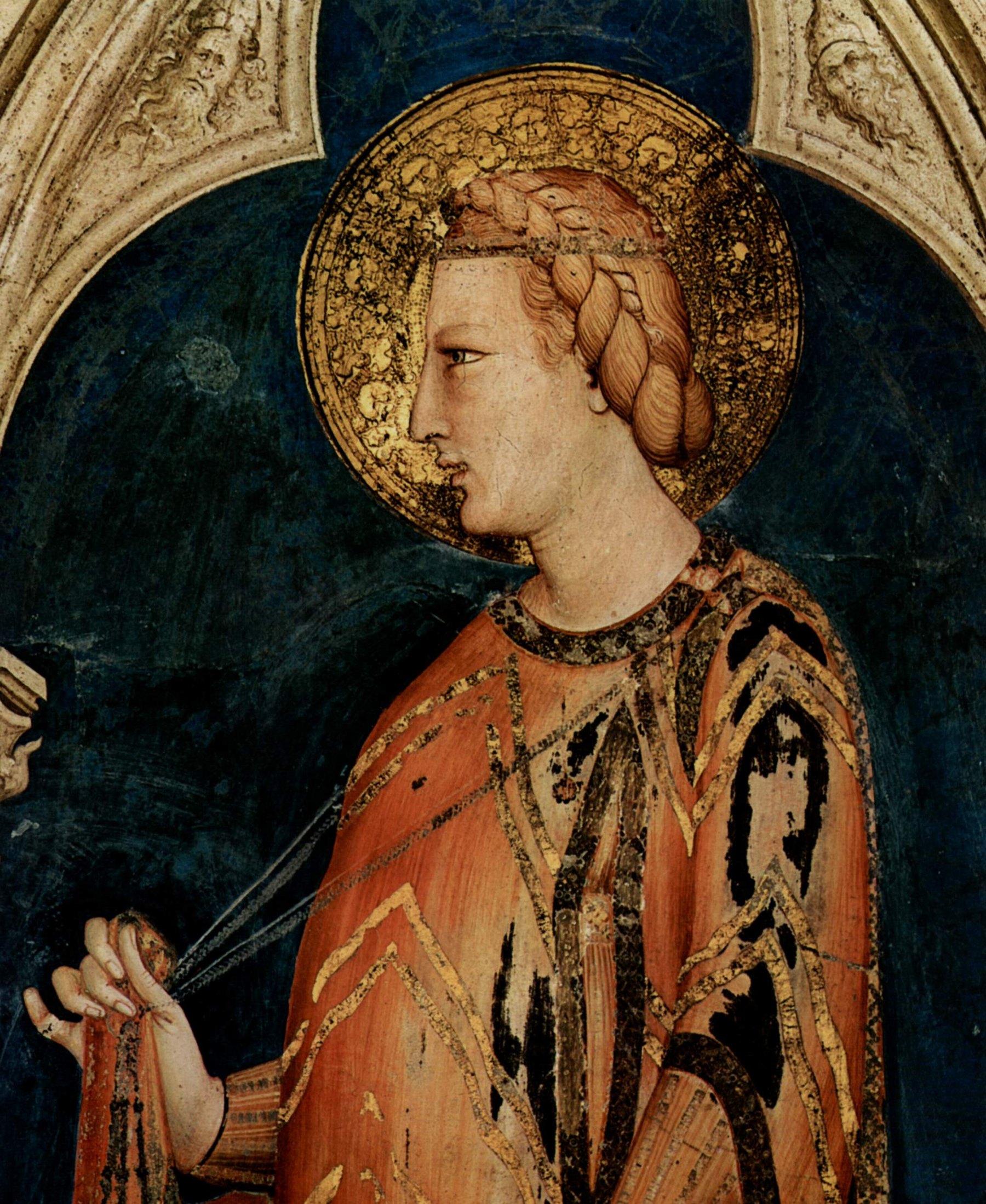
Today, 17 November, the Church keeps Saint Elizabeth of Hungary, also called Elizabeth of Thuringia. On a feast of the Assumption, entering the church, the young princess took off her crown, laid it before the crucifix and lay prostrate on the ground with her face covered. When her mother-in-law rebuked her, she answered: “How can I, a wretched creature, go on wearing a crown of earthly dignity, when I see my King Jesus Christ crowned with thorns?”
A princess of four
Elizabeth was born in 1207, the daughter of King Andrew II of Hungary and Gertrude of Andechs-Meran. Her birthplace is disputed: Pressburg (today’s Bratislava) or the castle of Sárospatak. Her mother’s sister was Saint Hedwig of Silesia; and Saint Elizabeth of Portugal, the Holy Queen, wife of King Denis, was her great-niece.
As was the custom among ruling families, the marriage was arranged for political reasons. At the age of four, in 1211, Elizabeth was taken to the court of the Landgrave of Thuringia, at the castle of the Wartburg above the town of Eisenach in central Germany, to be brought up with her future husband. Promised first to the eldest son, Hermann, who died in 1216, she was then promised to the second, Ludwig. They married in 1221: she was fourteen, he twenty-one. The marriage, born of politics, was a happy one; they had three children, Hermann, Sophia and Gertrude.
At the Wartburg, with the poor
The court whispered against her: she did not behave as a princess should. The maids who had been with her since childhood, and who later testified at her canonisation process, relate that she would eat nothing without knowing it came from her husband’s lawful goods, and that she sought to make amends to those who had suffered violence. She gave food and drink to whoever knocked at the door, clothed the poor, paid debts, nursed the sick and buried the dead; she went down from the castle to take bread, meat and flour to poor homes and handed it out herself.
When she was denounced to her husband, Ludwig replied, Benedict XVI recounts: “So long as she does not sell the castle, I am content!” Shortly after 1220 the Friars Minor reached Thuringia, and Elizabeth heard of the conversion of Francis of Assisi; from then on she wanted to follow the poor and crucified Christ still more closely. In 1226, a year of floods, famine and plague, she governed in Ludwig’s absence and gave alms throughout the territory, even giving her robes of state to the poor.
Tradition tells that Elizabeth was coming down from the castle with her apron full of bread for the poor when she met her husband, who asked what she was carrying. She opened her apron and, instead of bread, there were magnificent roses.
The story is not in the earliest sources — the letters of her spiritual director, Conrad of Marburg, to the Pope, and the testimony of her maids of 1235 —, and the same scene is told of other saints, among them Saint Elizabeth of Portugal. Benedict XVI recalls it as a symbol of her charity; and it is so, with roses in her lap, that Elizabeth appears in so many pictures.
Widowed at twenty
In June 1227 Ludwig left to join the crusade of the Emperor Frederick II. “Far be it from me to detain you”, Elizabeth told him. Fever swept through the army, and he died at Otranto in southern Italy on 11 September 1227, before embarking; he was twenty-seven. Their third child was born a few weeks later. Elizabeth, aged twenty, left the Wartburg: the sources differ on whether she was driven out by her brother-in-law, Henry Raspe, or left of her own accord, so as to live as she wished.
On Good Friday 1228, in the Franciscan church at Eisenach, she solemnly renounced the world and her own will; afterwards, at Marburg, she and her maids received the grey habit of the Third Order. That is why she is patroness of the Third Order of Saint Francis and of the Secular Franciscan Order. Her spiritual director, Master Conrad of Marburg, was an extremely severe man, and the sources do not hide the harshness with which he treated her. With the money of her dowry she built a hospital at Marburg and spent her last years there, caring for the most repellent of the sick and watching beside the dying. When Conrad rebuked her for serving the most wretched at table, she answered, he writes, that she received from the poor a special grace and humility.
In November 1231 she was taken ill with a high fever. On the night of 17 November she fell asleep in the Lord; she was twenty-four. The miracles at her tomb were so many that Gregory IX canonised her four years later, at Perugia, on the feast of Pentecost 1235. That same year the Gothic church of Saint Elizabeth began to rise at Marburg; in 1539 Landgrave Philip of Hesse, who had become a Protestant, had her relics removed from it.
- Authority as service. Benedict XVI holds her up as a model for those who govern: power is for justice and charity.
- Christ in the poor. It is the heart of the Collect of her memorial: to recognise and revere Christ in those who suffer.
- A holy marriage. Ludwig protected his wife’s charity; the Germans call him “Saint Ludwig”, though he was never canonised.
- Poverty chosen. Princess, widow and penitent sister: in under twenty-five years she went from the castle to the hospital.
The fresco on this page was painted by Simone Martini in the early decades of the fourteenth century, in the Lower Basilica of San Francesco at Assisi, in the chapel dedicated to Saint Martin of Tours — another saint of charity, who cut his cloak in two for a beggar. Less than a century after Elizabeth’s death, the Franciscans already counted her among their saints.
“How can I, a wretched creature, go on wearing a crown of earthly dignity, when I see my King Jesus Christ crowned with thorns?”— Saint Elizabeth, from the testimony of her maids, quoted by Benedict XVI (audience of 20 October 2010)
“Far be it from me to detain you. I have given my whole self to God, and now I must give you too.”— Saint Elizabeth to her husband Ludwig, as he left for the crusade (1227), ibid.
“Dear Elizabeth, it is Christ whom you have washed, fed and cared for.”— Ludwig of Thuringia to his wife, ibid.
The prayers
The Collect of Saint Elizabeth’s memorial sums up her life in one sentence: to recognise Christ in the poor and to serve him in them. Below, the Latin text of the Roman Missal and a translation.
Deus, qui beatae Elisabeth tribuisti in pauperibus Christum cognoscere ac venerari, da nobis, eius intercessione, egenis et tribulatis iugi caritate servire. Per Dominum.
O God, who granted blessed Elizabeth to recognise and revere Christ in the poor, grant us, through her intercession, to serve the needy and the afflicted with unfailing charity. Through our Lord.
Amen.
Sancta Elisabeth, ora pro nobis. Saint Elizabeth of Hungary, pray for us — and teach us to see Christ in whoever knocks at our door.
- Saint Martin of Tours — the cloak divided with a beggar, on the 11th.
- Saint Francis of Assisi and Saint Clare — the poverty Elizabeth longed to follow.
- Saint Albert the Great — the Universal Doctor, on the 15th.
- Words of the saints — a growing collection, in English and Portuguese.

Comments