Today, 22 November, the Church keeps the Solemnity of Our Lord Jesus Christ, King of the Universe, the last Sunday of the liturgical year; next Sunday Advent begins. The Gospel shows this King in a strange place for a king: hands bound, before a Roman governor. It is there that he says: “My kingdom is not of this world” (Jn 18:36). And then: “Thou sayest that I am a king. For this was I born” (Jn 18:37).
22 November is also the memorial of Saint Cecilia, virgin and martyr; this year she gives way to the Sunday.
A feast born of an encyclical
The feast is a recent one. On 11 December 1925, at the close of a Holy Year, Pope Pius XI published the encyclical Quas primas and instituted the feast of the Kingship of Christ. He begins by recalling his first encyclical, of 1922: the ills of the world came from men having thrust Christ out of private and public life, and the peace of Christ would only be found in the Kingdom of Christ.
Why a feast, and not just one more document? Pius XI answers with a comparison that has become famous: the documents of the teaching Church usually reach a few, the more learned, and speak once; feasts reach all the faithful and speak every year. Documents touch above all the mind; feasts touch mind and heart, the whole man, who is made of body and soul.
He set the feast on the last Sunday of October, the one before All Saints, and ordered that on that day the consecration of the human race to the Sacred Heart of Jesus be renewed every year. For that first year, however, he wanted the consecration made on the 31st of that same month of December, in his presence, at a pontifical Mass in honour of Christ the King, to close the Holy Year.
From the end of October to the end of the year
In the reform of the calendar promulgated by Paul VI in 1969 (the motu proprio Mysterii Paschalis), the feast received its present name, Our Lord Jesus Christ, King of the Universe, and moved to the last Sunday of Ordinary Time. So it now stands where the liturgical year closes: having gone through the life of Christ, from Advent to Pentecost, the Church ends by looking towards the King who will come again. Advent begins on the Sunday that falls on or closest to 30 November; that is why Christ the King always falls between 20 and 26 November.
The idea was already in Pius XI himself. He explained that he had chosen the end of October because the liturgical year is then almost over, and the feast comes as the crown of all the mysteries of Christ celebrated through the year.
What kind of king
Quas primas gives two reasons for calling Christ King. The first is who he is: the Word of God made man; he reigns by nature. The second, which Pius XI calls the sweeter, is the price he paid: he also reigns by a right acquired, by redemption. “We are no longer our own”, the Pope writes, quoting Saint Paul and Saint Peter: we were bought with the blood of Christ.
And it is a kingdom of another kind. Pius XI recalls that Jesus fled when the crowd wanted to make him king, that he refused to be the political liberator many were expecting, and that before Pilate he said his kingdom was not of this world. This kingdom is entered by penance, faith and Baptism; the only kingdom opposed to it is that of Satan and the power of darkness. Its subjects, the encyclical says, must be detached from riches, gentle, hungry and thirsty for justice, ready to deny themselves and carry the cross.
That does not mean Christ has nothing to do with public life. The same text asks that rulers and nations acknowledge him too, and repeats with Leo XIII that his empire takes in the whole human race, baptised or not. But the encyclical ends by coming down to what is most personal: Christ must reign in the mind, the will, the heart and the body of each one of us.
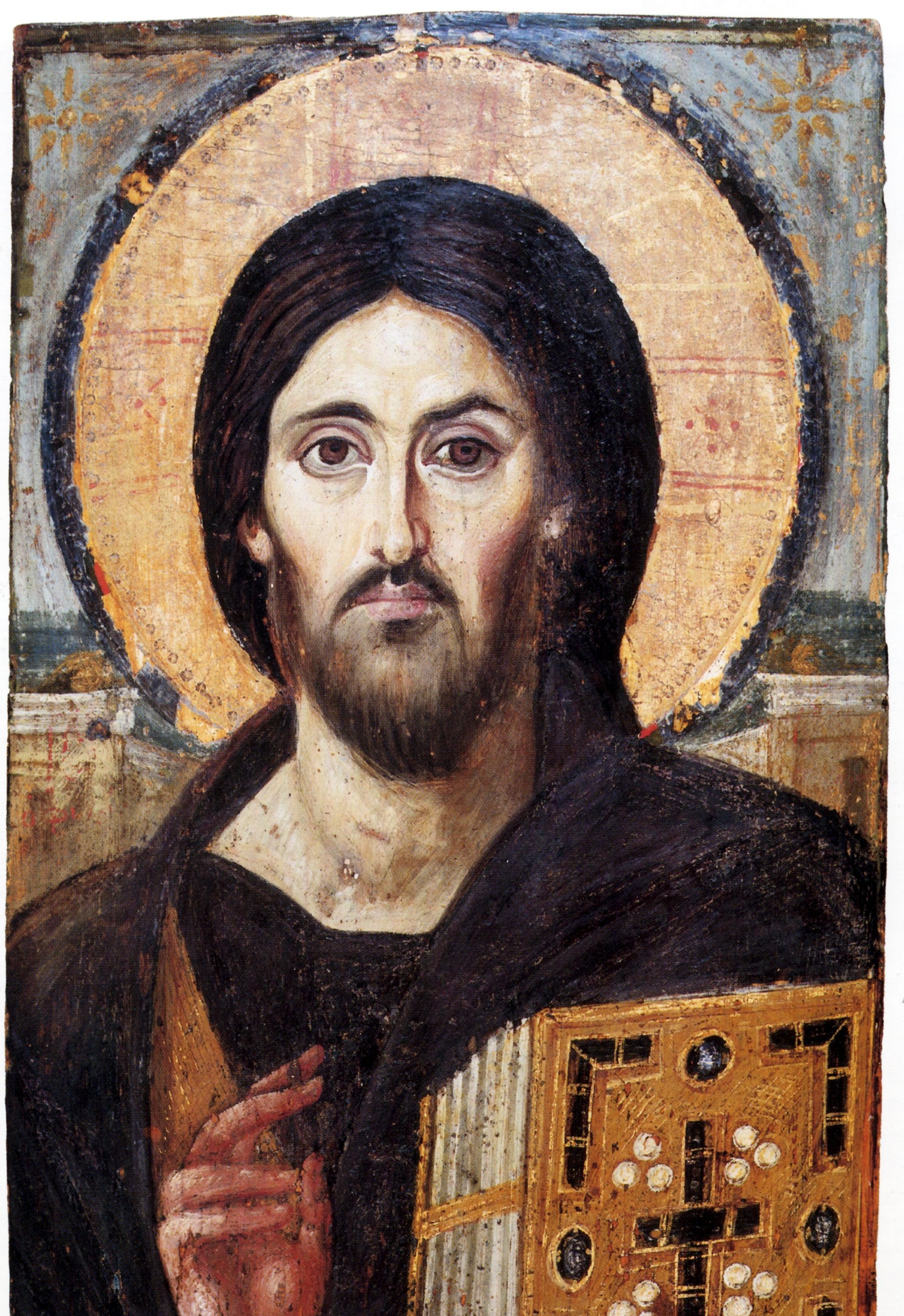
The image at the top of this page is the Christ Pantocrator (in Greek, “the ruler of all”) of Saint Catherine’s Monastery at the foot of Mount Sinai, one of the oldest Christian icons known. It was painted in encaustic, with hot wax mixed into the pigment; a study in 1962 placed it in the mid-sixth century. The monastery was founded by Justinian, and the icon may have been an imperial gift.
It escaped the destruction of icons in the eighth and ninth centuries because Sinai was by then beyond the reach of Constantinople. It is eighty-four centimetres high and has been cut down at the top and sides. Christ blesses with his right hand and holds the Gospel book in his left: a King who rules by blessing and by speaking.
- King by nature. He is the Son of God made man; the kingdom belongs to him by what he is.
- King by conquest. He bought us with his blood; he reigns not by force but by the price he paid.
- A spiritual kingdom. It is entered by faith, Baptism and conversion; his throne, in the Passion, was the cross.
- A kingdom over all. It takes in persons, families and nations, and no part of our life is left outside it.
“Documents, as a rule, reach a few, the more learned; feasts move and teach all the faithful. The former speak once; the latter speak every year and, so to say, for ever.”— Pius XI, encyclical Quas primas (1925), no. 21
“What happiness we might enjoy, if individuals, families and nations would let themselves be governed by Christ!”— Pius XI, encyclical Quas primas (1925), no. 20
“We are no longer our own, since Christ has bought us at a great price; our very bodies are members of Christ.”— Pius XI, encyclical Quas primas (1925), no. 13
The prayers
Today’s Mass opens with an antiphon taken from the Apocalypse (Rev 5:12 and 1:6), which sings of the King as the Lamb that was slain: the kingship of Christ passes through the cross. Then the Collect of the solemnity, as it stands in the present Roman Missal, in Latin and in translation. To pray the Act of Consecration of the Human Race to Jesus Christ the King, which Pius XI ordered to be renewed every year on this day, see the Christ the King novena.
Dignus est Agnus, qui occisus est, accipere virtutem, et divinitatem, et sapientiam, et fortitudinem, et honorem. Ipsi gloria et imperium in saecula saeculorum.
Worthy is the Lamb that was slain to receive power and divinity, and wisdom, and strength, and honour. To him be glory and dominion for ever and ever.
— Dignus est Agnus
Omnipotens sempiterne Deus, qui in dilecto Filio tuo, universorum Rege, omnia instaurare voluisti, concede propitius, ut tota creatura, a servitute liberata, tuae maiestati deserviat ac te sine fine collaudet. Per Dominum.
Almighty and eternal God, who willed to restore all things in your beloved Son, the King of the universe, graciously grant that the whole creation, set free from bondage, may serve your majesty and praise you without end. Through our Lord.
Amen.
Adveniat regnum tuum. Thy kingdom come — in our homes, in our hearts and in the whole world.
- Christ the King novena — from 13 to 21 November, with the Act of Consecration.
- The Sacred Heart of Jesus — the devotion to which today’s consecration is bound.
- The Presentation of Mary, yesterday, and Saint Andrew, on the 30th, already in Advent.
- Words of the saints — a growing collection, in English and Portuguese.

Comments