Today, 24 November, the traditional calendar of the Church (that of the 1962 Roman Missal) keeps the feast of Saint John of the Cross, priest and Doctor of the Church. In the current calendar his memorial falls on 14 December, the day of his death. He was a friar so small he could barely be seen among the others; he spent nine months locked in a cell with almost no light; and when Christ asked him what reward he wanted for all his labours, he answered in four Latin words: Domine, pati et contemni pro te — “Lord, to suffer and to be despised for you”.
The weaver’s son
Juan de Yepes was born in 1542 at Fontiveros, a village near Ávila in Old Castile. His father, Gonzalo de Yepes, came from a noble family of Toledo, who disowned him for marrying Catalina Álvarez, a poor weaver. Gonzalo died young, and his widow had to raise the children in poverty. When John was nine the family moved to Medina del Campo, a market town near Valladolid.
There the boy went to a school for poor children, worked as a nurse in the Hospital of the Conception caring for the poorest of the sick, and, for his ability, was admitted to the newly founded Jesuit college, where he studied the humanities, rhetoric and the classical languages. At twenty-one, in 1563, he joined the Carmelites of Medina, taking the name Brother John of Saint Matthias. He studied at Salamanca and was ordained priest in 1567. At the time he was thinking of leaving Carmel for the stricter life of the Carthusians.
Meeting Teresa
It was then, still in 1567 and in Medina del Campo, that he met Saint Teresa of Jesus, the Mother of Ávila, who had come to the town to found a convent of nuns. Teresa was fifty-two; he was twenty-five. She told him of her plan to bring to the friars the reform she was already making among the nuns — a return to the primitive Rule of Carmel, without its mitigations — and persuaded him to stay.
On 28 November 1568, in a poor little house at Duruelo, in the countryside of Ávila, John and two companions began the first community of Discalced Carmelite friars. On renewing their profession each took a new name. From then on he was John of the Cross. In 1572, at Teresa’s request, he became confessor to the monastery of the Incarnation in Ávila, where she was prioress. These were years of working side by side and of a spiritual friendship that marked them both.
The night of Toledo
The reform divided the Order. On the night of 2–3 December 1577, friars of the older observance seized John and took him to the Carmelite priory in Toledo. He spent more than nine months in a narrow, stifling cell with little light and little food, and with public punishments. It was there, in prison, that he composed much of the Spiritual Canticle, one of the masterpieces of Spanish poetry.
On the night of 16–17 August 1578 he escaped — by the accounts, climbing down a rope made of strips of blanket — and hid in the convent of the Discalced Carmelite nuns in the city. The lines of the Dark Night — “I went out unseen, my house being now at rest” — are not an account of the escape, but it is hard to read them without thinking of it.
The night, the ascent and the flame
John’s last thirteen years were spent mostly in Andalusia — Baeza, Granada, Córdoba — and then in Segovia, founding and governing houses and directing souls. In that time, to explain his own poems, he wrote four great works: the Ascent of Mount Carmel, the Dark Night, the Spiritual Canticle and the Living Flame of Love.
His teaching fits in a line: to be filled with God, the soul must empty itself of self. Not out of contempt for created things — everything God made is good, as Benedict XVI recalls in the catechesis he devoted to him — but to uproot every disordered attachment. Part of that work belongs to the soul; the deepest part only God can do, through the dark night, when the soul finds no sweetness in anything and God seems to have hidden himself. For John that night is no punishment: it is God’s own love purifying, like the fire that first blackens green wood and makes it hiss, and then turns it into flame.
- Mystical Doctor. Pius XI declared him a Doctor of the Church in 1926; tradition calls him Doctor mysticus.
- Reformer of Carmel. With Saint Teresa, the first Discalced Carmelite friar.
- Poet. Counted among the greatest lyric poets of the Spanish language; since 1952, patron of Spanish poets.
- Master of the night. He taught that the darkness of faith is not God’s absence but the road by which he leads.
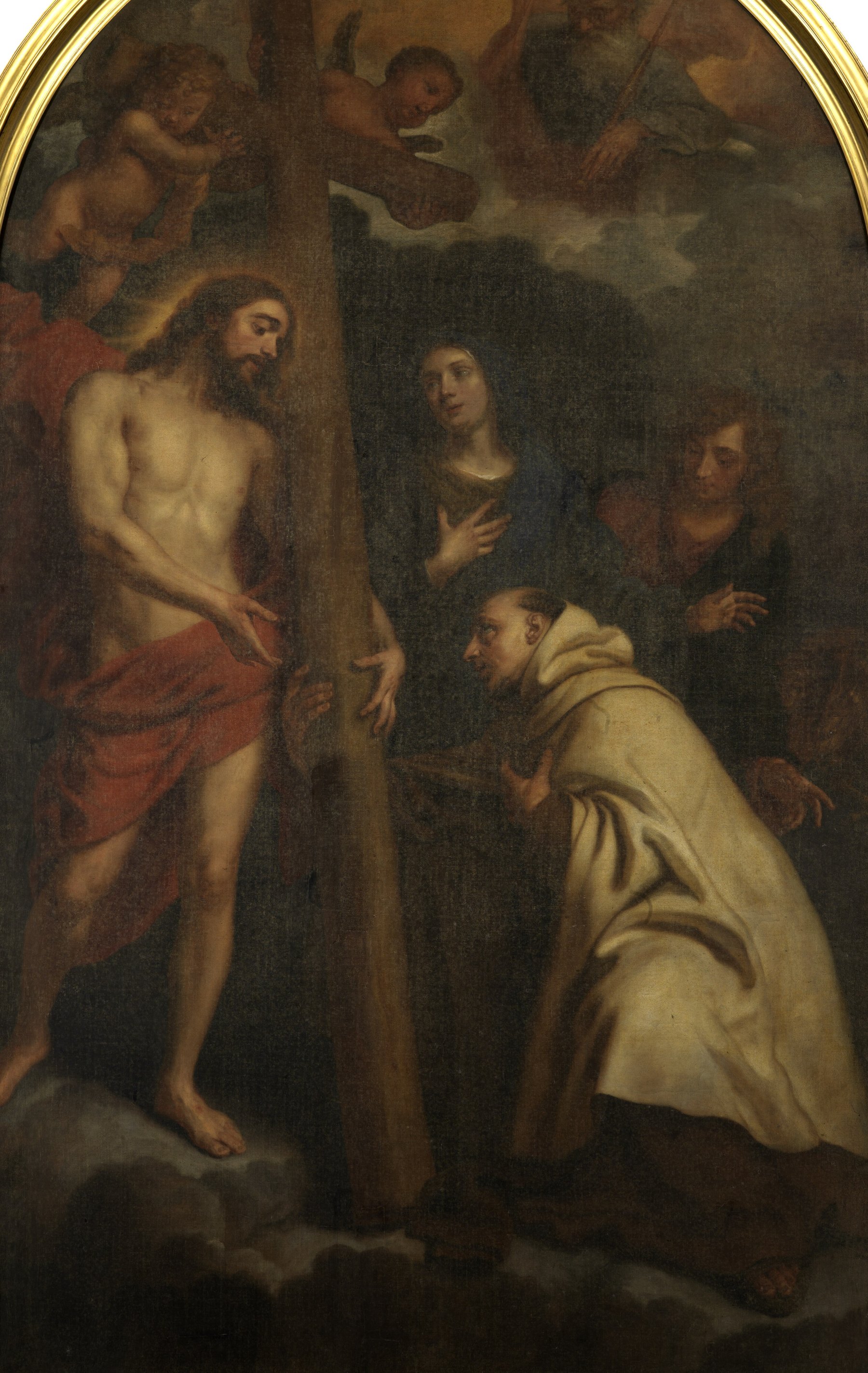
The picture on this page, by the Flemish painter Pieter Thijs, hangs in the Royal Museum of Fine Arts in Antwerp. It shows the scene told in the old Roman Breviary, in the lesson for today’s feast: Christ, holding the cross, asks the kneeling friar what prize he wants for his labours, and John answers: “Lord, to suffer and to be despised for you”. Tradition places the dialogue in Segovia, before an image of Christ carrying the cross. Our Lady and Saint John the Evangelist look on; above, the Father and the Holy Spirit.
Another image linked to the saint became famous in the twentieth century: a tiny pen drawing of Christ crucified seen from above, made by John himself and kept at the monastery of the Incarnation in Ávila. It inspired Salvador Dalí’s Christ of Saint John of the Cross (1951), now in Glasgow.
“Today I am going to sing the Office in heaven”
In 1591, amid the internal disputes of the reform, John lost all his offices and was sent to a remote friary in the Sierra Morena, near Jaén. He fell gravely ill, with open sores on one leg, and was taken to Úbeda, where the prior at first treated him harshly. He died there on the night of 13–14 December 1591, while the friars were reciting Matins, aged forty-nine. He took leave of them, tradition says, saying that he was going to sing the Office in heaven; his last words were those of Christ: In manus tuas, Domine, commendo spiritum meum.
His body was taken to Segovia, where it rests today. Clement X beatified him in 1675, and Benedict XIII canonised him on 27 December 1726. Pius XI declared him a Doctor of the Church in 1926.
“In the evening you will be examined in love.”— Saint John of the Cross, Sayings of Light and Love, 57; quoted in the Catechism of the Catholic Church, §1022
“Lord, to suffer and to be despised for you.”— Saint John of the Cross’s answer to Christ, according to the Roman Breviary, feast of 24 November, lesson VI
“O night that joined Beloved with beloved, beloved in the Beloved transformed!”— Saint John of the Cross, The Dark Night, stanza 5
The prayers
The traditional Collect of the feast asks for exactly what John lived: that, following him, we may learn to love self-denial and the Cross. Here is the Latin text with a translation.
Deus, qui sanctum Ioannem Confessorem tuum atque Doctorem perfectae sui abnegationis et Crucis amatorem eximium effecisti: concede; ut, eius imitationi iugiter inhaerentes, gloriam assequamur aeternam. Per Dominum.
O God, who made Saint John, your Confessor and Doctor, an outstanding lover of perfect self-denial and of the Cross: grant that, holding fast always to his example, we may attain to eternal glory. Through our Lord.
Amen.
And, to pray in the saint’s own words, the first and fifth stanzas of the Dark Night, in the original Spanish and a faithful translation.
En una noche oscura,
con ansias, en amores inflamada,
¡oh dichosa ventura!,
salí sin ser notada,
estando ya mi casa sosegada.
¡Oh noche que guiaste!
¡Oh noche amable más que el alborada!
¡Oh noche que juntaste
Amado con amada,
amada en el Amado transformada!
On a dark night,
with longings, kindled into love,
O happy chance!
I went out unseen,
my house being now at rest.
O night that guided me!
O night more lovely than the dawn!
O night that joined
Beloved with beloved,
beloved in the Beloved transformed!
Sancte Ioannes a Cruce, ora pro nobis.
Sancte Ioannes a Cruce, ora pro nobis. Saint John of the Cross, pray for us.
- Saint Teresa of Ávila — the Mother of the reform, and her prayer, Let nothing disturb you.
- Flos Carmeli and Our Lady of Mount Carmel and the scapular — the Order of Saint John of the Cross.
- Saint Catherine of Alexandria, tomorrow, the 25th.
- Words of the saints — a growing collection, in English and Portuguese.

Comments