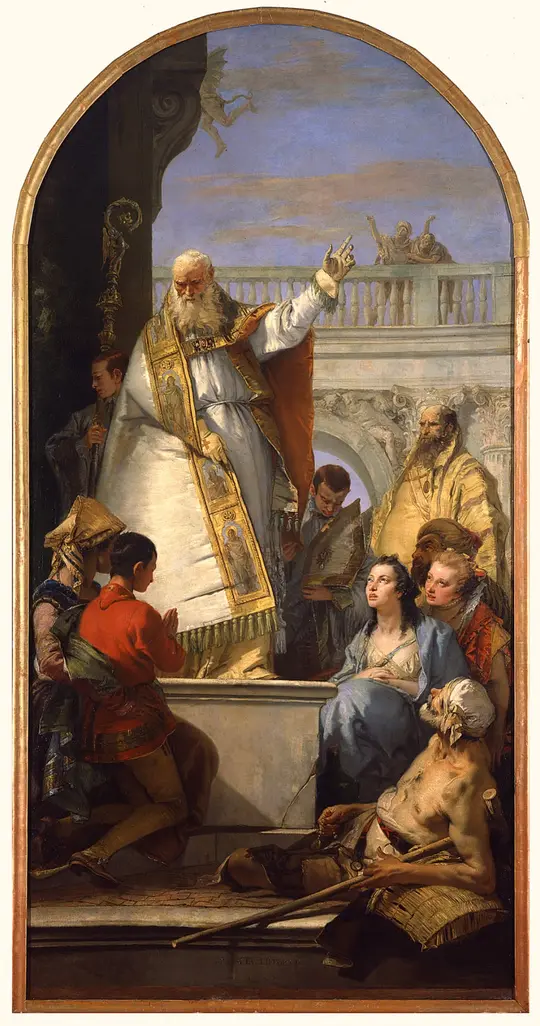
17 March · St Patrick, bishop, apostle of Ireland
St Patrick's Day: prayers, history and the man behind the legends
On 17 March the Church keeps the feast of St Patrick, the fifth-century bishop who brought the faith to Ireland. In Ireland it is a solemnity and a holy day of obligation; in the Irish diaspora, from Boston to Sydney, it is the one saint's day that almost everyone notices.
Behind the parades there is a real man who left us two short writings in his own hand. This page lets him speak for himself, separates what we know from what legend added later, explains how the feast falls in Lent 2027, and gathers the prayers most closely tied to him, with links to the full texts on the site.
Who St Patrick really was
Almost everything certain about Patrick comes from two Latin texts he wrote himself in the fifth century: the Confessio, an account of his life and calling written towards the end of it, and the Letter to the soldiers of Coroticus, a fierce protest against a British warlord whose men had killed and enslaved newly baptized Irish Christians. Everything else, including the great medieval Lives, was written centuries later.
From the Confessio we learn that Patrick was a Briton from a Christian family. His father, Calpornius, was a deacon and his grandfather, Potitus, a priest; they lived near a place he calls Bannavem Taburniae, which no one has been able to identify with certainty. At about sixteen he was seized by raiders and taken to Ireland as a slave, with thousands of others. He spent six years there tending flocks, and it was there, he says, that he turned to God in earnest. Warned in a dream that a ship was ready, he escaped, walked a long way to the coast and got home to Britain.
Years later, back with his family, he dreamed that a man called Victoricus came from Ireland with countless letters, and in one of them he heard the voice of the Irish calling him back. He returned as a bishop and spent the rest of his life preaching, baptizing and ordaining clergy in Ireland, at real risk to himself. Tradition places his death on 17 March; the year is uncertain, and the two dates most often given are 461 and 493.
St Patrick in his own words
These short passages are our own translations from Patrick's Latin. The numbers are the section numbers used in modern editions.
Confessio 1
Ego Patricius peccator rusticissimus et minimus omnium fidelium et contemptibilissimus apud plurimos…
“I, Patrick, a sinner, the most unlearned of men, the least of all the faithful and utterly despised in the eyes of many…”
Confessio 16
“After I came to Ireland I was pasturing flocks every day, and many times a day I prayed. More and more the love of God and the fear of him came to me, and faith grew and the spirit was stirred, so that in a single day I said as many as a hundred prayers, and at night nearly as many, even while I was staying in the woods and on the mountain. Before daylight I would be roused to prayer, in snow, in frost, in rain, and I felt no harm.”
Confessio 23
“…and they cried out as with one voice: ‘We beg you, holy boy, to come and walk among us once more.’ And I was deeply moved in heart, and could read no further, and so I woke up.”
Confessio 41
“How has it come about in Ireland that those who never had any knowledge of God, and until now always worshipped only idols and unclean things, have lately become a people of the Lord and are called children of God, and that the sons of the Irish and the daughters of their chieftains are seen to be monks and virgins of Christ?”
Confessio 62
Et haec est confessio mea antequam moriar.
“And this is my confession before I die.”
Letter to the soldiers of Coroticus 1
“I, Patrick, a sinner, unlearned indeed, established in Ireland, declare that I am a bishop. I am entirely certain that what I am, I have received from God.”
Legend and history: shamrocks and snakes
Patrick never mentions the shamrock, and neither do the early Lives. Irish copper coins of the 1670s appear to show the saint preaching with a shamrock in his hand, and a travel journal of 1681 records the Irish wearing shamrocks on 17 March. The oldest written source usually cited for the story that he used the three-leafed plant to explain the Holy Trinity is the botanist Caleb Threlkeld, in 1726, who speaks of it as a current tradition. It may preserve an old oral memory, but it cannot be traced back to Patrick himself. As a picture of one God in three Persons it remains a fine catechism lesson, as long as it is not taken too literally.
Ireland had no snakes long before Patrick: Roman-era writers such as Solinus already noted it, and naturalists explain it by the island's separation from the mainland after the last Ice Age. The tale of Patrick driving every venomous creature into the sea appears at the end of the twelfth century: Jocelin of Furness tells it in the Life of the saint he wrote around 1200, and Gerald of Wales, in 1188, already mentioned it as a pious conjecture, preferring a natural explanation. Many read it as an image of the old paganism giving way to the Gospel, which is something Patrick really did see happen, as he says in Confessio 41.
St Patrick's Day in Lent: 2027
In 2027, 17 March falls on a Wednesday in the fifth week of Lent. In Ireland it is a solemnity and a holy day of obligation, so the Mass is that of St Patrick and the faithful are bound to attend Mass. In the general Roman calendar, used in most other countries, St Patrick is an optional memorial; on a weekday of Lent it can only be kept as a commemoration, with the collect of the saint said at the weekday Mass, unless a local calendar ranks it higher.
Because 17 March 2027 is not a Friday, the question of Friday abstinence does not arise this year. In years when it does fall on a Friday, the answer depends on where you are: where the day is a solemnity, as in Ireland, the law of abstinence does not apply (Code of Canon Law, can. 1251); elsewhere it is for the local bishop to grant a dispensation, as many have done in past years, so check your own diocese. Where it is a solemnity and 17 March falls in Holy Week, the feast is moved: in 2008 the Irish bishops kept it on 15 March.
Two days later, on Friday 19 March 2027, comes the solemnity of St Joseph, and since it is a solemnity the Friday abstinence does not apply that day anywhere in the Church.
St Patrick's Breastplate
The prayer most often called “St Patrick's prayer” is the Breastplate, or Lorica, also known as The Deer's Cry: “Christ with me, Christ before me, Christ behind me…”. It is written in Old Irish and survives in an eleventh-century collection of Irish hymns. Tradition ascribes it to Patrick himself, though scholars date the text to around the eighth century and regard it as the work of a later Irish churchman. Whoever wrote it, it is one of the great prayers of protection of the Christian West and the natural prayer for 17 March. The full text, with the Old Irish and an English translation, is on its own page.
The hymn “Hail, Glorious St Patrick”
The best-known hymn to the saint was written by an Irish Sister of Mercy, Sister Agnes, born Eliza McSweeney in Cobh, County Cork, who entered the Mercy convent at Charleville in the 1840s. It first appears around 1853 as No. 14 in a collection called Easy Hymns, attributed to “Sister Agnes, of the Convent of Charleville”. She later went out with the first Mercy Sisters to Bathurst, in New South Wales, and died in Australia in the early 1900s. Here is the first verse as printed in Cardinal Moran's Catholic Prayer Book of 1883:
Hail, glorious St. Patrick, dear Saint of our isle!
On us, thy poor children, bestow a sweet smile;
And now thou art high in the mansions above,
On Erin's green valleys look down in thy love.
In congregational singing the last line is usually repeated as a refrain.
A traditional prayer to St Patrick
The collect of St Patrick's Mass in the older Roman Missal is a short and sober prayer that anyone can make their own on 17 March. Here is the Latin with our own translation:
Deus, qui ad praedicandam gentibus gloriam tuam beatum Patricium Confessorem atque Pontificem mittere dignatus es: eius meritis et intercessione concede; ut, quae nobis agenda praecipis, te miserante adimplere possimus. Per Dominum nostrum Iesum Christum Filium tuum, qui tecum vivit et regnat in unitate Spiritus Sancti, Deus, per omnia saecula saeculorum. Amen.
O God, who didst vouchsafe to send blessed Patrick, thy Confessor and Bishop, to preach thy glory to the nations: grant, through his merits and intercession, that what thou commandest us to do, we may by thy mercy be able to fulfil. Through our Lord Jesus Christ, thy Son, who liveth and reigneth with thee in the unity of the Holy Spirit, God, for ever and ever. Amen.
Patrick's own words also make a good prayer. In one long passage of thanksgiving (Confessio 34) he asks: “Who am I, Lord, and what is my calling, that you should have wrought with me with so great divine power?”
Frequently asked questions
Is St Patrick's Day a holy day of obligation?
In Ireland, yes: it is a solemnity and one of the country's holy days of obligation, so Catholics there are bound to attend Mass. In most other countries it is an optional memorial and there is no obligation, though going to Mass is still the best way to keep the day.
Can Catholics eat meat on St Patrick's Day during Lent?
In 2027 the question does not arise, because 17 March is a Wednesday. When it falls on a Friday, abstinence does not apply where the day is a solemnity, as in Ireland; elsewhere it depends on whether your bishop grants a dispensation, so check your diocese.
Did St Patrick really use the shamrock to explain the Trinity?
There is no early evidence for it. Patrick never mentions the shamrock, and the earliest written form of the story usually cited dates from 1726. It may echo an older oral tradition, but it is a legend rather than history.
What did St Patrick actually write?
Two Latin works survive that are accepted as his own: the Confessio and the Letter to the soldiers of Coroticus, both from the fifth century. The Breastplate is traditionally ascribed to him, but scholars date the text to a later period.
Liturgical season
Lent and Holy Week
- Lent 2027Fasting, abstinence, dates and prayers
- Stations of the CrossSt Alphonsus, all 14 stations
- MisererePsalm 51 in Latin and English
- Seven Sundays of St Joseph31 January to 14 March
- Divine Mercy Sunday4 April 2027