Second Sunday of Easter · 4 April 2027
Divine Mercy Sunday: the feast, the plenary indulgence and the prayers
The Second Sunday of Easter, eight days after the Resurrection, has a second name in the Church: Divine Mercy Sunday. In 2027 Easter falls on 28 March, so the feast is kept on 4 April. On that day the Gospel tells how the risen Jesus came through locked doors to the disciples, wished them peace and gave them the power to forgive sins (John 20:19-31).
This page gathers what you need to keep the day well: where the feast comes from, who St Faustina was, what the decree granting the plenary indulgence actually says, what the image and the three o'clock hour mean, and how to pray the chaplet and the novena that prepare for it.
How the feast began
On 30 April 2000, the Second Sunday of Easter, St John Paul II canonized the Polish nun Maria Faustina Kowalska in Rome. In his homily he announced that this Sunday would from then on be called Divine Mercy Sunday throughout the Church. A few days later, on 5 May 2000, the decree Misericors et miserator of the Congregation for Divine Worship and the Discipline of the Sacraments added the name to the Sunday's title in the Roman Missal.
It is not a new feast replacing the octave day of Easter: the readings and prayers of the Mass remain those of the Second Sunday of Easter. The name underlines what the day already celebrates, the mercy of the risen Christ who forgives and gives peace.
The day is also bound up with John Paul II himself. He died on Saturday evening, 2 April 2005, when the vigil of Divine Mercy Sunday had already begun. He was beatified on 1 May 2011 and canonized on 27 April 2014, both on that same Sunday.
St Faustina and the image “Jesus, I trust in You”
Helena Kowalska was born in 1905 into a poor family in rural Poland and entered the Congregation of the Sisters of Our Lady of Mercy, taking the name Sister Maria Faustina. She worked as a cook, gardener and porter in several of its houses and died of tuberculosis in Kraków on 5 October 1938, aged 33. At the request of her confessors she wrote down her spiritual experiences, later gathered in the book known as her Diary.
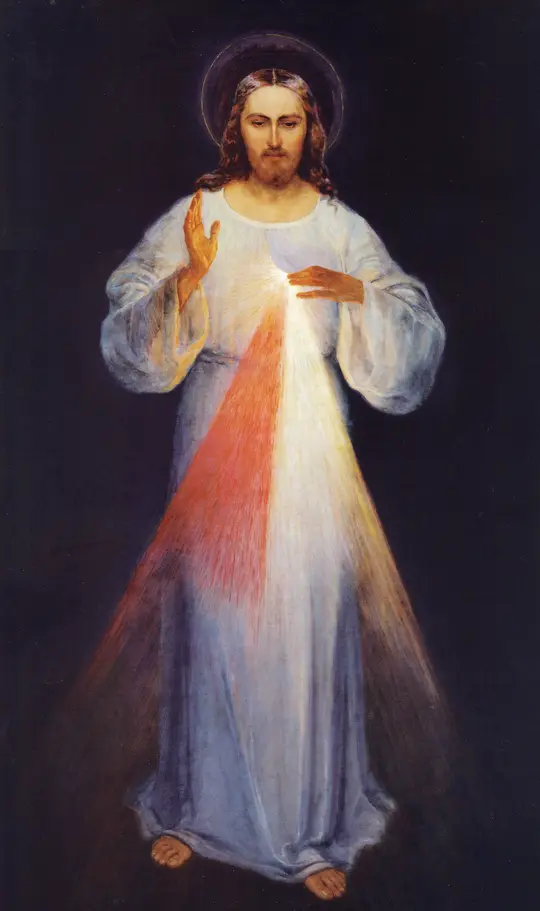
By her account, on the night of 22 February 1931, in the convent at Płock, she saw Jesus clothed in white, one hand raised in blessing and the other touching his breast, from which came two rays, one pale and one red, which she understood as the water and blood that flowed from the pierced side of Christ. Jesus asked her to have the image painted with the words “Jesus, I trust in You” (in Polish, Jezu, ufam Tobie). She could not paint; the first picture was made in Vilnius in 1934 by the painter Eugeniusz Kazimirowski, under the direction of Faustina and her confessor, Fr Michał Sopoćko.
On Divine Mercy Sunday many parishes set up the image for veneration. The words of the inscription, “Jesus, I trust in You”, are the simplest prayer of the whole devotion and can be said at any moment.
The plenary indulgence of Divine Mercy Sunday
On 29 June 2002 the Apostolic Penitentiary published, with the approval of John Paul II, a decree granting indulgences connected with this Sunday. The decree was given perpetual force, so it applies every year, including 2027.
A plenary indulgence is granted on the Second Sunday of Easter, under the usual conditions, to anyone who does one of these two things:
1. Takes part, in any church or chapel, in prayers and devotions held in honour of Divine Mercy; or
2. In the presence of the Blessed Sacrament, exposed or reserved in the tabernacle, recites the Our Father and the Creed, adding a devout prayer to the merciful Lord Jesus, for example: “Merciful Jesus, I trust in You!”
The decree also asks for a spirit completely detached from attachment to any sin, even venial. Under the general norms on indulgences, without that detachment, or without one of the conditions, the indulgence is only partial. The same decree grants a partial indulgence to anyone who, at least with a contrite heart, prays to the merciful Lord Jesus a legitimately approved invocation.
The usual conditions
The usual conditions are three: sacramental confession, Eucharistic communion and prayer for the Pope's intentions (an Our Father and a Hail Mary suffice, though another prayer may be chosen). Confession and Communion may be made some days before or after the Sunday, but it is fitting to receive Communion on the day itself.
Those who cannot get to church
The decree names sailors at sea, those driven from their homeland by war, political upheaval, local violence and similar causes, the sick and those who nurse them, and all who for a just cause cannot leave home or are doing work for the community that cannot be put off. They can gain the plenary indulgence on that Sunday if, detesting all sin and intending to fulfil the three conditions as soon as possible, they recite the Our Father and the Creed before a devout image of the merciful Lord Jesus, with a devout invocation. If even that is impossible, they may unite themselves in spirit with those carrying out the prescribed practice and offer God their prayers and sufferings, with the same intention of fulfilling the conditions later.
The decree further asks priests, especially parish priests, to make the provision known, to hear confessions generously, and to lead the prescribed prayers on the Sunday after Mass or Vespers.
The Hour of Mercy and the Divine Mercy Chaplet
In St Faustina's writings Jesus asks that at three in the afternoon, the hour he died on the cross, his Passion be remembered and mercy be begged for the world, above all for sinners. Many parishes gather at that hour on Divine Mercy Sunday; anyone who cannot get to church can stop wherever they are, even for a moment.
The prayer most closely tied to that hour is the Chaplet of Divine Mercy, which St Faustina received in Vilnius in 1935. It is prayed on ordinary rosary beads: on the large beads, the offering to the Father of the Body and Blood, Soul and Divinity of Jesus; on the small beads, “for the sake of his sorrowful Passion, have mercy on us and on the whole world”. The full text and how to pray it are on the chaplet page.
The novena that begins on Good Friday
According to the Diary, Jesus asked St Faustina for a novena beginning on Good Friday and ending on the Saturday before Divine Mercy Sunday. In 2027 it runs from 26 March to 3 April. Each day has its own intention, and the usual practice is to say the prayer of the day followed by the Divine Mercy Chaplet.
The nine intentions, in brief: day 1, all mankind, especially sinners; day 2, priests and religious; day 3, devout and faithful souls; day 4, those who do not believe in God and those who do not yet know Jesus; day 5, those separated from the Church; day 6, the meek and humble and little children; day 7, those who venerate and proclaim God's mercy; day 8, the souls in Purgatory; day 9, lukewarm souls.
The daily prayers belong to St Faustina's Diary, whose text is under copyright, so we do not reproduce it here. It can be found in the authorized editions of the Diary and in many parish leaflets. Anyone without the text can pray the chaplet each day for the intention of that day. The novena is not a condition for the plenary indulgence.
Preparing with confession
The Gospel of this Sunday is the institution of the sacrament of penance: “Receive ye the Holy Ghost. Whose sins you shall forgive, they are forgiven them” (John 20:22-23, Douay-Rheims). The best preparation for the feast is a good confession, made in Holy Week or during the Easter octave, which also counts as one of the conditions for the indulgence.
Because queues are often long in the days before Easter, it is worth going to confession early, in the last weeks of Lent.
Frequently asked questions
When is Divine Mercy Sunday in 2027?
It is always the Second Sunday of Easter, eight days after the Resurrection. In 2027 Easter is on 28 March, so Divine Mercy Sunday falls on 4 April. The novena that prepares for it begins on Good Friday, 26 March.
What are the conditions for the plenary indulgence?
Sacramental confession, Eucharistic communion, prayer for the Pope's intentions and detachment from all sin, even venial. On the Sunday itself you take part in prayers in honour of Divine Mercy in a church or chapel, or before the Blessed Sacrament recite the Our Father and the Creed with an invocation such as “Merciful Jesus, I trust in You!”
Can the sick and housebound gain the indulgence?
Yes. The 2002 decree allows them to recite the Our Father and the Creed before an image of the merciful Lord Jesus, with a devout invocation, and to make their confession and Communion as soon as they can. If even that is impossible, it is enough to unite themselves in spirit with those who pray and offer God their prayers and sufferings.
Do I have to pray the novena to gain the indulgence?
No. The novena and the chaplet are recommended devotions to prepare for the feast, but the Apostolic Penitentiary's decree asks only for the works proper to the Sunday and the usual conditions.
Liturgical season
Lent and Holy Week
- Lent 2027Fasting, abstinence, dates and prayers
- Stations of the CrossSt Alphonsus, all 14 stations
- MisererePsalm 51 in Latin and English
- Seven Sundays of St Joseph31 January to 14 March
- St Patrick's Day17 March