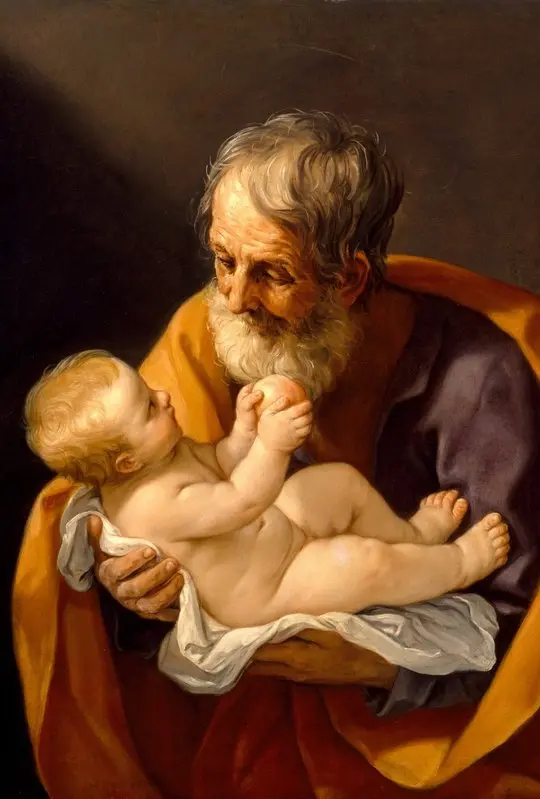
31 January to 14 March 2027 · preparing for the solemnity of 19 March
The Seven Sundays of St Joseph: the sorrows and joys of Mary's spouse
Before the solemnity of St Joseph on 19 March there is an old and simple custom: to give him the seven Sundays that come before it. Each Sunday one of the seven sorrows and one of the seven joys Joseph lived beside Jesus and Mary is pondered, drawn mostly from the Gospels of the infancy, and a proper prayer is said, followed by an Our Father, a Hail Mary and a Glory Be.
This page brings together what you need: where the devotion comes from, the 2027 dates, the full text of the seven traditional prayers, the closing prayer and where to go next to keep praying to St Joseph on this site.
What the Seven Sundays devotion is
Joseph's life as the Gospels tell it is a sequence of trials and consolations that follow close upon each other: his doubt about Mary's pregnancy and the angel's revelation; the poverty of Bethlehem and the song of the angels; the flight into Egypt and the quiet life at Nazareth. The devotion gathers these episodes into seven pairs of sorrow and joy and proposes one pair for each Sunday.
The most common custom is to keep the seven Sundays before 19 March as a preparation for the feast. But the devotion is not tied to that date: since the nineteenth century the sources speak of any seven consecutive Sundays of the year. Traditionally those who make it try to receive Holy Communion on each of the seven Sundays and offer it in honour of St Joseph.
Where it comes from: the tradition of the two friars
The origin of the devotion is told in a pious story with no secure historical documentation. According to tradition, two Franciscan friars were shipwrecked off the coast of Flanders and spent days clinging to a plank, praying to St Joseph. A man of venerable appearance is said to have appeared, brought them safely to land and, as he left, told them he was Joseph and asked them to honour his sorrows and joys each day with seven Our Fathers and seven Hail Marys. The account is usually attributed to Giovanni da Fano, a Franciscan friar who later joined the Capuchins, in the sixteenth century, and it was widely retold in the nineteenth.
Whatever its exact origin, the idea of looking at Joseph's life through his sorrows and joys is old and rests on the Gospel. The form prayed today, with a prayer for each pair, is the one found in the Raccolta, the Roman collection of indulgenced prayers, published in Italian and translated into English in the nineteenth century.
Indulgences: then and now
The 1910 English edition of the Raccolta records grants by Pius VII (1819, through the Cardinal Vicar of Rome), Gregory XVI (1836) and Pius IX (1847) for the prayers of the seven sorrows and joys. Among them was a plenary indulgence on each of the seven Sundays for those who said the prayers on seven consecutive Sundays at any time of the year. The same source adds that those who could not read, where the devotion was not practised publicly, might say seven Our Fathers, Hail Marys and Glory Bes instead.
Those grants are no longer in force in that form. In 1967 St Paul VI reformed the discipline of indulgences (apostolic constitution Indulgentiarum doctrina): the reckoning in days and years was dropped, and the grants now in force are those of the Enchiridion of Indulgences. The current Enchiridion (4th edition, 1999) has no grant of its own for the Seven Sundays; it does, however, grant a partial indulgence to the faithful who invoke St Joseph with a duly approved prayer, giving Leo XIII's prayer (To thee, O blessed Joseph) as its example. The devotion remains entirely commendable for what it is: a school of prayer with the Gospel in hand.
The 2027 calendar
In 2027, 19 March falls on a Friday, in the fifth week of Lent. The seven Sundays before it are:
1st Sunday: 31 January
2nd Sunday: 7 February
3rd Sunday: 14 February (First Sunday of Lent; Ash Wednesday is 10 February)
4th Sunday: 21 February (Second Sunday of Lent)
5th Sunday: 28 February (Third Sunday of Lent)
6th Sunday: 7 March (Fourth Sunday of Lent)
7th Sunday: 14 March (Fifth Sunday of Lent)
So five of the seven Sundays fall in Lent, and the devotion joins naturally with the road to Easter, which in 2027 is on 28 March. You may also pray the St Joseph novena from 10 to 18 March, ending on the eve of the solemnity.
There is no fixed rite. A simple way, faithful to the Raccolta, is this: read slowly the Gospel passages given for that Sunday's sorrow and joy; say the proper prayer; say an Our Father, a Hail Mary and a Glory Be; and finish with the antiphon, versicle and closing prayer at the end of this page. Many families say all seven prayers every Sunday; others say only the one for that Sunday. Both ways are traditional.
The prayers below are given as they appear in the 1910 edition of the Raccolta, in the public-domain translation of Ambrose St John.
First Sunday: Joseph's doubt and the angel's message31 January 2027
The sorrow: on learning that Mary was with child, Joseph, being a just man and unwilling to expose her, was minded to put her away privately (Mt 1:19). The joy: in a dream the angel of the Lord told him not to fear to take Mary his wife, for what was conceived in her was of the Holy Spirit (Mt 1:20).
Prayer
Pure spouse of most holy Mary, glorious St Joseph, the trouble and anguish of thy heart were great when, being in sore perplexity, thou wast minded to put away thy stainless spouse; yet was thy joy inexpressible when the Archangel revealed to thee the sublime mystery of the Incarnation. By this thy sorrow and thy joy, we pray thee comfort our souls now and in their last pains with the consolation of a well-spent life, and a holy death like unto thy own, with Jesus and Mary at our side.
Our Father, Hail Mary, Glory Be.
2
Second Sunday: the poverty of the crib and the song of the angels7 February 2027
The sorrow: in Bethlehem there was no room for them in the inn, and Mary laid her newborn Son in a manger (Lk 2:7). The joy: the angel announced to the shepherds good tidings of great joy, the birth of the Saviour, and a multitude of the heavenly host praised God (Lk 2:10-14).
Prayer
Most blessed Patriarch, glorious St Joseph, chosen to the office of Father of the Word made Man, the pain was keen that thou didst feel when thou didst see the Infant Jesus born in abject poverty; but thy pain was changed into heavenly joy when thou didst hear the harmony of angel-choirs, and behold the glory of that night. By this thy sorrow and thy joy, we pray thee obtain for us that, when the journey of our life is ended, we too may pass to that blessed land where we shall hear the angel-chants, and rejoice in the bright light of heavenly glory.
Our Father, Hail Mary, Glory Be.
3
Third Sunday: the Circumcision and the Holy Name14 February 2027
The sorrow: when eight days were accomplished the Child was circumcised (Lk 2:21), and tradition sees in that rite the first shedding of his Blood. The joy: it was Joseph who gave him the name Jesus, as the angel had commanded (Mt 1:21, 25).
Prayer
O thou who wast ever most obedient in executing the law of God, glorious St Joseph, thy heart was pierced with pain when the precious Blood of the Infant Saviour was shed at his Circumcision; but with the Name of Jesus new life and heavenly joy returned to thee. By this thy sorrow and thy joy, obtain for us that, being freed, while we still live, from every vice, we too may cheerfully die with the sweet Name of Jesus in our hearts and on our lips.
Our Father, Hail Mary, Glory Be.
4
Fourth Sunday: the prophecy of Simeon21 February 2027
The sorrow: in the Temple Simeon foretold that the Child would be a sign to be contradicted and that a sword would pierce Mary's soul (Lk 2:34-35). The joy: the same Simeon saw in him the salvation prepared before the face of all peoples, set for the rising again of many in Israel (Lk 2:30-32, 34).
Prayer
Most faithful Saint, glorious St Joseph, who wast admitted to take part in the redemption of man; the prophecy of Simeon foretelling the sufferings of Jesus and Mary caused thee a pang like that of death, but, at the same time, by his prediction of the salvation and glorious resurrection of innumerable souls, filled thee with great joy. By this thy sorrow and thy joy, help us with thy prayers to be of the number of those who, by the merits of Jesus and the intercession of his Virgin Mother, shall be partakers of the resurrection to glory.
Our Father, Hail Mary, Glory Be.
5
Fifth Sunday: the flight into Egypt28 February 2027
The sorrow: warned in a dream, Joseph arose by night and fled with the Child and his Mother into Egypt, out of reach of Herod (Mt 2:13-14). The joy: tradition reads in the Child's coming into Egypt the fulfilment of Isaiah: the Lord shall enter into Egypt, and the idols of Egypt shall be moved at his presence (Is 19:1).
Prayer
Most watchful Guardian, glorious St Joseph, who wast so intimately familiar with the Incarnate Son of God, greatly thou didst toil to nurture and to serve the Son of the Most High, especially in the flight thou madest with Him into Egypt; greatly also didst thou rejoice to have God Himself always with thee, and to see the overthrow of the idols of Egypt. By this thy sorrow and thy joy, obtain for us grace to keep far out of the reach of the enemy of our souls, by quitting all dangerous occasions, that so no idol of earthly affection may any longer occupy a place in our hearts, but that, being entirely devoted to the service of Jesus and Mary, we may live and die for them alone.
Our Father, Hail Mary, Glory Be.
6
Sixth Sunday: the return from Egypt and the life at Nazareth7 March 2027
The sorrow: on the way back from Egypt Joseph heard that Archelaus reigned in Judaea in place of his father Herod, and he was afraid to go there (Mt 2:22). The joy: warned in a dream, he withdrew into Galilee and dwelt in Nazareth, where the Child grew in wisdom and grace (Mt 2:23; Lk 2:39-40, 52).
Prayer
Angel on earth, glorious St Joseph, who didst so wonder to see the King of Heaven obedient to thy bidding, the consolation thou hadst at his return from Egypt was disturbed by the fear of Archelaus, but nevertheless, being reassured by the angel, thou didst go back and dwell happily at Nazareth, in the company of Jesus and Mary. By this thy sorrow and thy joy, obtain for us that, having our hearts freed from idle fears, we may enjoy the peace of a tranquil conscience, dwelling safely with Jesus and Mary, and dying at last in their arms.
Our Father, Hail Mary, Glory Be.
7
Seventh Sunday: the loss and the finding of Jesus in the Temple14 March 2027
The sorrow: returning from the Passover, the Child remained in Jerusalem without his parents knowing, and they sought him sorrowing (Lk 2:43-45, 48). The joy: after three days they found him in the Temple, sitting in the midst of the doctors (Lk 2:46).
Prayer
Example of holy living, glorious St Joseph, when through no fault of thine thou didst lose Jesus, the Holy Child, thou didst search for Him with great sorrow for three days, until with joy unspeakable thou didst find Him, who was thy Life, amidst the doctors in the Temple. By this thy sorrow and thy joy, we pray thee with our whole hearts so to interpose always in our behalf, that we may never lose Jesus by mortal sin, and if we are at any time so wretched as to lose Him, then we pray thee to aid us to seek Him with unwearied sorrow until we find Him, particularly in the hour of our death, that we may pass from this life to enjoy Him for ever in heaven, there to sing with thee his divine mercies without end.
Our Father, Hail Mary, Glory Be.
Closing prayer
Antiphon: Jesus Himself was about thirty years old, being, as was supposed, the son of Joseph (Lk 3:23).
V. Pray for us, holy Joseph.
R. That we may be made worthy of the promises of Christ.
Let us pray. O God, who in thine ineffable providence didst vouchsafe to choose blessed Joseph to be the spouse of thy most holy Mother; grant, we beseech Thee, that we may have him for our intercessor in heaven, whom on earth we venerate as our holy Protector. Who livest and reignest, world without end. Amen.
In Latin
Ant. Ipse Iesus erat incipiens quasi annorum triginta, ut putabatur, filius Ioseph.
V. Ora pro nobis, sancte Ioseph.
R. Ut digni efficiamur promissionibus Christi.
Oremus. Deus, qui ineffabili providentia beatum Ioseph sanctissimae Genitricis tuae sponsum eligere dignatus es: praesta, quaesumus, ut quem protectorem veneramur in terris, intercessorem habere mereamur in caelis. Qui vivis et regnas in saecula saeculorum. Amen.
Keep praying to St Joseph
The Seven Sundays sit well beside the other traditional prayers to St Joseph. The litany, approved by St Pius X in 1909, suits Wednesdays, the weekday popular piety gives to him; Leo XIII's prayer belongs after the Rosary; and the Memorare to St Joseph is a short plea for hard moments.
When do the Seven Sundays of St Joseph start in 2027?
On Sunday 31 January 2027. The others are 7, 14, 21 and 28 February and 7 and 14 March. The solemnity of St Joseph is on Friday 19 March.
Do I have to start exactly seven Sundays before 19 March?
No. That is the most common way, as a preparation for the feast, but the devotion may be made on any seven consecutive Sundays of the year. If you missed the start, you can begin on the next Sunday and complete the seven afterwards.
What is prayed each Sunday?
The proper prayer for that sorrow and joy, followed by an Our Father, a Hail Mary and a Glory Be, and at the end the antiphon, versicle and closing prayer. Many say all seven prayers every Sunday. It is also customary to receive Holy Communion on each of these Sundays in honour of St Joseph.
Is there still an indulgence for the Seven Sundays?
The indulgences granted in the nineteenth century by Pius VII, Gregory XVI and Pius IX are no longer in force in that form, because the discipline was reformed in 1967. The current Enchiridion of Indulgences has no grant of its own for the Seven Sundays, but it grants a partial indulgence to those who invoke St Joseph with a duly approved prayer, such as Leo XIII's To thee, O blessed Joseph.