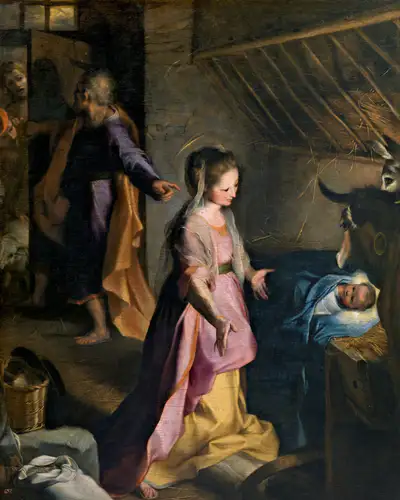
Medieval Christmas carol, 14th century

Medieval Christmas carol, 14th century

Resonet in Laudibus — Let Sion Resound in Praise

The medieval carol that sings: “fulfilled is all that Gabriel foretold”

LatinEnglish

Resonet in laudibus
cum iucundis plausibus
Sion cum fidelibus:
apparuit quem genuit Maria.

Let Sion resound in praises
with joyful acclamation,
together with the faithful:
he has appeared whom Mary bore.

℟. Sunt impleta quae praedixit Gabriel.
Eia, eia, Virgo Deum genuit,
quem divina voluit clementia.
Hodie apparuit, apparuit in Israel:
ex Maria Virgine est natus Rex.

℟. Fulfilled is all that Gabriel foretold.
Eia, eia, the Virgin has brought forth God,
as the divine mercy willed.
Today he has appeared, appeared in Israel:
of the Virgin Mary the King is born.

Christus natus hodie
ex Maria Virgine
sine virili semine:
apparuit quem genuit Maria. ℟.

Christ is born today
of the Virgin Mary,
without the seed of man:
he has appeared whom Mary bore. ℟.

Pueri, concinite,
nato Regi psallite,
voce pia dicite:
apparuit quem genuit Maria. ℟.

Children, sing together,
sing psalms to the new-born King,
say with devout voice:
he has appeared whom Mary bore. ℟.

Sion, lauda Dominum,
Salvatorem hominum,
purgatorem criminum:
apparuit quem genuit Maria. ℟.

Sion, praise the Lord,
the Saviour of men,
who cleanses us from sin:
he has appeared whom Mary bore. ℟.

SourceMedieval Christmas carol, 14th century · The medieval carol that sings: “fulfilled is all that Gabriel foretold”

The history of this prayer

Resonet in laudibus is one of the most widely sung Christmas carols of the Middle Ages in the German lands and Bohemia. The oldest manuscripts date from the mid-fourteenth century: a songbook from the abbey of Seckau in Austria (1345), where it frames the Nunc dimittis at Christmas Compline, and the Moosburg Gradual (about 1360), where it serves as a trope to the Benedicamus Domino. Some twenty stanzas are known in all, arranged differently from one manuscript to another.

The refrain is the heart of the carol: “Fulfilled is all that Gabriel foretold. Eia, eia, the Virgin has brought forth God.” It is Christmas seen from the Annunciation: what the angel promised at Nazareth is fulfilled at Bethlehem. This page follows the form printed in 1582 in Piae Cantiones, with four stanzas, the refrain being sung after each.

Rocking the crib

The “Eia, eia” of the refrain is a cry of joy and also the sound of someone lulling a child. In many German churches the carol seems to have gone with the medieval custom of the Kindelwiegen, the rocking of a cradle holding a figure of the Christ Child. To the same tune is still sung the lullaby “Joseph, lieber Joseph mein” (“Joseph, dearest Joseph mine”), in which Mary asks Joseph to help her rock her Son; in an early fifteenth-century Leipzig manuscript the two songs alternate.

Polyphonists such as Orlande de Lassus, Jacobus Gallus (Handl) and Michael Praetorius wrote motets on it. In English, John Mason Neale wrote “Christ was born on Christmas Day” to the same tune in 1853.

The English on this page is our own, from the Latin.

Frequently asked questions

What does Resonet in laudibus mean?

“Let it resound in praises”: the carol calls on Sion, the people of God, to resound in praise with the faithful, because he has appeared whom Mary bore.

How old is Resonet in laudibus?

It dates from the fourteenth century. The oldest manuscripts, from Seckau (1345) and Moosburg (about 1360), already contain it.

What is the link with “Joseph, lieber Joseph mein”?

They share the same tune. The German lullaby, in which Mary asks Joseph to help her rock the Child, was sung in alternation with the Resonet.

How many verses does Resonet in laudibus have?

It depends on the source: the manuscripts give from three to ten stanzas, some twenty in all. The four given here are those of Piae Cantiones (1582).

More prayers: Advent and Christmas

← All the traditional prayers · Prayers and novenas

Schola Gregoriana · CC BY-SA