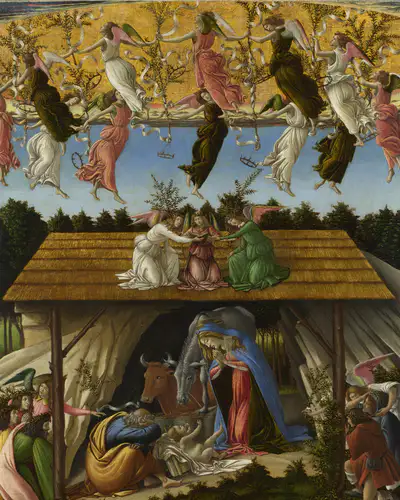
The Order of Mass, the hymn of the angels

The Order of Mass, the hymn of the angels

Gloria in excelsis Deo — Glory be to God on high

The angels’ hymn of Bethlehem, heard again on Christmas night

LatinEnglish

Gloria in excelsis Deo.
Et in terra pax hominibus bonae voluntatis.

Glory be to God on high,
and on earth peace to men of good will.

Laudamus te. Benedicimus te.
Adoramus te. Glorificamus te.
Gratias agimus tibi propter magnam gloriam tuam.

We praise thee. We bless thee.
We adore thee. We glorify thee.
We give thee thanks for thy great glory.

Domine Deus, Rex caelestis,
Deus Pater omnipotens.
Domine Fili unigenite, Iesu Christe.
Domine Deus, Agnus Dei, Filius Patris.

O Lord God, heavenly King,
God the Father Almighty.
O Lord Jesus Christ, the only begotten Son.
O Lord God, Lamb of God, Son of the Father.

Qui tollis peccata mundi, miserere nobis.
Qui tollis peccata mundi, suscipe deprecationem nostram.
Qui sedes ad dexteram Patris, miserere nobis.

Who takest away the sins of the world, have mercy on us.
Who takest away the sins of the world, receive our prayers.
Who sittest at the right hand of the Father, have mercy on us.

Quoniam tu solus Sanctus.
Tu solus Dominus.
Tu solus Altissimus, Iesu Christe.
Cum Sancto Spiritu, in gloria Dei Patris. Amen.

For thou only art holy.
Thou only art the Lord.
Thou only, O Jesus Christ, together with the Holy Ghost,
art most high in the glory of God the Father. Amen.

SourceThe Order of Mass, the hymn of the angels · The angels’ hymn of Bethlehem, heard again on Christmas night

The history of this prayer

The Gloria is the “angelic hymn”: it opens with the words the angels sang to the shepherds on Christmas night — “Glory to God in the highest; and on earth peace to men of good will” (Luke 2:14) — and goes on to praise God the Father and to plead with Christ, the Lamb of God, until it ends in the Holy Trinity. It is also called the “greater doxology”, as distinct from the lesser one, the Glory Be.

Where it comes from

It is a very old hymn, composed in Greek as a morning prayer. One form of it appears in the Apostolic Constitutions (book VII, 47), of the fourth century, and another in the Codex Alexandrinus, a fifth-century manuscript of the Bible. Tradition credits the Latin translation to St Hilary of Poitiers († 367), who may have learned the hymn during his exile in the East; it cannot be proved, but it is quite possible.

The Liber Pontificalis records that Pope St Telesphorus, in the second century, ordered the angelic hymn to be sung at the Mass of Christmas night, and that Pope Symmachus (498–514) extended it to Sundays and the feasts of martyrs, but only at a bishop’s Mass. Priests could say it only at Easter; not until the end of the eleventh century did it pass into every festive Mass. The Liber Pontificalis is not always reliable about the early popes, but the order of things is clear: the Gloria came into the Mass through Christmas.

When it is sung

The Gloria follows the Kyrie on Sundays outside Advent and Lent, on solemnities and on feasts. It falls silent on the Sundays of Advent and Lent and at Requiem Masses; in the traditional rite it is silent too from Septuagesima until Easter. In Rome it was still sung in Advent until the end of the twelfth century; then Advent came to be kept as a season of penance, and the hymn was held back to ring out again on Christmas night, when the Gospel of the Midnight Mass (Luke 2:1-14) ends with the very song of the angels. On Holy Thursday the bells ring during the Gloria and then fall silent until the Easter Vigil, when they ring again at the Gloria.

The English given here is the traditional wording of the old Catholic hand missals, as printed in The Roman Missal for the Use of the Laity (London, 1806). In Church Latin, “excelsis” is said “ek-SHEL-sis” and “caelestis” “chay-LESS-tis”.

Frequently asked questions

What does Gloria in excelsis Deo mean?

“Glory to God in the highest”: the opening words of the angels’ song to the shepherds on Christmas night (Luke 2:14).

Why is the Gloria not sung in Advent and Lent?

Because they are seasons of waiting and penance. The angels’ hymn is held back for Christmas night, when it rings out again at the Midnight Mass; after Lent it returns on Holy Thursday and at the Easter Vigil.

Who wrote the Gloria?

The author is unknown. The hymn is Greek and already existed in the fourth century; tradition credits the Latin translation to St Hilary of Poitiers.

When is the Gloria said at Mass?

Straight after the Kyrie and before the Collect, on Sundays outside Advent and Lent, on solemnities and on feasts.

What is the difference between the Gloria and the Glory Be?

The Glory Be is the lesser doxology, a single sentence that closes the psalms and the decades of the Rosary. The Gloria in excelsis is the greater doxology, the long hymn of the Mass.

More prayers: At Mass, in Latin

← All the traditional prayers · Prayers and novenas

Schola Gregoriana · CC BY-SA