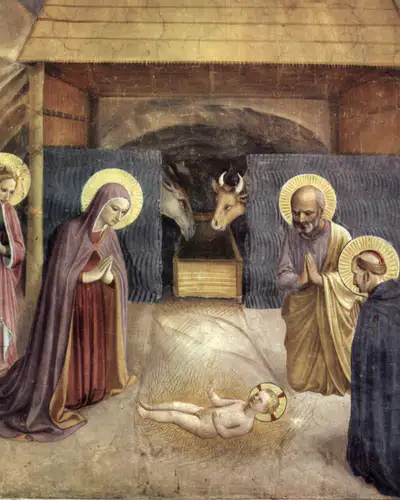
Corde natus ex parentis
Ante mundi exordium
A et O cognominatus,
ipse fons et clausula
Omnium quae sunt, fuerunt,
quaeque post futura sunt.
Saeculorum saeculis.
Of the Father’s love begotten,
Ere the worlds began to be,
He is Alpha and Omega,
He the source, the ending He,
Of the things that are, that have been,
And that future years shall see,
Evermore and evermore!
Ipse iussit et creata,
dixit ipse et facta sunt,
Terra, caelum, fossa ponti,
trina rerum machina,
Quaeque in his vigent sub alto
solis et lunae globo.
Saeculorum saeculis.
At His Word the worlds were framèd;
He commanded; it was done:
Heaven and earth and depths of ocean
In their threefold order one;
All that grows beneath the shining
Of the moon and burning sun,
Evermore and evermore!
Corporis formam caduci,
membra morti obnoxia
Induit, ne gens periret
primoplasti ex germine,
Merserat quem lex profundo
noxialis tartaro.
Saeculorum saeculis.
He is found in human fashion,
Death and sorrow here to know,
That the race of Adam’s children
Doomed by law to endless woe,
May not henceforth die and perish
In the dreadful gulf below,
Evermore and evermore!
O beatus ortus ille,
virgo cum puerpera
Edidit nostram salutem,
feta Sancto Spiritu,
Et puer redemptor orbis
os sacratum protulit.
Saeculorum saeculis.
O that birth forever blessèd,
When the virgin, full of grace,
By the Holy Ghost conceiving,
Bore the Saviour of our race;
And the Babe, the world’s Redeemer,
First revealed His sacred face,
evermore and evermore!
Psallat altitudo caeli,
psallite omnes angeli,
Quidquid est virtutis usquam
psallat in laudem Dei,
Nulla linguarum silescat,
vox et omnis consonet.
Saeculorum saeculis.
O ye heights of heaven adore Him;
Angel hosts, His praises sing;
Powers, dominions, bow before Him,
and extol our God and King!
Let no tongue on earth be silent,
Every voice in concert sing,
Evermore and evermore!
Ecce, quem vates vetustis
concinebant saeculis,
Quem prophetarum fideles
paginae spoponderant,
Emicat promissus olim;
cuncta conlaudent eum.
Saeculorum saeculis.
This is He Whom seers in old time
Chanted of with one accord;
Whom the voices of the prophets
Promised in their faithful word;
Now He shines, the long expected,
Let creation praise its Lord,
Evermore and evermore!
Macte iudex mortuorum,
macte rex viventium,
Dexter in Parentis arce
qui cluis virtutibus,
Omnium venturus inde
iustus ultor criminum.
Saeculorum saeculis.
Righteous Judge of souls departed,
Righteous King of them that live,
On the Father’s throne exalted
None in might with Thee may strive;
Who at last in vengeance coming
Sinners from Thy face shalt drive,
Evermore and evermore!
Te senes et te iuventus,
parvulorum te chorus,
Turba matrum, virginumque,
simplices puellulae,
Voce concordes pudicis
perstrepant concentibus.
Saeculorum saeculis.
Thee let old men, Thee let young men,
Thee let boys in chorus sing;
Matrons, virgins, little maidens,
With glad voices answering:
Let their guileless songs re-echo,
And the heart its music bring,
Evermore and evermore!
Tibi, Christe, sit cum Patre
hagioque Pneumate
Hymnus, decus, laus perennis,
gratiarum actio,
Honor, virtus, victoria,
regnum aeternaliter.
Saeculorum saeculis.
Christ, to Thee with God the Father,
And, O Holy Ghost, to Thee,
Hymn and chant with high thanksgiving,
And unwearied praises be:
Honour, glory, and dominion,
And eternal victory,
Evermore and evermore!
SourcePrudentius, 4th century · Prudentius’ Christmas hymn, written sixteen centuries ago