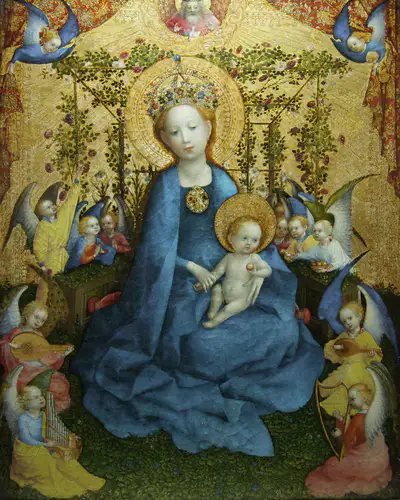
German Christmas carol, 14th century

German Christmas carol, 14th century

In Dulci Jubilo — In Sweet Rejoicing

The Latin and German Christmas carol, with its verse to Our Lady

Latin and GermanEnglish

In dulci jubilo,
nun singet und seid froh!
Unsers Herzens Wonne
liegt in praesepio
und leuchtet als die Sonne
matris in gremio.
Alpha es et O!

In sweet rejoicing,
now sing and be glad!
Our heart’s delight
lies in the manger,
and shines like the sun
in his mother’s lap.
Thou art Alpha and Omega!

O Jesu parvule,
nach dir ist mir so weh!
Tröst mir mein Gemüte,
o puer optime,
durch alle deine Güte,
o princeps gloriae.
Trahe me post te!

O little Jesus,
for thee I long so sore!
Comfort my heart,
O best of children,
by all thy goodness,
O Prince of glory.
Draw me after thee!

Ubi sunt gaudia?
Nirgend mehr denn da,
da die Engel singen
nova cantica
und die Schellen klingen
in Regis curia.
Eia, wären wir da!

Where are joys to be found?
Nowhere but there,
where the angels sing
new songs
and the bells ring
in the King’s court.
O that we were there!

Mater et filia
ist Jungfrau Maria.
Wir waren gar verdorben
per nostra crimina;
nun hat sie uns erworben
coelorum gaudia.
O quanta gratia!

Mother and daughter
is the Virgin Mary.
We were utterly lost
through our sins;
now she has won for us
the joys of heaven.
O how great a grace!

SourceGerman Christmas carol, 14th century · The Latin and German Christmas carol, with its verse to Our Lady

The history of this prayer

In dulci jubilo (“in sweet rejoicing”) is one of the oldest Christmas carols still sung. It is “macaronic”: it alternates lines in Latin and in German, as ordinary people did who knew the words of the liturgy by heart and wove them into their own tongue. The oldest known copy dates from the end of the fourteenth century (Mainz City Library), and the text is also found in a Leipzig codex of the early fifteenth century.

Blessed Henry Suso

Tradition credits the carol to Blessed Henry Suso († 1366), the German Dominican mystic. His Life relates that, in a time of suffering, heavenly youths came to cheer him, drew him by the hand into a dance, and one of them began a joyful song about the Infant Jesus which went: “In dulci jubilo…”. There is no proof that the words are his; it is simply the earliest memory that links the carol with a name.

The verse to Our Lady

In the medieval manuscripts the last stanza belongs to Our Lady: “Mater et filia ist Jungfrau Maria” — Mary is mother and daughter of her Son, as Dante would say (“Vergine Madre, figlia del tuo figlio”) — and it is she who, by giving us the Redeemer, won for us the joys of heaven. The first printed Lutheran hymnals (Klug, Wittenberg, 1529 and 1533) dropped that verse, and in the 1540s another took its place, addressed to the Father and the Son, “O Patris caritas” (Leipzig, 1543, then Babst’s hymnal of 1545), which is the one sung in most German and English versions. Here the carol is given with its Marian verse, as in the manuscripts.

In music

Bach wrote chorale preludes for organ on the tune (BWV 608, in the Orgelbüchlein, and BWV 729); BWV 729 is traditionally played at the end of the Festival of Nine Lessons and Carols at King’s College, Cambridge. In English, Robert Pearsall’s macaronic version (1837) is a choir favourite, and John Mason Neale’s free paraphrase, “Good Christian Men, Rejoice” (1853), became a popular hymn. In 1975 Mike Oldfield made it an instrumental hit.

When sung, the last line of each stanza is repeated. The German is given in modern spelling: the first three stanzas follow Klug’s hymnal (Wittenberg, 1533), the fourth the Leipzig codex. The English is our own, from both languages.

Frequently asked questions

What does In dulci jubilo mean?

“In sweet rejoicing”, that is, in sweet joy. They are the opening words of the carol, which mixes Latin and German.

Who wrote In dulci jubilo?

The author is unknown. Tradition links it with Blessed Henry Suso, a fourteenth-century Dominican mystic, whose Life tells how he heard it sung by heavenly youths.

What is the missing verse of In dulci jubilo?

“Mater et filia ist Jungfrau Maria”, the fourth stanza of the medieval manuscripts, addressed to Our Lady, which Lutheran hymnals replaced with “O Patris caritas”.

What does “Alpha es et O” mean?

“Thou art Alpha and Omega”, the first and last letters of the Greek alphabet: Christ is the beginning and the end (Apocalypse 1:8).

Is Good Christian Men, Rejoice the same carol?

It is the same tune. John Mason Neale’s words (1853) are a free paraphrase, not a translation; Robert Pearsall’s version (1837) keeps the Latin lines.

More prayers: Advent and Christmas

← All the traditional prayers · Prayers and novenas

Schola Gregoriana · CC BY-SA