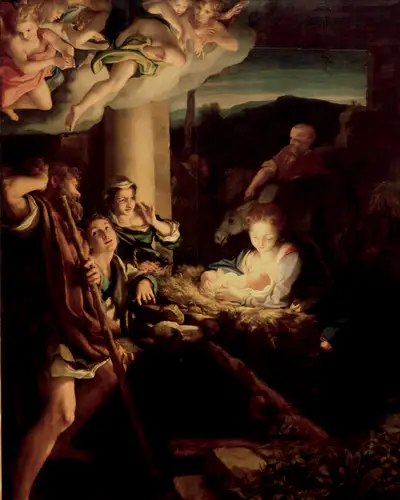
Christmas carol from Piae Cantiones, 1582

Christmas carol from Piae Cantiones, 1582

Gaudete — Rejoice, Christ Is Born

A medieval Christmas carol with the refrain “Rejoice!”

LatinEnglish

℟. Gaudete, gaudete! Christus est natus
ex Maria virgine: gaudete!

℟. Rejoice, rejoice! Christ is born
of the Virgin Mary: rejoice!

Tempus adest gratiae,
hoc quod optabamus;
carmina laetitiae
devote reddamus. ℟.

The time of grace has come,
the time for which we longed;
let us devoutly render
songs of gladness. ℟.

Deus homo factus est,
natura mirante;
mundus renovatus est
a Christo regnante. ℟.

God is made man,
while nature marvels;
the world is made new
by Christ who reigns. ℟.

Ezechielis porta
clausa pertransitur;
unde lux est orta,
salus invenitur. ℟.

The closed gate of Ezekiel
is passed through;
whence the Light is risen,
there salvation is found. ℟.

Ergo nostra contio
psallat iam in lustro;
benedicat Domino:
salus Regi nostro. ℟.

Therefore let our gathering
sing praise now, made clean;
let it bless the Lord:
salvation to our King! ℟.

SourceChristmas carol from Piae Cantiones, 1582 · A medieval Christmas carol with the refrain “Rejoice!”

The history of this prayer

Gaudete is a Latin Christmas carol published in 1582 in Piae Cantiones, a collection of sacred and school songs gathered by Jacobus Finno, headmaster of the cathedral school at Turku in Finland (then part of Sweden), and printed at Greifswald in Germany. The book appeared after the Swedish Lutheran Reformation, but what it preserves is mostly medieval Catholic song, sung by the boys of the cathedral schools.

Its form is that of the medieval carol: a short refrain, or burden, sung at the start and after every stanza, and four stanzas of four lines. Piae Cantiones gives music only for the refrain; the stanzas are usually sung to a simple recitation. The third stanza, “Ezechielis porta”, is already found with a similar refrain (“Gaudete, gaudete cum Domino nascente…”) in fifteenth- and sixteenth-century manuscripts at Prague, as G. R. Woodward noted in his 1910 edition.

The gate of Ezekiel

The finest stanza is the third. In Ezekiel 44:1-2 the prophet sees the east gate of the Temple shut, and hears that it shall stay shut, because the Lord, the God of Israel, has entered in by it. Fathers of the Church such as St Ambrose and St Jerome read in that gate the perpetual virginity of Mary: the Lord passed through, and the gate remained closed. That is what the carol sings: Christ was born of the Virgin without harm to her virginity, and through that gate the Light came into the world.

The last stanza has a hard phrase, “psallat iam in lustro”: a “lustrum” was the Roman rite of purification (and also a period of five years), and most translators take it as “sing now, made clean”. The last line echoes the Apocalypse: “Salvation… to our God” (Apocalypse 19:1).

From the charts to the choir loft

Gaudete became famous in the English-speaking world in 1973, when the folk-rock band Steeleye Span recorded it unaccompanied and it reached number 14 in the UK singles chart — one of only a handful of hits sung entirely in Latin. It has been a staple of Christmas concerts ever since. It should not be confused with Gaudete Sunday, the Third Sunday of Advent, which takes its name from the Introit of the Mass, “Gaudete in Domino semper” (Philippians 4:4).

The English on this page is our own, from the Latin.

Frequently asked questions

What does Gaudete mean?

“Rejoice!”, in the Latin plural imperative. The refrain says: “Rejoice, rejoice! Christ is born of the Virgin Mary: rejoice!”

Is Gaudete an Advent or a Christmas song?

It is a Christmas carol: it celebrates the birth of Christ. Gaudete Sunday, the Third Sunday of Advent, is something else: it takes its name from the Introit, “Gaudete in Domino semper” (Philippians 4:4).

How old is Gaudete?

It was published in 1582 in Piae Cantiones, but it is older: the stanza “Ezechielis porta” is already found in fifteenth-century manuscripts at Prague.

What is the gate of Ezekiel in Gaudete?

The Temple gate the prophet saw shut, because the Lord had entered by it (Ezekiel 44:1-2). The Fathers read it as a figure of Mary’s perpetual virginity.

Who made Gaudete famous?

The folk-rock band Steeleye Span, whose unaccompanied recording reached number 14 in the UK singles chart in 1973.

More prayers: Advent and Christmas

← All the traditional prayers · Prayers and novenas

Schola Gregoriana · CC BY-SA