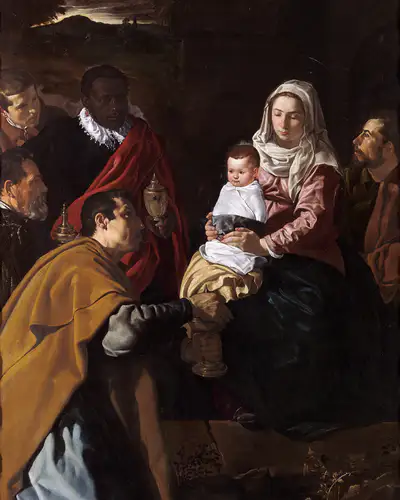
Benedictio cretae℣. Adiutorium nostrum in nomine Domini.
℟. Qui fecit caelum et terram.
℣. Dominus vobiscum.
℟. Et cum spiritu tuo.
Blessing of the chalk (in church, by the priest)℣. Our help is in the name of the Lord.
℟. Who made heaven and earth.
℣. The Lord be with you.
℟. And with thy spirit.
Benedic, Domine Deus, creaturam istam cretae: ut sit salutaris humano generi; et praesta per invocationem nominis tui sanctissimi, ut, quicumque ex ea sumpserint, vel in ea in domus suae portis scripserint nomina sanctorum tuorum Gasparis, Melchioris et Baltassar, per eorum intercessionem et merita, corporis sanitatem et animae tutelam percipiant. Per Christum Dominum nostrum.
℟. Amen.
(Et aspergatur aqua benedicta.)
Bless, O Lord God, this creature chalk, that it may be a help to mankind; and grant, through the invocation of thy most holy name, that all who take of it, or write with it upon the doors of their house the names of thy saints Caspar, Melchior and Balthasar, may through their intercession and merits receive health of body and protection of soul. Through Christ our Lord.
℟. Amen.
(And the chalk is sprinkled with holy water.)
Benedictio domorum℣. Pax huic domui.
℟. Et omnibus habitantibus in ea.
Blessing of the house (on entering)℣. Peace be to this house.
℟. And to all who dwell therein.
Ant. Ab Oriente venerunt Magi in Bethlehem adorare Dominum: et apertis thesauris suis pretiosa munera obtulerunt, aurum Regi magno, thus Deo vero, myrrham sepulturae eius. Alleluia.
Ant. From the East came the Magi to Bethlehem to adore the Lord; and opening their treasures they offered precious gifts: gold to the great King, frankincense to the true God, myrrh for his burial. Alleluia.
Canticum B. Mariae Virginis (Luc. 1, 46-55)Magnificat anima mea Dominum,
et exsultavit spiritus meus in Deo salutari meo.
Quia respexit humilitatem ancillae suae:
ecce enim ex hoc beatam me dicent omnes generationes.
Quia fecit mihi magna qui potens est:
et sanctum nomen eius.
Et misericordia eius a progenie in progenies
timentibus eum.
Fecit potentiam in brachio suo:
dispersit superbos mente cordis sui.
Deposuit potentes de sede,
et exaltavit humiles.
Esurientes implevit bonis:
et divites dimisit inanes.
Suscepit Israel puerum suum,
recordatus misericordiae suae.
Sicut locutus est ad patres nostros,
Abraham et semini eius in saecula.
Gloria Patri, et Filio, et Spiritui Sancto.
Sicut erat in principio, et nunc, et semper,
et in saecula saeculorum. Amen.
The Canticle of Our Lady (Luke 1:46-55)My soul doth magnify the Lord,
and my spirit hath rejoiced in God my Saviour.
Because he hath regarded the humility of his handmaid;
for behold from henceforth all generations shall call me blessed.
Because he that is mighty hath done great things to me;
and holy is his name.
And his mercy is from generation unto generations,
to them that fear him.
He hath shewed might in his arm:
he hath scattered the proud in the conceit of their heart.
He hath put down the mighty from their seat,
and hath exalted the humble.
He hath filled the hungry with good things;
and the rich he hath sent empty away.
He hath received Israel his servant,
being mindful of his mercy:
As he spoke to our fathers,
to Abraham and to his seed for ever.
Glory be to the Father, and to the Son, and to the Holy Ghost.
As it was in the beginning, is now, and ever shall be,
world without end. Amen.
(Interea aspergitur et incensatur domus, et in fine repetitur antiphona Ab Oriente venerunt.)
(Meanwhile the house is sprinkled with holy water and incensed; at the end the antiphon From the East came the Magi is repeated.)
Pater noster (secreto)…
℣. Et ne nos inducas in tentationem.
℟. Sed libera nos a malo.
℣. Omnes de Saba venient.
℟. Aurum et thus deferentes.
℣. Domine, exaudi orationem meam.
℟. Et clamor meus ad te veniat.
℣. Dominus vobiscum.
℟. Et cum spiritu tuo.
Our Father… (silently)
℣. And lead us not into temptation.
℟. But deliver us from evil.
℣. All they from Saba shall come.
℟. Bringing gold and frankincense.
℣. O Lord, hear my prayer.
℟. And let my cry come unto thee.
℣. The Lord be with you.
℟. And with thy spirit.
Oremus.
Deus, qui hodierna die Unigenitum tuum gentibus stella duce revelasti: concede propitius; ut, qui iam te ex fide cognovimus, usque ad contemplandam speciem tuae celsitudinis perducamur. Per eundem Dominum nostrum Iesum Christum Filium tuum, qui tecum vivit et regnat in unitate Spiritus Sancti Deus, per omnia saecula saeculorum.
℟. Amen.
Let us pray.
O God, who on this day didst reveal thine only-begotten Son to the Gentiles by the guidance of a star: mercifully grant that we, who already know thee by faith, may be led on to contemplate the beauty of thy majesty. Through the same Jesus Christ thy Son our Lord, who liveth and reigneth with thee in the unity of the Holy Ghost, God, world without end.
℟. Amen.
Responsorium. Illuminare, illuminare, Ierusalem, quia venit lux tua: et gloria Domini super te orta est, Iesus Christus ex Maria Virgine.
℣. Et ambulabunt gentes in lumine tuo, et reges in splendore ortus tui.
℟. Et gloria Domini super te orta est.
Responsory. Be enlightened, be enlightened, O Jerusalem, for thy light is come, and the glory of the Lord is risen upon thee: Jesus Christ, born of the Virgin Mary.
℣. And the Gentiles shall walk in thy light, and kings in the brightness of thy rising.
℟. And the glory of the Lord is risen upon thee.
Oremus.
Benedic, Domine Deus omnipotens, domum istam: ut sit in ea sanitas, castitas, victoriae virtus, humilitas, bonitas et mansuetudo, plenitudo legis, et gratiarum actio Deo Patri, et Filio, et Spiritui Sancto; et haec benedictio maneat super hanc domum, et super habitantes in ea. Per Christum Dominum nostrum.
℟. Amen.
Let us pray.
Bless, O Lord God almighty, this house, that in it there may be health, chastity, the strength of victory, humility, goodness and meekness, the fulness of the law, and thanksgiving to God the Father, and to the Son, and to the Holy Ghost; and may this blessing remain upon this house and upon all who dwell therein. Through Christ our Lord.
℟. Amen.
Super ianuam20 + C + M + B + 27
Over the door, with the blessed chalk20 + C + M + B + 27
SourceThe Roman Ritual, for the feast of the Epiphany · The blessing of chalk and of homes at Epiphany, and 20 + C + M + B + 27 over the door