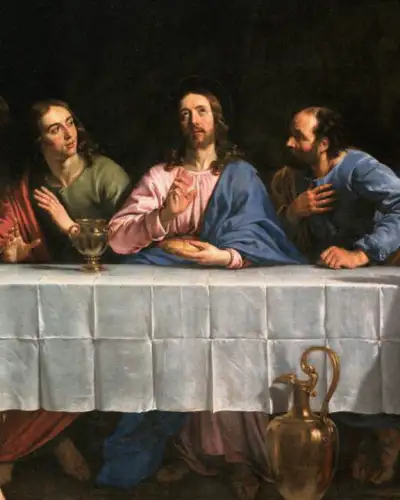
Saint Thomas Aquinas

Saint Thomas Aquinas

Pange lingua gloriosi

The Corpus Christi Vespers hymn — its last two stanzas are the Tantum ergo

LatinEnglish

Pange, lingua, gloriósi
Córporis mystérium,
Sanguinísque pretiósi,
Quem in mundi prétium
Fructus ventris generósi
Rex effúdit géntium.

Sing, my tongue, the Saviour's glory,
of his Flesh the mystery sing;
of the Blood, all price exceeding,
shed by our immortal King,
destined, for the world's redemption,
from a noble womb to spring.

Nobis datus, nobis natus
Ex intácta Vírgine,
Et in mundo conversátus,
Sparso verbi sémine,
Sui moras incolátus
Miro clausit órdine.

Of a pure and spotless Virgin
born for us on earth below,
he, as Man with man conversing,
stayed, the seeds of truth to sow;
then he closed in solemn order
wondrously his life of woe.

In suprémæ nocte cœnæ
Recúmbens cum frátribus,
Observáta lege plene
Cibis in legálibus,
Cibum turbæ duodénæ
Se dat suis mánibus.

On the night of that Last Supper,
seated with his chosen band,
he the paschal victim eating,
first fulfils the Law's command;
then, as Food to all his brethren
gives himself with his own hand.

Verbum caro, panem verum
Verbo carnem éfficit:
Fitque sanguis Christi merum,
Et si sensus déficit,
Ad firmándum cor sincérum
Sola fides súfficit.

Word made Flesh, the bread of nature
by his word to Flesh he turns;
wine into his Blood he changes:
what though sense no change discerns?
Only be the heart in earnest,
faith her lesson quickly learns.

Tantum ergoTantum ergo Sacraméntum
Venerémur cérnui:
Et antíquum documéntum
Novo cedat rítui:
Præstet fides suppleméntum
Sénsuum deféctui.

Tantum ergoDown in adoration falling,
Lo! the sacred Host we hail;
Lo! o'er ancient forms departing,
newer rites of grace prevail;
faith for all defects supplying,
where the feeble senses fail.

Genitóri, Genitóque
Laus et jubilátio,
Salus, honor, virtus quoque
Sit et benedíctio:
Procedénti ab utróque
Compar sit laudátio. Amen.

To the everlasting Father,
and the Son who reigns on high,
with the Holy Ghost proceeding
forth from each eternally,
be salvation, honour, blessing,
might, and endless majesty. Amen.

SourceSaint Thomas Aquinas · The Corpus Christi Vespers hymn — its last two stanzas are the Tantum ergo

Related reading →

The history of this prayer

The Pange lingua gloriosi Corporis mysterium is the Vespers hymn of Corpus Christi, written by Saint Thomas Aquinas for the Office of the feast that Pope Urban IV extended to the whole Church in 1264. Saint Thomas borrowed the opening words and the metre of another Pange lingua, the hymn of the Cross by Venantius Fortunatus (6th century).

In six stanzas he tells the whole mystery: the Incarnation, Christ’s life among us, the Last Supper and transubstantiation — “and if the senses fall short, faith alone suffices”. The last two stanzas, from “Tantum ergo”, are sung on their own at Benediction and have their own page here.

The whole hymn is sung on Holy Thursday, in the procession that carries the Blessed Sacrament to the altar of repose after the Mass of the Lord’s Supper, and in the Corpus Christi procession. In Church Latin, “gentium” is said “JEN-tsee-um”.

Many composers have set it in polyphony; Josquin des Prez built a whole Mass, the Missa Pange lingua, on its chant melody.

The right-hand column gives Edward Caswall’s version (Lyra Catholica, 1849), “Sing, my tongue, the Saviour’s glory”, long sung by English-speaking Catholics to the Latin chant; its last two stanzas are his “Down in adoration falling”. In Anglican hymnals the familiar version is J. M. Neale’s “Of the glorious Body telling”. The literal translation is given below.

Literal translation

Sing, my tongue, the mystery
of the glorious Body,
and of the precious Blood
which — the price of the world —
the King of the nations poured forth,
fruit of a noble womb.

Given to us, born for us
of an undefiled Virgin,
he dwelt among us in the world
and scattered the seed of the word;
and the time of his sojourning
he closed in a wondrous order.

On the night of the Last Supper,
reclining with his brethren,
the Law fully kept
as to the prescribed foods,
he gives himself with his own hands
as food to the company of the Twelve.

The Word made flesh, by a word,
makes true bread his flesh;
and the wine becomes the Blood of Christ.
And if the senses fall short,
faith alone suffices
to make firm the sincere heart.

Tantum ergo
So great a Sacrament, therefore,
let us venerate, bowed low;
and let the old observance
give way to the new rite;
let faith supply
for the failure of the senses.

To the Father and the Son
be praise and jubilation,
salvation, honour, and power,
and blessing too;
and to the One who proceeds from both
be equal praise. Amen.

Frequently asked questions

Who wrote the Pange Lingua?

Saint Thomas Aquinas, for the Office of Corpus Christi, around 1264.

How are the Pange Lingua and the Tantum Ergo related?

The Tantum ergo is the last two stanzas of the Pange lingua. Sung on their own, they close adoration before Benediction.

When is the Pange Lingua sung?

In the Holy Thursday procession to the altar of repose, in the Corpus Christi procession and at Vespers of the feast.

More prayers: Prayers of the saints

← All the traditional prayers · Prayers and novenas

Schola Gregoriana · CC BY-SA