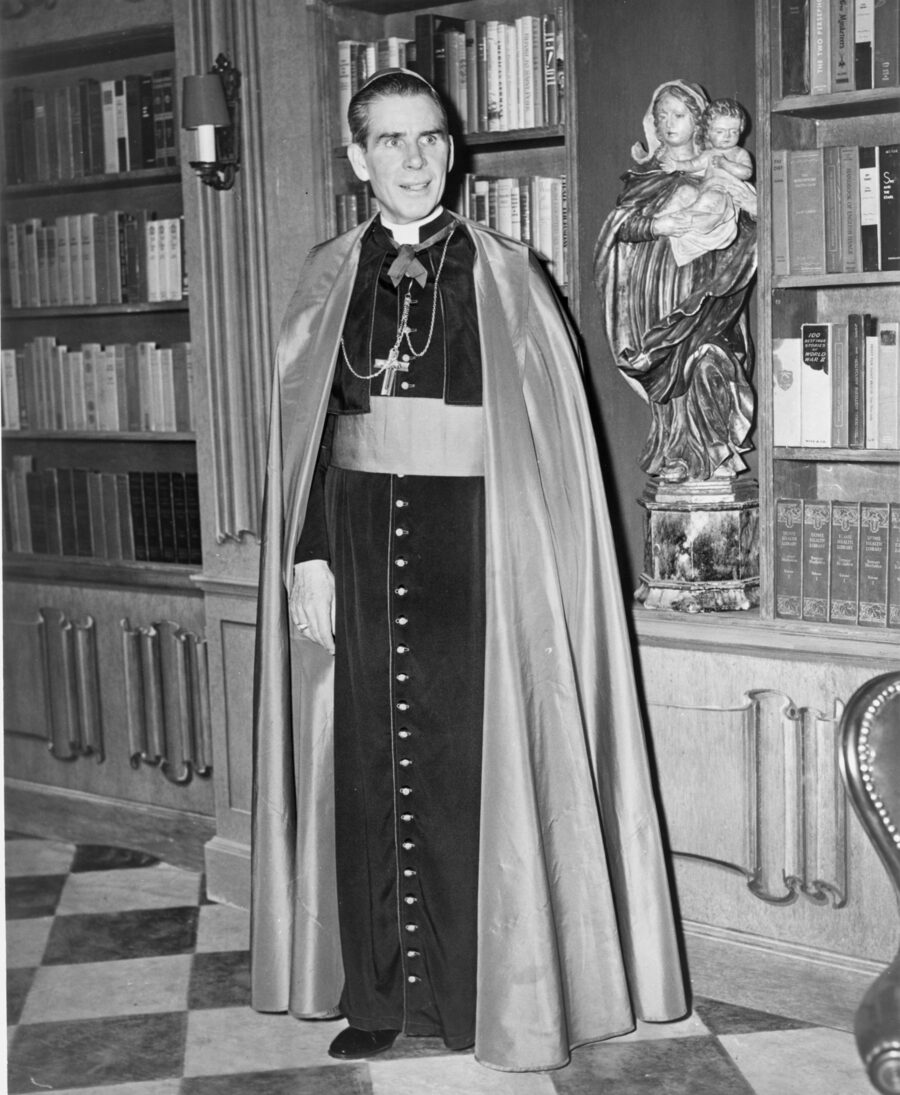
On Thursday, 24 September 2026, at the Dome at America’s Center in St Louis, Missouri, Archbishop Fulton John Sheen was declared Blessed. Cardinal Luis Antonio Tagle presided at the Mass as the representative of Pope Leo XIV. The man who once explained the Catholic faith to thirty million people on live television, with nothing on set but a blackboard and an angel to clean it, is now held up by the Church as someone worth imitating.
What happened in St Louis
The rite itself is brief. The postulator asks; the apostolic letter is read; from that moment the man may be called Blessed, his relics may be venerated publicly, and the churches of the dioceses concerned may keep his memory on a fixed day. For Sheen that day is 9 December, the day he died.
The Mass was announced in March by Bishop Louis Tylka, of the Diocese of Peoria — the diocese where Sheen was born, ordained and first served, and the diocese that carried his cause for twenty-four years. St Louis was chosen for a practical reason: they expected a crowd, and they wanted it indoors and close to Peoria.
The relics were carried up by the Engstrom family. To understand why, you have to go back to a bedroom near Peoria in September 2010.
The sixty-one minutes
On 16 September 2010, Bonnie Engstrom gave birth to her son James after a healthy, low-risk pregnancy. What nobody knew was that the umbilical cord had a true knot in it, and that the knot had tightened during labour and cut off the boy’s oxygen.
He was delivered without a pulse. His father Travis baptised him at once. At the hospital in Peoria the medical staff worked on him for an hour, and were preparing to call the time of death when the boy’s heart started to beat. In his mother’s words, “it never stopped again”.
He had been sixty-one minutes without a pulse. The parents, their friends and then — through a blog post and a few lines on Facebook — strangers all over the world had been asking one man to intercede: Fulton Sheen.
The first scan showed serious damage to the boy’s brain. A later scan showed a brain that was, simply, fine. James grew up without impairment.
The distinction is worth keeping straight, because the two words are often swapped in the news. Beatification ordinarily requires one verified miracle after the candidate’s death, and it permits public veneration in a limited place — a diocese, a country, a religious order. Canonization requires a second miracle, worked after the beatification, and extends that veneration to the whole Church.
So Fulton Sheen is not yet Saint Fulton Sheen. He is Blessed Fulton Sheen, and the Church is now, in effect, waiting to see whether God will give the second sign.
The investigation was not casual. A tribunal was opened in Peoria when James was one year old; his parents handed over every medical record, and fifteen other people — doctors, the midwife, priests, friends — answered the same list of questions, for consistency. The file went to Rome. In March 2014 the medical board that advises the Dicastery for the Causes of Saints declared the recovery scientifically inexplicable, unanimously. That June the theologians agreed, also unanimously, that it had come through Sheen’s intercession. On 6 July 2019 Pope Francis signed the decree.
From El Paso, Illinois, to prime time
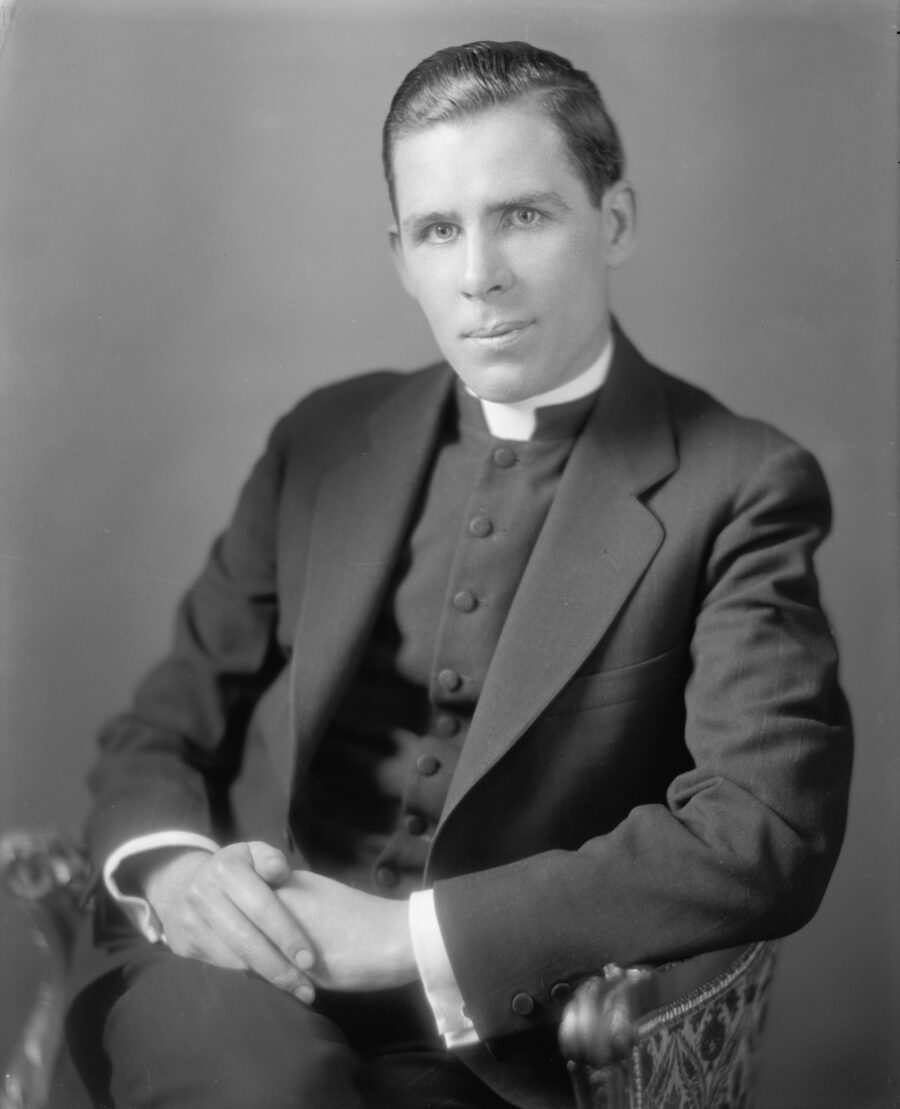
He was born Peter John Sheen on 8 May 1895, in El Paso, Illinois, to an Irish-American farming family; the household later moved to Peoria, and he took his mother’s maiden name, Fulton, as his own.
He was ordained a priest on 20 September 1919, in the Cathedral of St Mary in Peoria — one hundred and seven years, and four days, before the Mass that made him Blessed. Sent to study in Europe, at Leuven he became the first American to win the Cardinal Mercier Prize for International Philosophy. He taught at the Catholic University of America for more than twenty years.
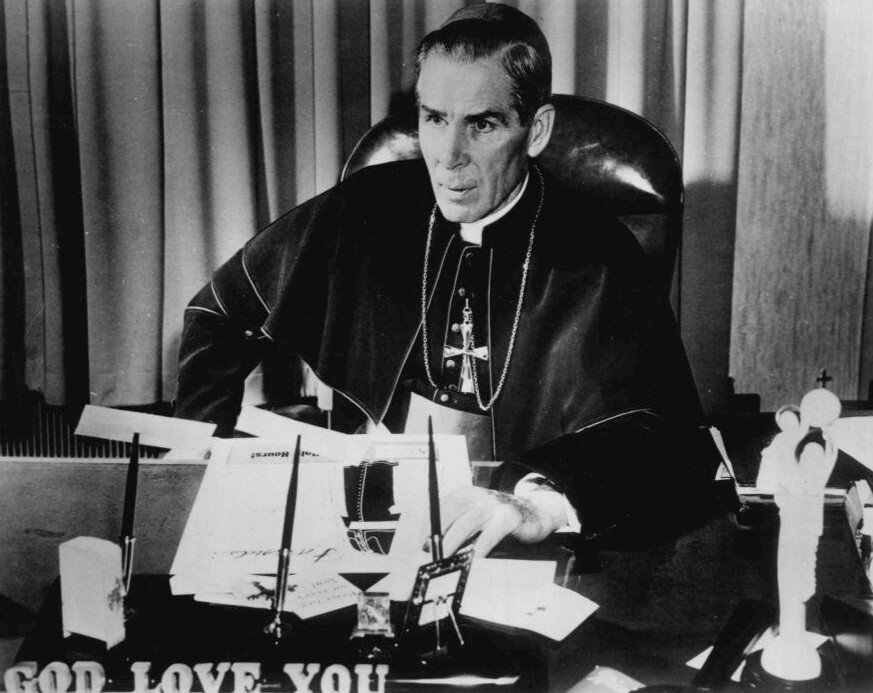
Then came the microphones. From 1930 he preached on The Catholic Hour, a Sunday radio programme that at its height reached some four million listeners. In 1951 he moved to television with Life Is Worth Living — scheduled opposite the biggest entertainers in America, and drawing about thirty million viewers. He won an Emmy for it. Accepting the award, he thanked his writers:
I feel it is time I pay tribute to my four writers — Matthew, Mark, Luke and John.
For sixteen years he also ran the Society for the Propagation of the Faith in the United States, raising an enormous sum for the missions — and giving away, quietly, most of what came to him personally. He was made Auxiliary Bishop of New York in 1951, Bishop of Rochester from 1966 to 1969, and then titular Archbishop of Newport, in Wales, by Paul VI.
The hour behind the voice
The detail that explains the rest is not the television. It is what he did on the day of his ordination, and every day afterwards. In his autobiography he wrote:
I resolved also to spend a continuous Holy Hour every day in the presence of our Lord in the Blessed Sacrament.
— A Treasure in Clay
He kept it for sixty years, through lecture tours, broadcasts, diocesan government and illness. He said repeatedly that the hour was not his preparation for the work; the work was what spilled out of the hour. Priests who asked him for advice about preaching were told to make the hour first and worry about the sermon second.
That is the part of him a reader can actually copy. Almost nobody will be handed a television network. Anybody can be given an hour.
In his own words
Sheen wrote more than sixty books. A few lines survive him better than the rest:
God, who made the sun, also made the moon. The moon does not take away from the brilliance of the sun. All Mary’s light is the reflected light of Christ.
— The World’s First Love
The Rosary is the book of the blind, where souls see and there enact the greatest drama of love the world has ever known.
— The World’s First Love
The level of any civilization is the level of its womanhood.
— Life Is Worth Living, Second Series (1954), p. 173
And two months before he died, on 2 October 1979, John Paul II called him forward at St Patrick’s Cathedral in New York, embraced him in front of the whole congregation, and said:
You have written and spoken well of the Lord Jesus Christ. You are a loyal son of the Church.
Sheen’s written reply, a fortnight before his death, was one sentence: “I bow in humble gratitude for the Pontifical approval of my ministry of the Word.” He died on 9 December 1979, aged 84.
The six years the cause stood still
It is worth telling this part plainly, because it explains why a miracle approved in 2019 produced a beatification only in 2026.
- His cause was opened in Peoria in 2002; Benedict XVI declared him Venerable in 2012.
- In 2014 the cause was suspended over a dispute about his body. Sheen’s will asked for burial in New York; his niece, Joan Sheen Cunningham, wanted him in the cathedral at Peoria. The case went through the New York courts and was settled in her favour in June 2019. His remains were moved to St Mary’s Cathedral, Peoria, on 27 June 2019.
- The beatification was then set for 21 December 2019 — and called off on 3 December, three weeks beforehand, after some United States bishops asked the Holy See to look further into his three years governing Rochester.
- The Vatican gave the green light again in February 2026, and the date was announced in March.
Six years is a long time to wait, and the Engstroms waited them with a small boy in the middle of it. His mother put it this way in an interview: they had to accept that God’s timeline was not theirs.
What changes now
He may be called Blessed. His memory may be kept liturgically on 9 December in the places concerned. His relics may be venerated in public. And the Church waits for a second miracle, which is the ordinary door to canonization — the one that would make him, as his own diocese has long hoped, a saint born and raised in the United States.
Until then, the most Sheen-like response available to a reader is not to argue about him on the internet. It is to find a church with the Blessed Sacrament in it, sit down, and give the hour.
Beate Fulton, ora pro nobis. Blessed Fulton Sheen, pray for us — and win us the patience to keep the hour nobody sees.
Vatican News (25 March 2026); the statement of Bishop Louis Tylka and the Archbishop Fulton J. Sheen Foundation, at celebratesheen.com; the account of the cause kept by the Catholic University of America; and Bonnie Engstrom’s own account of the miracle, given to America magazine in July 2019.
- The priesthood was born at the Last Supper — what Sheen gave his hour to.
- What is a priest for?
- Words of the saints — a growing collection, in English and Portuguese.

Comments