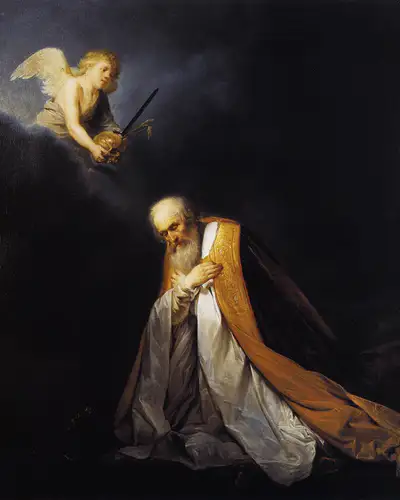
Psalm 90 (91), prayed at Compline

Psalm 90 (91), prayed at Compline

Psalm 91 — the Psalm of Protection (Qui habitat)

“He that dwelleth in the aid of the most High”: the psalm of trust, of the night and of Lent

LatinEnglish

Qui habitat in adiutorio Altissimi,
in protectione Dei caeli commorabitur.

He that dwelleth in the aid of the most High,
shall abide under the protection of the God of Jacob.

Dicet Domino: Susceptor meus es tu, et refugium meum:
Deus meus sperabo in eum.

He shall say to the Lord: Thou art my protector, and my refuge:
my God, in him will I trust.

Quoniam ipse liberavit me de laqueo venantium,
et a verbo aspero.

For he hath delivered me from the snare of the hunters:
and from the sharp word.

Scapulis suis obumbrabit tibi:
et sub pennis eius sperabis.

He will overshadow thee with his shoulders:
and under his wings thou shalt trust.

Scuto circumdabit te veritas eius:
non timebis a timore nocturno,

His truth shall compass thee with a shield:
thou shalt not be afraid of the terror of the night.

A sagitta volante in die, a negotio perambulante in tenebris:
ab incursu, et daemonio meridiano.

Of the arrow that flieth in the day, of the business that walketh about in the dark:
of invasion, or of the noonday devil.

Cadent a latere tuo mille, et decem millia a dextris tuis:
ad te autem non appropinquabit.

A thousand shall fall at thy side, and ten thousand at thy right hand:
but it shall not come nigh thee.

Verumtamen oculis tuis considerabis:
et retributionem peccatorum videbis.

But thou shalt consider with thy eyes:
and shalt see the reward of the wicked.

Quoniam tu es, Domine, spes mea:
Altissimum posuisti refugium tuum.

Because thou, O Lord, art my hope:
thou hast made the most High thy refuge.

Non accedet ad te malum:
et flagellum non appropinquabit tabernaculo tuo.

There shall no evil come to thee:
nor shall the scourge come near thy dwelling.

Quoniam Angelis suis mandavit de te:
ut custodiant te in omnibus viis tuis.

For he hath given his angels charge over thee;
to keep thee in all thy ways.

In manibus portabunt te:
ne forte offendas ad lapidem pedem tuum.

In their hands they shall bear thee up:
lest thou dash thy foot against a stone.

Super aspidem, et basiliscum ambulabis:
et conculcabis leonem et draconem.

Thou shalt walk upon the asp and the basilisk:
and thou shalt trample under foot the lion and the dragon.

Quoniam in me speravit, liberabo eum:
protegam eum, quoniam cognovit nomen meum.

Because he hoped in me I will deliver him:
I will protect him because he hath known my name.

Clamabit ad me, et ego exaudiam eum: cum ipso sum in tribulatione:
eripiam eum et glorificabo eum.

He shall cry to me, and I will hear him: I am with him in tribulation,
I will deliver him, and I will glorify him.

Longitudine dierum replebo eum:
et ostendam illi salutare meum.

I will fill him with length of days;
and I will shew him my salvation.

Gloria Patri, et Filio, et Spiritui Sancto.
Sicut erat in principio, et nunc, et semper, et in saecula saeculorum. Amen.

Glory be to the Father, and to the Son, and to the Holy Spirit.
As it was in the beginning, is now, and ever shall be, world without end. Amen.

SourcePsalm 90 (91), prayed at Compline · “He that dwelleth in the aid of the most High”: the psalm of trust, of the night and of Lent

The history of this prayer

Psalm 91 is Psalm 90 in the numbering of the Latin Vulgate and of older Catholic Bibles, and Psalm 91 in the Hebrew numbering that most modern Bibles follow. In Hebrew it has no title; the Vulgate calls it “The praise of a canticle for David”. It is the psalm of the one who takes refuge in God: the fowler’s snare, the arrow, the pestilence, the terror of the night — none of it reaches the one who “dwelleth in the aid of the most High”.

The psalm of the night

The Church has prayed it before sleep since at least the sixth century. The Rule of St Benedict (ch. 18) appoints Psalms 4, 90 and 133 for Compline every night. In the Roman Breviary, after the reform of St Pius X (1911), it was kept for Sunday Compline, and in today’s Liturgy of the Hours it is still sung at Sunday Night Prayer. That is why so many Christians know it by heart as a night prayer.

The psalm of Lent

In the traditional Roman Missal, the Mass of the First Sunday of Lent is drawn almost entirely from it: the Introit “Invocabit me” (vv. 15-16), the Gradual (vv. 11-12), the Tract, which sings almost the whole psalm, and the Offertory and Communion “Scapulis suis” (vv. 4-5). The reason lies in the Gospel of the day (Mt 4:1-11): in the desert the devil tempts Jesus by quoting verses 11 and 12, “he hath given his angels charge over thee”, and Jesus answers, “Thou shalt not tempt the Lord thy God”. To trust God is not to put him to the test.

The early monks also read here the “noonday devil” of verse 6. St John Cassian, in his Institutes (book X), records that some of the elders saw in it acedia, the weariness and dejection that assail the monk around the middle of the day.

A word of caution

Some people keep a Bible open at this psalm as a sign of trust. The gesture can be a good one, but protection does not lie in an open page: the Catechism (no. 2111) warns that to attribute the efficacy of prayers to their mere external performance, apart from the interior dispositions they demand, is superstition. The psalm shelters the one who prays it and lives what it says: “Because thou, O Lord, art my hope”.

The Latin text is that of the Vulgate, as prayed in the Divine Office; the English is the Douay-Rheims in Challoner’s revision; the Portuguese is the Catholic translation of Fr António Pereira de Figueiredo, made from the Vulgate (London edition of 1866), in modern spelling.

Frequently asked questions

Are Psalm 91 and Psalm 90 the same?

Yes. It is the same psalm: 90 in the numbering of the Latin Vulgate and of older Catholic Bibles, 91 in the Hebrew numbering used by most Bibles today.

What is the Catholic version of Psalm 91?

Every Catholic Bible gives the psalm in full. Here it is in the Douay-Rheims, translated from the Vulgate, beside the Latin the Church prays in the Divine Office. Translations made from the Hebrew change some words, but the psalm is the same.

When should I pray Psalm 91?

At night before sleep, as the Church does at Compline; in times of fear, danger or illness; and in Lent, whose First Sunday has a Mass drawn from this psalm.

Is Psalm 91 a prayer of protection?

Yes, in the sense that it is a prayer of trust in God, who protects. It is not a charm: the Catechism (no. 2111) calls it superstition to attribute efficacy to the external performance of a prayer apart from the dispositions of the heart.

What is the “noonday devil”?

It is the Vulgate’s phrase in verse 6. The early monks connected it with acedia, the spiritual listlessness that strikes in the middle of the day, as St John Cassian records.

More prayers: Every Catholic's prayers

← All the traditional prayers · Prayers and novenas

Schola Gregoriana · CC BY-SA