Prayer of the Church

Prayer of the Church

Come, Holy Spirit — Veni, Sancte Spiritus

Before study, work, a decision — any time

LatinEnglish

Veni, Sancte Spiritus,
reple tuorum corda fidelium,
et tui amoris in eis ignem accende.

Come, Holy Spirit,
fill the hearts of thy faithful
and enkindle in them the fire of thy love.

℣. Emitte Spiritum tuum et creabuntur.
℟. Et renovabis faciem terrae.

℣. Send forth thy Spirit and they shall be created.
℟. And thou shalt renew the face of the earth.

Oremus. Deus, qui corda fidelium Sancti Spiritus illustratione docuisti, da nobis in eodem Spiritu recta sapere, et de eius semper consolatione gaudere. Per Christum Dominum nostrum. Amen.

Let us pray. O God, who didst instruct the hearts of the faithful by the light of the Holy Spirit, grant us in the same Spirit to be truly wise, and ever to rejoice in his consolation. Through Christ our Lord. Amen.

SourcePrayer of the Church · Before study, work, a decision — any time

The history of this prayer

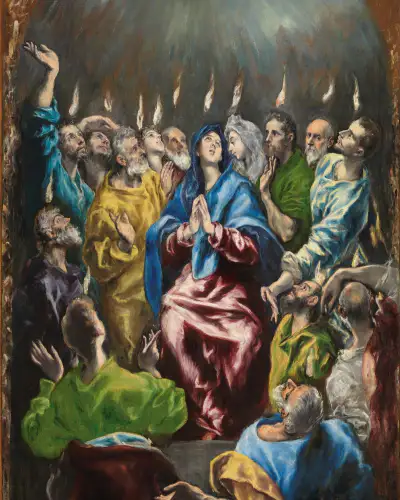
This prayer joins three pieces of the liturgy: the antiphon “Veni, Sancte Spiritus, reple tuorum corda fidelium”, sung at Pentecost; the verse from Psalm 104:30, “Send forth your Spirit and they shall be created”; and the collect of the Mass of the Holy Spirit, “Deus, qui corda fidelium”.

It is the traditional prayer to begin study, work, a meeting or a decision. It should not be confused with the hymn Veni Creator Spiritus or with the Pentecost sequence, which opens with the same words.

The English text is the traditional form with thee and thou found in most prayer books.

Frequently asked questions

Is this the same as the Veni Creator?

No. The Veni Creator Spiritus is a ninth-century hymn attributed to Rabanus Maurus. This is a short antiphon with a collect.

When should “Come, Holy Spirit” be prayed?

Before study, work, decisions or prayer, and especially in the season of Pentecost.

And the sequence “Veni, Sancte Spiritus”?

That is another text, the “Golden Sequence” of the Pentecost Mass (“et emitte caelitus lucis tuae radium”), attributed to Stephen Langton.

More prayers: Every Catholic's prayers

← All the traditional prayers · Prayers and novenas

Schola Gregoriana · CC BY-SA