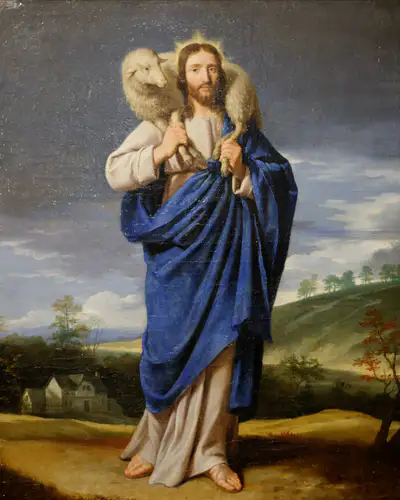
Psalm 22 (23), the psalm of the Good Shepherd

Psalm 22 (23), the psalm of the Good Shepherd

Psalm 23 — the Lord is my Shepherd (Dominus regit me)

“The Lord ruleth me: and I shall want nothing”: the psalm of the shepherd, the table and the cup

LatinEnglish

Dominus regit me, et nihil mihi deerit:
in loco pascuae ibi me collocavit.

The Lord ruleth me: and I shall want nothing.
He hath set me in a place of pasture.

Super aquam refectionis educavit me:
animam meam convertit.

He hath brought me up, on the water of refreshment:
he hath converted my soul.

Deduxit me super semitas iustitiae,
propter nomen suum.

He hath led me on the paths of justice,
for his own name’s sake.

Nam, et si ambulavero in medio umbrae mortis, non timebo mala:
quoniam tu mecum es.

For though I should walk in the midst of the shadow of death, I will fear no evils,
for thou art with me.

Virga tua, et baculus tuus:
ipsa me consolata sunt.

Thy rod and thy staff,
they have comforted me.

Parasti in conspectu meo mensam,
adversus eos, qui tribulant me.

Thou hast prepared a table before me
against them that afflict me.

Impinguasti in oleo caput meum:
et calix meus inebrians quam praeclarus est!

Thou hast anointed my head with oil;
and my chalice which inebriateth me, how goodly is it!

Et misericordia tua subsequetur me
omnibus diebus vitae meae:

And thy mercy will follow me
all the days of my life.

Et ut inhabitem in domo Domini,
in longitudinem dierum.

And that I may dwell in the house of the Lord
unto length of days.

Gloria Patri, et Filio, et Spiritui Sancto.
Sicut erat in principio, et nunc, et semper, et in saecula saeculorum. Amen.

Glory be to the Father, and to the Son, and to the Holy Spirit.
As it was in the beginning, is now, and ever shall be, world without end. Amen.

SourcePsalm 22 (23), the psalm of the Good Shepherd · “The Lord ruleth me: and I shall want nothing”: the psalm of the shepherd, the table and the cup

The history of this prayer

Psalm 23 is Psalm 22 in the numbering of the Latin Vulgate and Psalm 23 in the Hebrew numbering that most modern Bibles follow. It is the psalm of the shepherd: God leads, feeds and guards, and in the midst of the shadow of death walks beside us. Jesus took the image for himself: “I am the good shepherd” (Jn 10:11).

“Ruleth me” or “is my shepherd”?

The Hebrew says “the Lord is my shepherd”. The Vulgate, following the ancient Greek translation, says “Dominus regit me”, “the Lord ruleth me”, and so translate the Catholic versions made from the Latin, such as the Douay-Rheims and Fr Figueiredo’s Portuguese Bible. The Douay-Rheims explains in a note: “In Hebrew, Is my shepherd, viz., to feed, guide, and govern me.” The meaning is one and the same.

The psalm of the newly baptized

In the early centuries it was the psalm of those just baptized on Easter night. St Ambrose (On the Mysteries, 43) describes the cleansed people hastening to the altar of Christ and, seeing it prepared, crying out: “Thou hast prepared a table before me”. St Cyril of Jerusalem (Mystagogical Catechesis 4, 7) explains each image: the table is the mystical and spiritual table God has prepared for us; the oil is the anointing received on the forehead; and the inebriating cup is the cup Jesus took in his hands, saying “This is my blood”.

For the departed

The Church also prays it for the dead. In the traditional Office of the Dead it opens the second nocturn of Matins, with the antiphon “In loco pascuae ibi me collocavit”, “in a place of pasture he hath set me”. To this day it is one of the psalms most often chosen for wakes and funeral Masses.

The Latin text is that of the Vulgate, as prayed in the Divine Office; the English is the Douay-Rheims in Challoner’s revision; the Portuguese is the Catholic translation of Fr António Pereira de Figueiredo, made from the Vulgate (London edition of 1866), in modern spelling.

Frequently asked questions

Are Psalm 23 and Psalm 22 the same?

Yes. It is the same psalm: 22 in the numbering of the Latin Vulgate and of older Catholic Bibles, 23 in the Hebrew numbering used by most Bibles today.

Why does it say “The Lord ruleth me” instead of “The Lord is my shepherd”?

Because the Douay-Rheims was translated from the Latin Vulgate, which reads “Dominus regit me”. Translations from the Hebrew say “The Lord is my shepherd”. The meaning is the same: the shepherd is the one who guides and rules the flock.

Can Psalm 23 be prayed for someone who has died?

Yes. The Church prays it in the Office of the Dead, and it is often read at wakes and funerals. Prayed for the dead, it may end with “Eternal rest grant unto him, O Lord, and let perpetual light shine upon him” in place of the Glory Be.

When should I pray Psalm 23?

In any trouble, before sleep, beside someone who is sick or dying, and after Holy Communion, because of the “table” and the “cup” the psalm speaks of.

More prayers: Every Catholic's prayers

← All the traditional prayers · Prayers and novenas

Schola Gregoriana · CC BY-SA