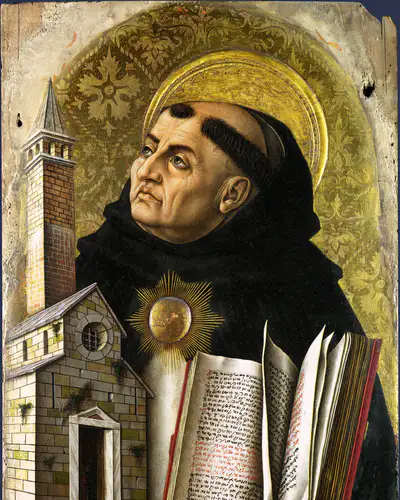
Attributed to St Thomas Aquinas (1225–1274)

Attributed to St Thomas Aquinas (1225–1274)

Prayer of St Thomas Aquinas after Communion

“Gratias tibi ago”: the thanksgiving the Roman Missal kept for after Mass

LatinEnglish

Gratias tibi ago, Domine sancte, Pater omnipotens, aeterne Deus, qui me peccatorem, indignum famulum tuum, nullis meis meritis, sed sola dignatione misericordiae tuae satiare dignatus es pretioso Corpore et Sanguine Filii tui, Domini nostri Iesu Christi.

I give thee thanks, O holy Lord, Father almighty, eternal God, who hast vouchsafed, not for any merit of mine, but of the sole condescension of thy mercy, to feed me, a sinner and thine unworthy servant, with the precious Body and Blood of thy Son, our Lord Jesus Christ.

Et precor, ut haec sancta communio non sit mihi reatus ad poenam, sed intercessio salutaris ad veniam.

And I pray that this holy Communion may not be to me guilt unto punishment, but a saving intercession unto pardon.

Sit mihi armatura fidei et scutum bonae voluntatis. Sit vitiorum meorum evacuatio, concupiscentiae et libidinis exterminatio, caritatis et patientiae, humilitatis et oboedientiae, omniumque virtutum augmentatio; contra insidias inimicorum omnium, tam visibilium quam invisibilium, firma defensio; motuum meorum, tam carnalium quam spiritalium, perfecta quietatio; in te uno ac vero Deo firma adhaesio; atque finis mei felix consummatio.

May it be to me the armour of faith and the shield of good will. May it be the emptying out of my vices, the rooting out of concupiscence and lust, the increase of charity and patience, of humility and obedience, and of all virtues; a firm defence against the snares of all my enemies, visible and invisible; the perfect calming of all my impulses, of the flesh and of the spirit; a firm cleaving to thee, the one true God; and the happy fulfilment of my end.

Et precor te, ut ad illud ineffabile convivium me peccatorem perducere digneris, ubi tu cum Filio tuo et Spiritu Sancto Sanctis tuis es lux vera, satietas plena, gaudium sempiternum, iucunditas consummata et felicitas perfecta.

And I pray thee to vouchsafe to bring me, a sinner, to that unspeakable banquet where thou, with thy Son and the Holy Spirit, art to thy Saints true light, full satisfaction, joy everlasting, gladness consummate and happiness perfect.

Per eundem Christum, Dominum nostrum. Amen.

Through the same Christ our Lord. Amen.

SourceAttributed to St Thomas Aquinas (1225–1274) · “Gratias tibi ago”: the thanksgiving the Roman Missal kept for after Mass

The history of this prayer

Among the prayers of thanksgiving after Mass, the Roman Missal printed this one under the name of St Thomas Aquinas, beside the “Transfige” of St Bonaventure. A rubric in the Missal recalled that Pope Leo XIII, on 20 December 1884, granted an indulgence to the priest who after celebrating recited the Canticle of the Three Young Men, Psalm 150 and these two prayers. Priests and lay people prayed it for generations after Communion.

What the prayer asks

It begins with gratitude: God has fed us with the Body and Blood of his Son “not for any merit” of ours. Then it asks that Communion be a cause not of condemnation but of pardon, and lists what it should do in the soul: armour of faith, shield of good will, an end to vices, growth in virtue, defence against enemies, inner peace, firm union with God. And it ends looking towards heaven, the “unspeakable banquet” where God is to the Saints light, fullness, joy and perfect happiness.

Is it really by St Thomas?

Tradition attributes it to him, and the Missal printed it under his name. The Corpus Thomisticum, the electronic edition of Thomas’s works maintained by the Fundación Tomás de Aquino, nevertheless places it among the prayers of unknown authorship that have been ascribed to him. Whoever the author, the Church has prayed it for centuries, and it remains one of the finest thanksgivings after Communion.

How to pray it

After Communion, kneeling or in silence in the pew, during the minutes of thanksgiving; or on leaving Mass. The Enchiridion of Indulgences (1999, grant 8) grants a partial indulgence to those who make their thanksgiving after Communion with an approved formula. St Thomas Aquinas (1225–1274), Dominican and Doctor of the Church, is commemorated on 28 January.

The Latin text is that of the Roman Missal; the English and Portuguese translations are our own.

Frequently asked questions

What is St Thomas Aquinas’ prayer after Communion?

It is the “Gratias tibi ago”: “I give thee thanks, O holy Lord, Father almighty, eternal God…”. The full text is above, in Latin and English.

Is there also a prayer of St Thomas before Communion?

Yes. Tradition also attributes to him the prayer beginning “Omnipotens sempiterne Deus, ecce accedo”, “Almighty and everlasting God, behold I approach the sacrament of thine only-begotten Son”, said in preparation for Mass.

Did St Thomas really write it?

Tradition and the Missal attribute it to him; scholars today regard it as the work of an unknown author. That takes nothing from its worth: the Church has prayed it for centuries.

When is the feast of St Thomas Aquinas?

On 28 January in the current calendar; in the traditional calendar, on 7 March.

More prayers: The Eucharist

← All the traditional prayers · Prayers and novenas

Schola Gregoriana · CC BY-SA