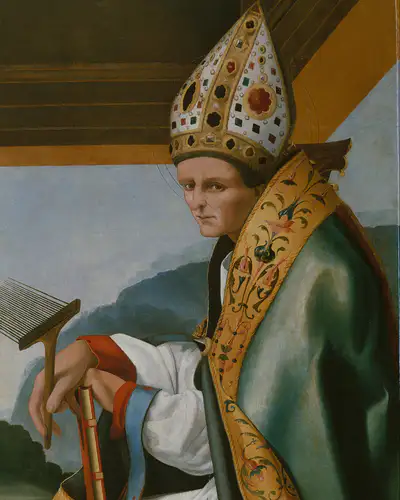
St Blaise, bishop and martyr — 3 February

St Blaise, bishop and martyr — 3 February

St Blaise Blessing of Throats — 3 February

The Roman Ritual formula and the collect of St Blaise’s Mass

LatinEnglish

Benedictio gutturis

Blessing of throats
(The priest touches the throat of the person with two crossed candles and says:)

Per intercessionem sancti Blasii, Episcopi et Martyris, liberet te Deus a malo gutturis, et a quolibet alio malo. In nomine Patris, et Filii, ✠ et Spiritus Sancti.
R. Amen.

Through the intercession of Saint Blaise, bishop and martyr, may God free you from ills of the throat and from every other ill. In the name of the Father, and of the Son, ✠ and of the Holy Ghost.
R. Amen.

Oratio (Missa sancti Blasii)

Collect of the Mass of St Blaise
(Anyone may pray it, at home as well.)

Deus, qui nos beati Blasii Martyris tui atque Pontificis annua solemnitate laetificas: concede propitius; ut, cuius natalitia colimus, de eiusdem etiam protectione gaudeamus. Per Dominum nostrum Iesum Christum Filium tuum, qui tecum vivit et regnat in unitate Spiritus Sancti, Deus, per omnia saecula saeculorum. Amen.

O God, who gladdenest us by the yearly feast of blessed Blaise, Thy martyr and bishop: mercifully grant that, as we keep his heavenly birthday, we may also rejoice in his protection. Through our Lord Jesus Christ, Thy Son, who liveth and reigneth with Thee in the unity of the Holy Ghost, God, world without end. Amen.

SourceSt Blaise, bishop and martyr — 3 February · The Roman Ritual formula and the collect of St Blaise’s Mass

The history of this prayer

On 3 February, the feast of St Blaise, many parishes give the blessing of throats: the priest touches each person’s throat with two crossed candles and asks God, through the saint’s intercession, to free them from ills of the throat “and from every other ill”. The formula given here is that of the traditional Roman Ritual, which also has a blessing of its own for the candles used that day. Since the feast falls the day after the Presentation of the Lord, Candlemas (2 February), candles blessed on the eve are often used.

Who St Blaise was

St Blaise was bishop of Sebaste in historic Armenia (today Sivas, in Turkey) and died a martyr early in the fourth century, probably around 316, under the emperor Licinius. That is almost all that is known for certain. The accounts of his life and martyrdom were written much later and blend memory with legend: the bishop hidden in a cave, where wild animals came to him to be healed; his arrest; the torture with iron wool-combs (hence the comb in the painting on this page); and his death by the sword. In the West his feast is on 3 February; in the East, on 11 February.

Why the throat

According to those accounts, on the way to prison a mother brought him her son, who had a fishbone stuck in his throat and was choking to death; Blaise prayed over him and the boy was healed. Another story, of a poor woman who brought him candles in prison, is the traditional origin of the candles of the blessing. These are pious traditions, not records. But the devotion itself is genuinely old: in the sixth century the physician Aetius of Amida told people to call on the martyr Blaise when someone was choking on a bone. St Blaise is one of the Fourteen Holy Helpers.

Who may give the blessing

In the traditional Ritual, the priest. The current Book of Blessings used in the United States also allows deacons and designated lay ministers to give it, the lay minister without making the sign of the cross over the person. Elsewhere, the ritual approved by the local bishops applies. The blessing is a sacramental: it is not a magic cure and does not replace the doctor. It is a humble petition, made by the Church, that God keep the person in health of body and soul.

The English translations are our own, made from the Latin.

Frequently asked questions

When is the St Blaise blessing?

On 3 February, the feast of St Blaise, the day after Candlemas. Many parishes give it after Mass.

What are the words of the blessing of throats?

In our translation of the Roman Ritual: “Through the intercession of Saint Blaise, bishop and martyr, may God free you from ills of the throat and from every other ill. In the name of the Father, and of the Son, and of the Holy Ghost. Amen.”

Why two crossed candles?

From an old tradition linked to the story of the woman who brought St Blaise candles in prison. The candles are blessed, often at Candlemas the day before.

Can I give the blessing at home?

The blessing is given by a minister of the Church. At home anyone may pray the collect of St Blaise’s Mass, given on this page, asking his intercession.

Is the fishbone story true?

It comes from late accounts of the saint’s life and cannot be proved. The devotion, though, is old: in the sixth century a physician told people to call on St Blaise when choking.

More prayers: Prayers of the saints

← All the traditional prayers · Prayers and novenas

Schola Gregoriana · CC BY-SA