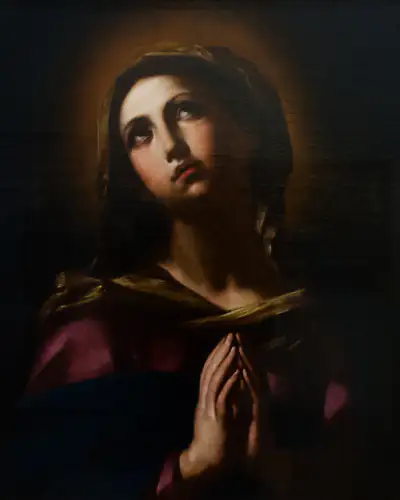
A traditional prayer from the Raccolta (Pius IX, 1851)

A traditional prayer from the Raccolta (Pius IX, 1851)

O my Queen, O my Mother — Consecration to Our Lady

“I give thee all myself”: the little consecration for every morning and night

LatinEnglish

Ave Maria, gratia plena, Dominus tecum.
Benedicta tu in mulieribus,
et benedictus fructus ventris tui, Iesus.
Sancta Maria, Mater Dei,
ora pro nobis peccatoribus,
nunc et in hora mortis nostrae. Amen.

Hail Mary, full of grace, the Lord is with thee.
Blessed art thou among women,
and blessed is the fruit of thy womb, Jesus.
Holy Mary, Mother of God,
pray for us sinners,
now and at the hour of our death. Amen.

O Domina mea! O Mater mea!
Tibi me totum offero,
atque ut me tibi probem devotum,
consecro tibi hodie oculos meos, aures meas, os meum, cor meum,
plane me totum.
Quoniam itaque tuus sum, o bona Mater,
serva me, defende me,
ut rem ac possessionem tuam.

O my Queen! my Mother!
I give thee all myself,
and, to show my devotion to thee,
I consecrate to thee this day my eyes, ears, mouth, heart,
my entire self.
Wherefore, O loving Mother, as I am thy own,
keep me, defend me,
as thy property and possession.

Amen.

SourceA traditional prayer from the Raccolta (Pius IX, 1851) · “I give thee all myself”: the little consecration for every morning and night

The history of this prayer

This is one of the best-loved prayers to Our Lady in Brazil and across the Spanish-speaking world: a few lines in which one gives oneself wholly to Mary and asks her to keep one as her own. In Latin it begins “O Domina mea! O Mater mea!”, “O my Lady! O my Mother!”. The custom is to say it morning and evening, after a Hail Mary.

Where it comes from

The Raccolta, the official collection of indulgenced prayers, gives the Latin text with the note that Pope Pius IX, on 5 August 1851, granted an indulgence to those who said one Hail Mary followed by this prayer, morning and evening, to obtain victory in temptations, especially those against chastity. The norms for indulgences have changed since then, but the custom remains.

Tradition links the prayer with the Jesuit Nicolò Zucchi, who worked in Rome in the seventeenth century. What is documented is the practice he taught. St Alphonsus Liguori, in The Glories of Mary, relates from Fr Paolo Segneri that Zucchi gave a young man who came to him for confession in Rome, enslaved to impurity, the penance of saying a Hail Mary every morning and evening, offering Our Lady his eyes, his hands and his whole body and praying her to keep him as her own; in time the young man came back to Rome entirely changed. Whether the Latin formula is Zucchi’s own is not known.

A short aspiration

The same Raccolta gives a very short form to repeat during the day: “O Domina mea! O Mater mea! memento me esse tuum. Serva me, defende me, ut rem et possessionem tuam.” In the Raccolta’s English: “O my Lady and my Mother, remember I am thine; protect and defend me as thy property and possession.”

The Latin and the English are those of the Raccolta in Ambrose St John’s translation (1910 edition); the Portuguese is our own rendering of the Latin.

Frequently asked questions

Who wrote the prayer “O my Queen, O my Mother”?

Its author is not known for certain. Tradition links it with the seventeenth-century Jesuit Nicolò Zucchi, who taught people to offer themselves to Our Lady every morning and evening; the Latin text is in the Raccolta, with an indulgence granted by Pius IX in 1851.

When should I pray it?

In the morning on rising and at night on going to bed, after a Hail Mary, as the old custom asks. Many also say it on leaving the house and in the moment of temptation.

Why is it called a consecration?

Because in it one gives oneself wholly to Mary, eyes, ears, mouth and heart, and asks her to keep one “as thy property and possession”. It is a short daily act, renewed each morning and night.

Is it the same as the consecration of St Louis de Montfort?

No. This is a little daily consecration; St Louis Mary Grignion de Montfort’s is a solemn act made after 33 days of preparation and renewed afterwards. One does not exclude the other.

More prayers: Our Lady

← All the traditional prayers · Prayers and novenas

Schola Gregoriana · CC BY-SA