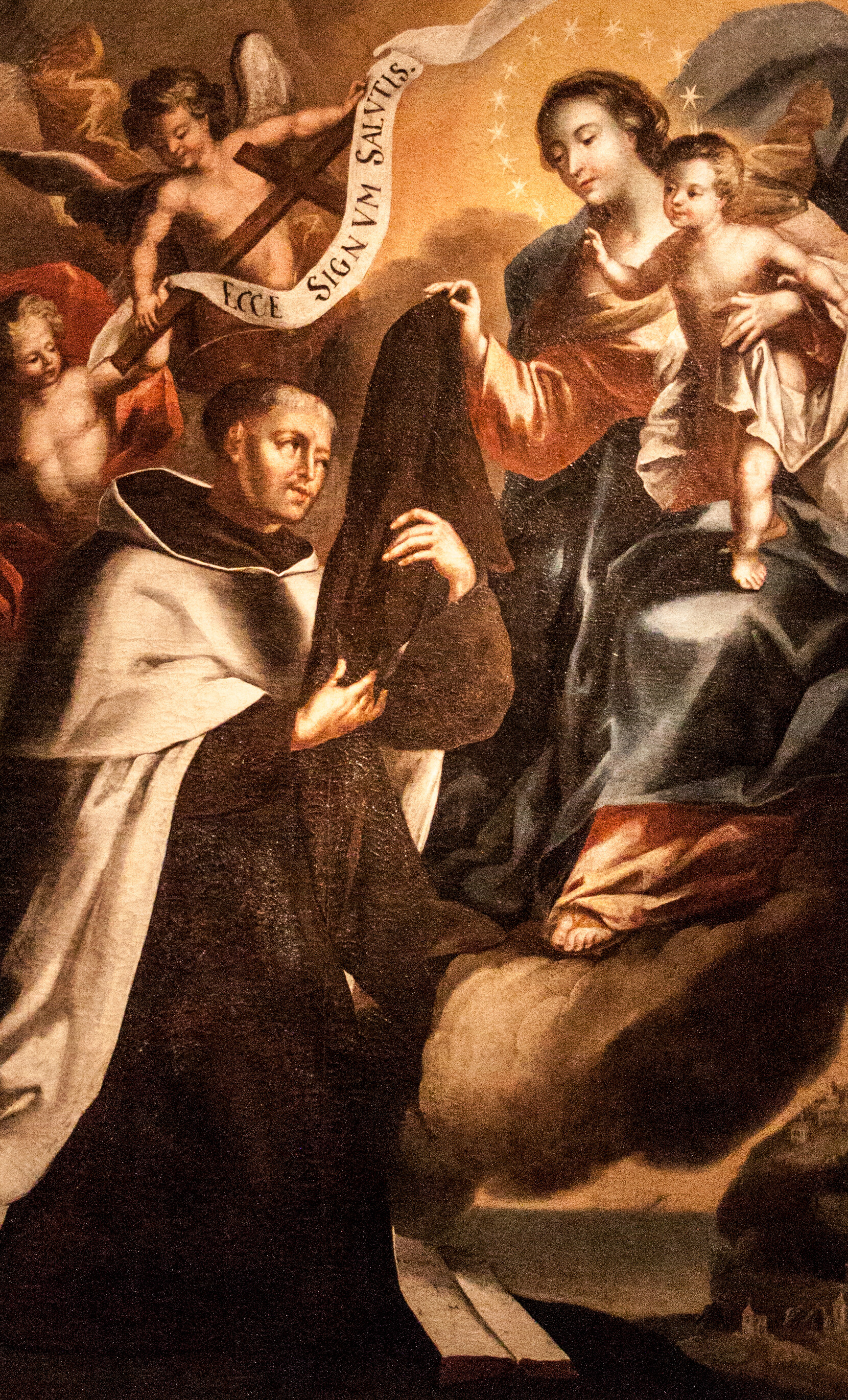
Today, 16 July, the Church keeps the feast of Our Lady of Mount Carmel — the great Marian day the Carmelites simply call the Scapular feast. Behind that little square of brown wool lies a whole world: a mountain in the Holy Land, a prophet of fire, an order of hermits who took the Mother of God for their patron and their sister, and a promise whispered to a praying friar. This is her story, the story of the scapular, and — woven into it — what that small habit of Mary really means.
The mountain of Elijah
Mount Carmel rises green above the sea in the north of the Holy Land, near today’s Haifa. It is the mountain of the prophet Elijah — where he stood alone against the four hundred prophets of Baal and called down fire from heaven (1 Kings 18), and where, after the long drought, he sent his servant seven times to look toward the sea until he saw it: “a little cloud, like a man’s hand, rising out of the sea” (1 Kings 18:44) — and then the rain came, and the earth was reborn.
The Carmelites have always read that little cloud with the eyes of faith: a figure of the Virgin Mary, who would rise, pure and small, from the salt sea of a fallen world and bring the rain of grace, Jesus Christ, upon the parched earth. So Elijah — the man of the mountain, of solitude, of the still small voice — became the spiritual father of Carmel, and Mary its mother. Carmel is, before it is anything else, a school of prayer.
The Order of Our Lady
Late in the twelfth century, near the spring of Elijah on the slopes of Carmel, a group of Latin hermits — pilgrims and former crusaders — settled to live in penance and prayer “in the footsteps of the holy prophet.” Among their caves they built a small chapel, and they dedicated it to Our Lady. From that dedication came their name, which they carry to this day: the Brothers of the Blessed Virgin Mary of Mount Carmel.
Around 1206–1214 St Albert of Jerusalem gave them a Rule — short, austere, luminous; it was approved by Pope Honorius III in 1226 and gently adapted by Innocent IV in 1247. When the Crusader kingdom collapsed and the Holy Land was lost, the brothers carried Carmel with them to Europe. Mary was not merely their patroness; she was the title of the Order itself — her habit their habit, her name their name.
Saint Simon Stock and the scapular
Those first European years were hard. The order of Eastern hermits struggled to find its place among the great mendicant families of the West. Tradition tells that its Prior General, the Englishman St Simon Stock, turned to the Mother of the Order and begged her help, praying the very hymn Carmel still sings — the Flos Carmeli. And on 16 July 1251, at Cambridge, Our Lady is said to have appeared to him holding the brown scapular of the habit, and to have given it to him with these words:
“Receive, my beloved son, this scapular of your Order; it shall be a sign of salvation, a protection in danger, and a pledge of peace. Whoever dies clothed in this habit shall not suffer eternal fire.”— Hoc erit tibi et cunctis Carmelitis privilegium: in hoc habitu moriens salvabitur.
Honesty asks a word here: the earliest written accounts of this vision come some decades later, and historians debate its details. But the Church, over seven centuries, has embraced, blessed and enriched the devotion again and again — not because of a legend, but because of what the scapular truly is. First, though, hear the prayer St Simon prayed, still sung on this feast — on an illuminated page:
Flos Carmeli, vitis florigera, splendor caeli, virgo puerpera singularis.
Mater mitis sed viri nescia, Carmelitis esto propitia, stella maris.
Flower of Carmel, tall vine blossom-laden; splendour of heaven, childbearing yet maiden. None equals thee.
Mother so tender, who no man didst know, on Carmel’s children thy favours bestow. Star of the Sea.
The traditional short form of the Flos Carmeli, ascribed to St Simon Stock; the Carmelite hymn to Our Lady of Mount Carmel, sung on her feast.
What the scapular is — and is not
The scapular is a sacramental, not an amulet. The devotional scapular worn by the laity is a small version of the Carmelite habit: two little squares of brown wool joined by cords, worn over the shoulders, one on the breast and one on the back. To put it on is to be clothed in Mary — to wear her habit in miniature, to be enrolled among her children, to place oneself, waking and sleeping, under her mantle.
And so it obliges more than it dispenses. It is not a magic charm that saves a soul careless of God; it is the sign of a real relationship — a promise made visible. The one who wears it faithfully takes on, in return, a way of life: to live in God’s grace, to keep chastity according to one’s state, and to love Our Lady and turn to her each day. Worn like that, the scapular is exactly what the promise says — a pledge that she who is our Mother will not let go, at the last, of the child who never let go of her.
The Sabbatine Privilege
To the scapular a second, later tradition became attached — the Sabbatine Privilege: that Our Lady would come to the aid of the souls of scapular-wearers in Purgatory, and free them — especially, tradition says, on the Saturday after their death. It rests on a papal document attributed to John XXII (1322) whose authenticity is disputed, and the Church has always spoken of it with care.
In 1613 the Holy See fixed what may rightly be preached: not a mechanical guarantee, but that the faithful may piously believe that Mary, by her continual intercession, her merits and her special protection, helps after death — particularly on Saturdays, her day — the souls of those who wore the scapular, kept chastity according to their state, and prayed as the Church asked. Held that way, the Sabbatine hope is only the scapular’s promise carried past the grave: the confidence that a true child of Mary is never abandoned by his Mother, not even in the purifying fire.
A family of saints — and Fátima
From this mountain came a whole family of the Church’s greatest contemplatives: Teresa of Ávila and John of the Cross, the reformers and doctors of prayer; little Thérèse of Lisieux, doctor of the Little Way; Elizabeth of the Trinity; and Teresa Benedicta of the Cross — Edith Stein — who carried Carmel into a concentration camp. And the devotion reaches into our own age: at Fátima, in the last apparition on 13 October 1917, Our Lady appeared to the children as Our Lady of Mount Carmel, holding out the scapular. Sister Lúcia said simply that Our Lady wants everyone to wear it — and that the Rosary and the Scapular are inseparable.
Two threads of brown wool over the shoulders; a sign small enough to forget you are wearing, and heavy enough to change a life. To take the scapular is to answer, quietly, the offer the angel’s banner makes in the painting above: Ecce signum salutis — behold the sign of salvation.
Sancta Maria de Monte Carmelo, ora pro nobis.Our Lady of Mount Carmel, pray for us.
- The prayers of Carmel — the full Flos Carmeli, the Ave Maris Stella and more, in Latin and English, ready to pray.
- Saint Bonaventure — the Seraphic Doctor and his prayer after Holy Communion.
- Saint Benedict of Nursia — his life, the Rule, and the Cross and Medal explained.


Comments Comentários