On 9 August 1253 a papal bull reached San Damiano. Clare, bedridden for years, asked for the parchment to be put into her hands and kissed it. She had fought forty years for that document. She had forty-eight hours to see it signed: she died on the 11th. What was written there was the first religious Rule ever composed by a woman in the history of the Church — and what it asked for, with a stubbornness that outlasted three pontificates, was the right to own absolutely nothing.
The door of the dead
Chiara Offreduccio was born at Assisi in 1194, into a family with a coat of arms, land, and a marriage already arranged. Her mother, Ortolana, had walked to the Holy Land, to Rome and to Compostela — in an age when that meant months on the road and a genuine chance of not coming home. The daughter inherited the restlessness.
She was eighteen when she heard Francis preach in Lent 1212. She did not ask for advice. She decided.
On the night of Palm Sunday 1212 she left the house by the door of the dead — the small opening that in noble houses was unsealed only to carry coffins out. Nobody picks that door by accident. She crossed the dark fields to the Portiuncula, where Francis and the friars were waiting with torches. There she traded her feast-day dress for a rough tunic, and Francis cut off her hair.
Her family came to drag her home. Clare gripped the altar and pulled back her veil to show the shorn head. No marriage was possible now — no negotiation undoes a tonsure. Sixteen days later her sister Agnes followed her. Then her sister Beatrice. In the end their widowed mother Ortolana entered the monastery where all three of her daughters were already living.
San Damiano: forty years in one place
Francis settled her at San Damiano, the ruined chapel he had rebuilt stone by stone, and where the crucifix had spoken to him. Clare arrived at nineteen and never left: forty-one years at the same address, much of it ill, a great deal of it unable to get out of bed.
Let that settle before reading on. Everything that follows — the bulls prised out of three popes, the letters that crossed Europe as far as Bohemia, the soldiers who backed down — was done by a woman who spent four decades inside one city block.
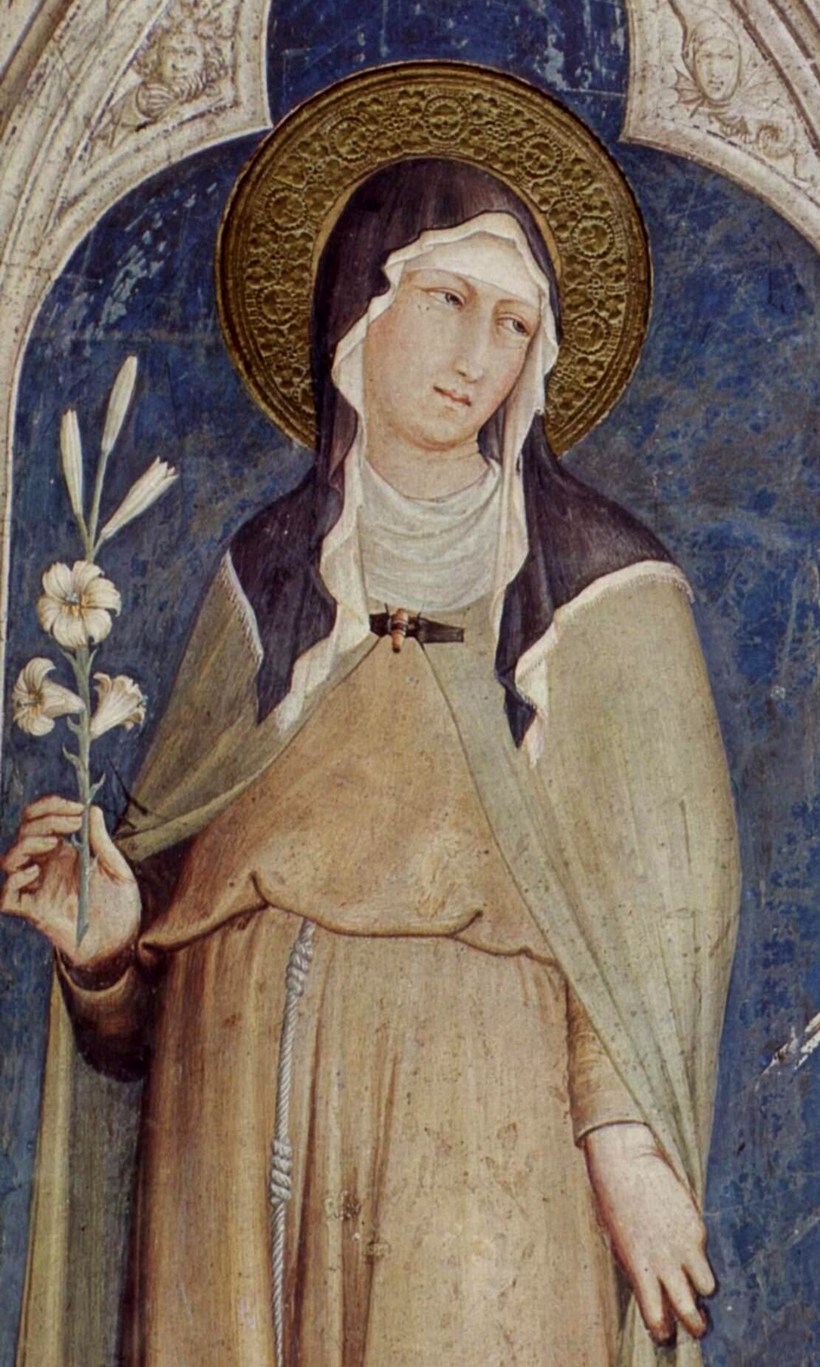
Around her formed the community of the Poor Ladies, whom history would call the Poor Clares. And it was at San Damiano, in the spring of 1225, that Francis — nearly blind, in savage pain from his eyes — spent some fifty days in a reed hut, nursed by Clare and her sisters. It was there, in those weeks, that he composed the Canticle of the Creatures. The oldest poem in Italian literature was written in a garden she lent him.
The privilege of owning nothing
Here is the nerve of this life, and the reason that calling her Francis's disciple is not enough.
The Church of her day would not let enclosed women live without an income, and for a practical reason: mendicant friars can beg in the street, cloistered nuns cannot. The standard remedy was to endow the monastery with land — security, predictability, an estate to carry the community through generations. Every foundress accepted it. Clare would not.
She wanted for her sisters precisely the poverty Francis wanted for the friars: no land, no rents, no reserves. To live on whatever arrived that day. And she spent her life defending it against popes who liked her and wanted to protect her from herself.
- 1216 — tradition dates from here the Privilege of Poverty, obtained from Innocent III: the right to own nothing. It is a very strange document — a papal privilege not to have.
- 1228 — Gregory IX, who was genuinely fond of her, tries to dispense her from the vow of absolute poverty. Clare answers that if he can absolve her from her sins, from this vow she does not wish to be absolved. The pope gives way and confirms the privilege in writing.
- 1253 — Innocent IV approves the Rule she drafted herself, instead of imposing one written by men, as had been done to her twice before. It is the first religious Rule composed by a woman in the history of the Church.
“Let the sisters appropriate nothing to themselves, neither house nor place nor anything at all; and as pilgrims and strangers in this world, serving the Lord in poverty and humility, let them confidently send for alms.”
Notice the argument. This is not poverty as household economics, it is poverty as the condition of a pilgrim. Whoever has no house here travels lighter. The whole sentence is built so that nobody coming after her could soften it.
The princess who turned down an emperor
In Prague a girl called Agnes of Bohemia, daughter of King Ottokar I, had been promised in marriage since childhood to half a catalogue of European nobles. The last suitor was the most powerful of them all: the Emperor Frederick II. Agnes refused, appealed to the pope, and in 1234 entered the Poor Clare monastery she had herself built.
They say that when the emperor heard, he remarked that had she left him for a mortal man he would have answered with the sword — but that he could take no offence at her preferring the King of Heaven.
Clare and Agnes never met. Bohemia is more than a thousand kilometres from Assisi, and neither woman could travel. What exists between them is four letters, written across twenty years, and they are the best writing Clare left us. They are not spiritual direction in a schoolmasterly tone; they are letters from one woman to another who has made the same wager and needs to hear that she has not lost her mind.
“Place your mind before the mirror of eternity, place your soul in the brilliance of glory, place your heart in the figure of the divine substance — and transform your whole self, through contemplation, into the image of the Godhead itself.”
Saint Clare — Fourth letter to Agnes of Prague, 1253The method of the mirror
That image is not a flourish. It is a method, and Clare sets it out with something close to technical precision.
Christ is the mirror. Nobody looks into a mirror to admire the mirror: you look to see yourself, and to put yourself right. In the second letter she reduces the exercise to four verbs, chained, each pulling the next:
- Look — actually notice him; most of our prayer never gets as far as looking.
- Consider — think about what you are seeing; let the fact land.
- Contemplate — stay there, unhurried, producing nothing.
- Desire to imitate — and here you find out whether the first three were real.
Then she divides the mirror itself into three bands, and gives each one an address in the life of Christ. At the edge, the manger: the poverty of being born in a stable. In the middle, the years of hidden work and weariness. In the depth, the cross — and you have to look all the way down, because that is where the mirror stops being beautiful and starts being true.
A woman who spent forty years without a view built an entire spirituality on the act of looking. That is not a coincidence.
The Saracens on the wall
In 1240 mercenary troops in the service of Frederick II — Saracens, in the chronicle of the day — scaled the monastery wall. San Damiano had no guard, no weapons and no men. It had forty women and a sick abbess.
Clare had herself carried to the door with the ciborium, the vessel that holds the Blessed Sacrament. She prayed aloud, asking God not to hand over those defenceless women. The soldiers came down off the wall and left. The following year a siege of Assisi broke up the same way, after she and her sisters spent the night fasting and praying.
That is why she appears in art with a monstrance or a ciborium in her hand. It is not a liturgical prop: it is the weapon she took to armed soldiers, and the only thing in the house.
Why a painter put her out over the sea
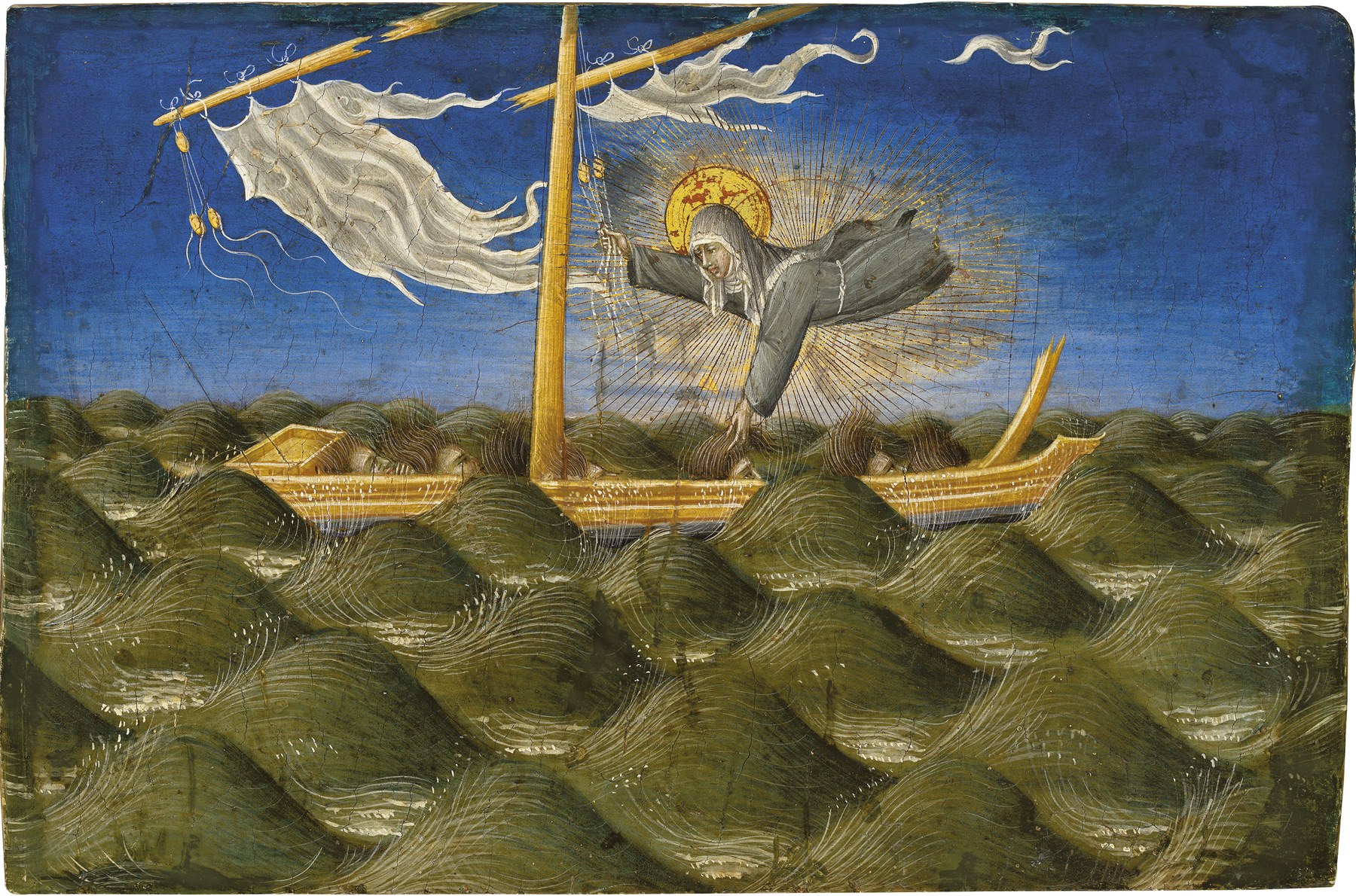
The scene at the top of this page is not an allegory. After Clare's death the canonisation process gathered testimony from the sisters who had lived with her, and popular devotion spread quickly through Italy and around the Mediterranean. Sailors began calling on her in storms.
Two hundred years later the Sienese Giovanni di Paolo painted exactly that: the bronze-coloured sea, the mast going, the sail in rags — and the nun in her grey habit arriving above the water in a burst of gold. The patron of people who are going under. The woman who never left one room ended as the saint you look for in open water.
The patroness of television
Near the end, unable to leave her bed on Christmas night, Clare saw and heard the Mass being celebrated in the basilica of Saint Francis on the other side of Assisi, cast on the wall of her cell. She reported it as plainly as she would have described the weather outside.
Because of that night, Pius XII declared her patroness of television in 1958. It is the title that usually raises a smile, and it deserves to be taken seriously: for the patron of the image sent across a distance, the Church chose the woman who made looking into a method — and who spent forty years with nothing to look at.
“I am speaking to my blessed soul”
In her last days the sisters heard her talking quietly, alone. One of them asked who she was speaking to. Clare answered: “I am speaking to my blessed soul.”
And this is what she said to that soul, at the moment of sending it away:
“Go forth in peace, for you will have a good escort: for he who created you first made you holy, and after he had created you he poured the Holy Spirit into you, and has always guarded you as a mother guards her little child.”
The last words of Saint Clare — 11 August 1253She died that day, aged fifty-nine. Innocent IV came down from Perugia for the funeral and wanted the Office of Virgins sung on the spot rather than the Office of the Dead — to sing to a saint rather than for a corpse. A cardinal restrained him: it was too soon. It was not too soon for long. Alexander IV canonised her in 1255, two years after her death, and the bull opens with a pun the Latinists never forgot, because her name means bright:
“Clare, bright by her bright merits, shines out clearly — by the great brightness of her glory in heaven, and on earth by the splendour of her sublime miracles.”
Clara claris praeclara meritis, magnae in caelo claritate gloriae ac in terra splendore miraculorum sublimium clare claret.
Bull of canonisation, Alexander IV, 1255Seven turns of the same root in a single sentence. Chancery excess, and still exact: her whole life was an argument about light. The mirror to be looked into. The Mass thrown on a wall. The gold rays a painter had to invent to explain why sailors called her name. And at the centre of it, a woman who chose to own nothing so that nothing would stand between her and the brightness.
Clare herself, in five sentences
“Love him totally, who gave himself totally for your love.”— Saint Clare, letters to Agnes of Prague
“Place your mind before the mirror of eternity, place your soul in the brilliance of glory.”— Saint Clare, fourth letter to Agnes of Prague
“Silence is the language of those who love; it is better that the word be renounced and that one express oneself with affection.”— Saint Clare of Assisi
“For love of Christ, there is no pain that makes me suffer.”— Saint Clare of Assisi
“Never lose sight of your point of departure.”— Saint Clare of Assisi
Sancta Clara, ora pro nobis. Saint Clare, pray for us — and win us something of your stubbornness, which was not stubbornness of temper but of fidelity.
- Saint Lawrence — the deacon who produced the poor as the treasure of the Church.
- Saint Dominic de Guzmán — another mendicant order born in the same generation.
- Words of the saints — a growing collection, in English and Portuguese.


Comments Comentários