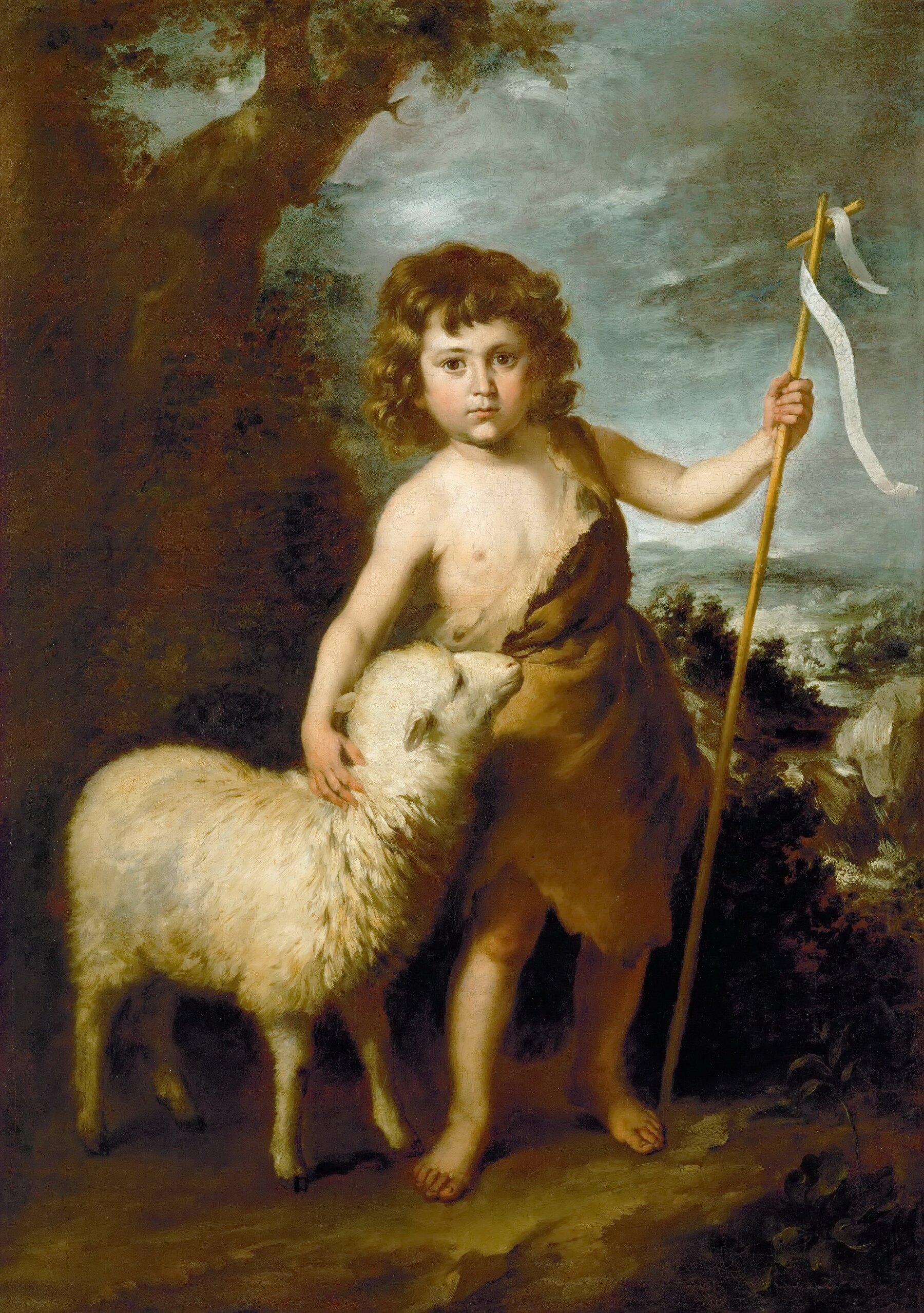
Today, 24 June, the Church keeps the Solemnity of the Nativity of Saint John the Baptist — the only saint, apart from Our Lady, whose birthday the whole Church celebrates. It is one of the oldest feasts in the calendar, older than Christmas in some places, and across Europe and Ireland it was kept not only in church but around great fires lit in the summer night. This is the story of the man Christ called the greatest born of woman, the words the saints have left us about him, and how his feast came to be marked by the bonfires of Ireland.
Among those born of women
His life is told in a few luminous scenes. An angel stood at the right of the altar of incense and promised the aged priest Zechariah a son, to be named John, who would “be great before the Lord” and “turn many of the children of Israel to the Lord their God” (Lk 1:15–16). When Mary, newly carrying the Lord, came to her cousin Elizabeth, the unborn John “leaped for joy” in the womb (Lk 1:44) — the forerunner already pointing to Christ before either child had drawn breath. At his birth the neighbours expected him to be named for his father; his mother insisted, “He shall be called John,” and Zechariah, his tongue loosed, broke into the Benedictus: “And you, child, shall be called the prophet of the Most High” (Lk 1:76).
He grew up and went into the desert. Clothed in camel’s hair, living on locusts and wild honey, he became the “voice of one crying in the wilderness” (Mk 1:3), preaching repentance and baptising in the Jordan. When Jesus came to him, John protested that he should be baptised by Christ instead — and then, seeing him, gave the Church the words she still sings at every Mass: “Behold, the Lamb of God, who takes away the sin of the world” (Jn 1:29). Of his own place he spoke the humblest and greatest line a man has ever said of himself before God:
“He must increase, but I must decrease.” — John 3:30
He decreased to the end. For rebuking Herod’s unlawful marriage he was imprisoned and beheaded, his death asked for as the price of a dance. Yet Christ’s verdict on him stands for ever:
“Among those born of women there has arisen no one greater than John the Baptist.” — Matthew 11:11
Why the Church keeps his birthday
The Church almost always celebrates her saints on the day of their death — their birth into heaven. Only three birthdays are kept as feasts: that of the Lord himself (25 December), of Our Lady (8 September), and of John the Baptist. He is the exception because, sanctified in the womb at the Visitation, he was already holy when he was born — the dawn before the Sun.
The date is no accident either. The angel told Mary that Elizabeth was “in her sixth month” (Lk 1:36), so John is born exactly six months before Christ: 24 June, six months before Christmas Eve. The early Church read a sign written into the very sky. John is born just after the summer solstice, when the days begin to shorten; Christ is born just after the winter solstice, when the light begins to grow. St Augustine loved this:
“John is born when the day begins to grow shorter; the Lord is born when the day begins to lengthen. Let the friend of the Bridegroom decrease, that the Bridegroom may increase.” — St Augustine, after John 3:30
The hymn for this day, Ut queant laxis, gave the world the musical scale. In the eighth century Paul the Deacon wrote it for the Baptist; centuries later Guido of Arezzo took the first syllable of each rising line — Ut–Re–Mi–Fa–Sol–La — and named the notes of the scale after them. Every time we sing do, re, mi, we are quietly keeping the feast of St John the Baptist.
The bonfires of Ireland
Long before the solstice was Christian, the peoples of the north lit fires at midsummer to mark the turning of the sun. The Church did not abolish the fires; she baptised them. Of John, the Lord himself had said, “He was a burning and shining lamp” (Jn 5:35) — and so the midsummer fire became St John’s Fire, lit on the eve of his nativity in honour of the lamp that burned to point men to Christ.
In Ireland the night of 23 June is still Bonfire Night — Oíche Fhéile Eoin, the Eve of the Feast of John. On hilltops and at crossroads, in the towns of Cork and across the west, great fires were built and lit as darkness fell. People gathered to pray — often the Rosary — before the flames; embers and ashes were carried to the fields and scattered over the crops to bless the harvest; cattle were driven near the cleansing smoke; and the young leapt over the dying fire for luck, for health, and for a good year to come. In many parishes a priest would come to bless the fire before it was lit. What looks at first like an old country custom is, underneath, a profession of faith: the people gathering their light around the memory of the man who was himself only a lamp, borrowed and burning, lit to make ready the way of the Lord.
“He was a burning and shining lamp, and you were willing to rejoice for a while in his light.”
— John 5:35, the Lord speaking of John the BaptistWhat the saints say
“John is the voice, but the Lord is the Word who was in the beginning. John is the voice that lasts for a time; from the beginning Christ is the Word who lives for ever.”— St Augustine, Sermon 293
“He was a burning and shining lamp — that he might prepare a perfect people for the Lord.”— from the Liturgy of the Nativity of St John the Baptist
“Whose greatness no one can express — for he was filled with the Holy Spirit even from his mother’s womb, and went before the Lord in the spirit and power of Elijah.”— St Bede the Venerable, on the Forerunner
“There is no greater among those born of women than John the Baptist.”— Our Lord Jesus Christ, Matthew 11:11
“Behold the Lamb of God, who takes away the sin of the world.”— St John the Baptist, John 1:29
How to keep the day
The feast asks little and gives much. A few simple things make it yours:
- Go to Mass if you can — it is a Solemnity, the highest rank of feast, and the readings are among the loveliest of the year.
- Pray the Benedictus (Lk 1:68–79), the song of Zechariah that the whole Church prays every morning — today it is sung for the child it first greeted.
- Take to heart John’s one rule of life — “He must increase, but I must decrease” — and find one place today where you can make yourself a little smaller so that Christ may be larger.
- If there is a fire in your evening — a hearth, a candle, a bonfire kept by an old custom — bless it, and let its light preach the “burning and shining lamp” to you.
O God, who raised up Saint John the Baptist to make ready a perfect people for Christ the Lord, give to your people, we pray, the grace of spiritual joys, and direct the hearts of all the faithful into the way of salvation and peace.
Saint John the Baptist, burning and shining lamp, voice that cried in the wilderness and pointed to the Lamb — teach us to decrease that Christ may increase, and pray for us, that the fire lit in our baptism may never go out.
Through Christ our Lord. Amen.
The fires of midsummer burn down to ash by morning, as all our lamps must. John knew it, and rejoiced: he was never the Light, only its herald, glad to fade as the day broke. May his feast leave us the same gladness — to point away from ourselves, to the Lamb of God, and to let him increase.

Comments